Times of India
Downing Street Churn: Keir Starmer exits after two years; Britain treats PMs like subscriptions
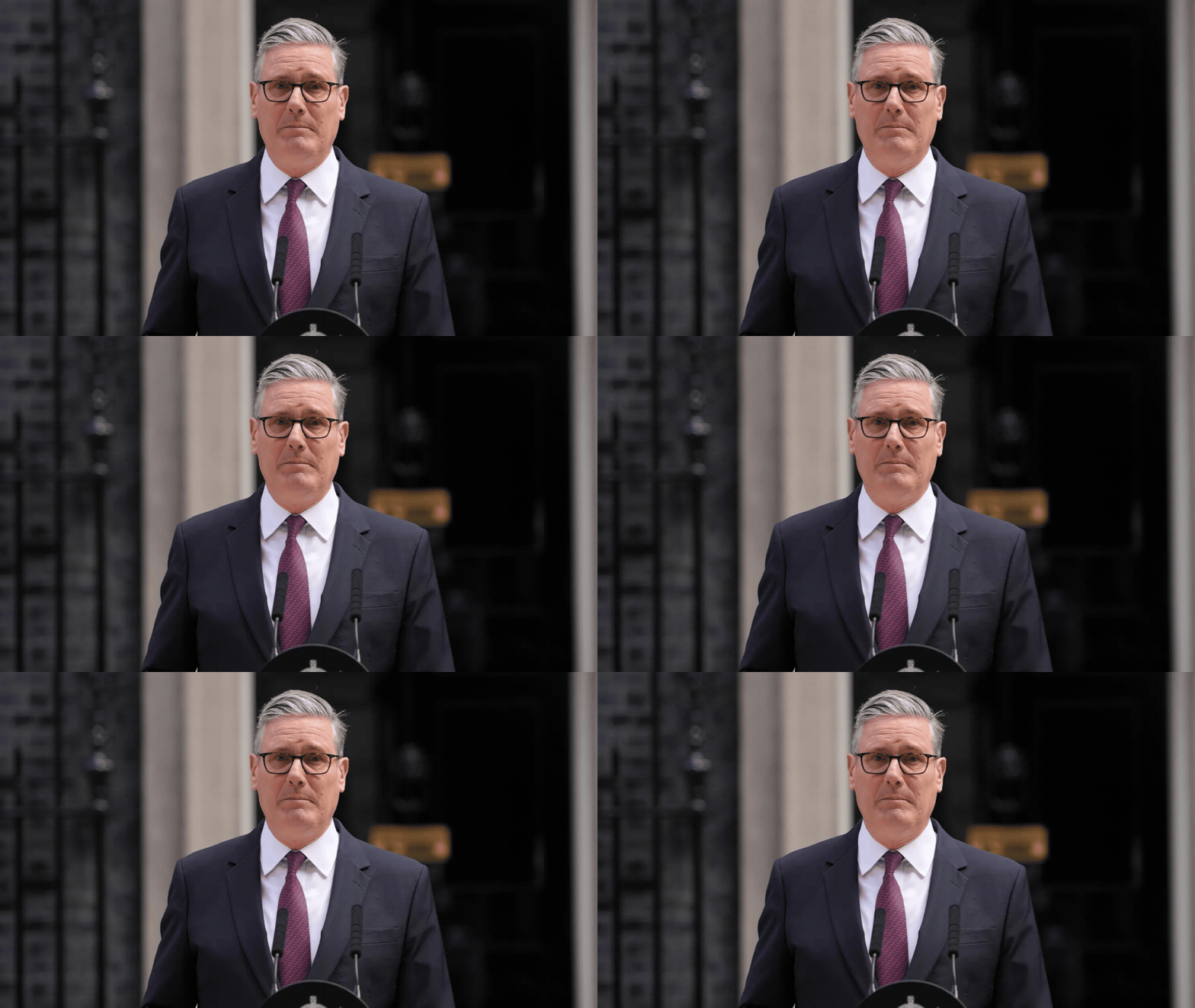
Britain's Prime Minister Keir Starmer announces his resignation to the media outside 10 Downing Street in London
There was a time when becoming Prime Minister of Britain represented the culmination of a life’s work. Men spent decades climbing party ladders, surviving ideological civil wars, losing elections, winning elections, winning wars, extending the empire, writing memoirs, and developing the sort of permanent expression that suggested they had personally negotiated the Treaty of Versailles.Now it appears to be a two-year free trial.Keir Starmer has announced his resignation after barely two years in office, the latest participant in what increasingly resembles Britain’s national pastime: changing prime ministers before the furniture has settled in Downing Street.
As Starmer himself put it in his resignation statement, “I have heard the answer of my parliamentary party to that question, and I accept that answer with good grace.”
There is something wonderfully British about being politically executed while simultaneously displaying impeccable manners.The British once gave the world parliamentary democracy. They are now stress-testing it at a pace that suggests they are trying to break it: seven prime ministers in a decade. The office of Prime Minister has acquired the life expectancy of a mayfly. Britain no longer elects governments.
It subscribes to them. This is not uniquely British. It is merely Britain performing a global trend with superior tailoring.
Who would claim the Downing Street next?
The modern politician faces a peculiar challenge. He is expected to govern a country while simultaneously behaving like a social media creator. Every policy must be immediate and the result must be visible. Every problem must have a villain and, in Western democracies, each setback must have a resignation attached to it.
The electorate that once tolerated wartime rationing in Britain post World War 2 now becomes restless if a policy initiative has not delivered measurable outcomes before the next Netflix season arrives.Keir Starmer’s tragedy, if one can call it that, is not that he failed spectacularly. It is that he appears to have failed gradually. Economic growth remained contested, public frustration mounted, Labour’s poll numbers deteriorated, internal dissent grew louder and rivals scented opportunity.
None of these individually are fatal in politics; together they become an obituary.Politics increasingly resembles football management. Nobody asks whether a strategy is correct, the only question is whether it has worked by half-time.What fascinates me most is the emergence of a new political species: the Successor-In-Waiting. In earlier centuries these people carried daggers. Today they carry opinion polls.The moment a leader’s popularity dips, newspapers begin writing profiles of his replacement. Television panels discuss transition scenarios and party insiders suddenly discover concerns they were previously too loyal to mention. Journalists start using phrases like “growing unease” and “questions about leadership.”The body is still warm but I cannot help admiring the efficiency. Corporate India takes eighteen months to replace a vice-president.UK Political parties can replace a prime minister before his dry cleaning is ready.The larger lesson may have nothing to do with a Keir Starmer or Britain. We have entered an era in which institutions no longer possess patience. Neither do the markets or the voters or the multitudes on social media. Everyone wants transformation and yet no one wishes to endure transition. The result is a civilisation permanently interviewing candidates for jobs currently occupied.Five centuries ago, Niccolò Machiavelli observed that “the first method for estimating the intelligence of a ruler is to look at the men he has around him.” In the age of rolling news, social media and permanent campaigning, rulers are increasingly judged not by the quality of those around them but by the volatility of those beneath them.And so Britain prepares to welcome another occupant of Number 10, while the previous one joins the queue of recent former prime ministers. At this rate, Downing Street may eventually require a loyalty programme - Stay for three years, get the fourth free.
View original source — Times of India ↗
Related stories

The Punch
PoliticsJun 22, 2026 · 1 min
Following UK’s Starmer’s exit, Peter Obi demands Tinubu’s resignation, cites governance failure
The Punch
The Punch
PoliticsJun 22, 2026 · 1 min
UK Labour leadership frontrunner Andy Burnham sworn in as MP
The Punch
The Punch
PoliticsJun 22, 2026 · 1 min
APC chieftain urges Kwara gov to reconcile aggrieved party members
The Punch

RFI
PoliticsJun 22, 2026 · 1 min
Brexit at 10: the promises, the costs and the search for accountability
RFI