Indian Express
Why Subhas Chandra Bose broke with the Congress to found Forward Bloc
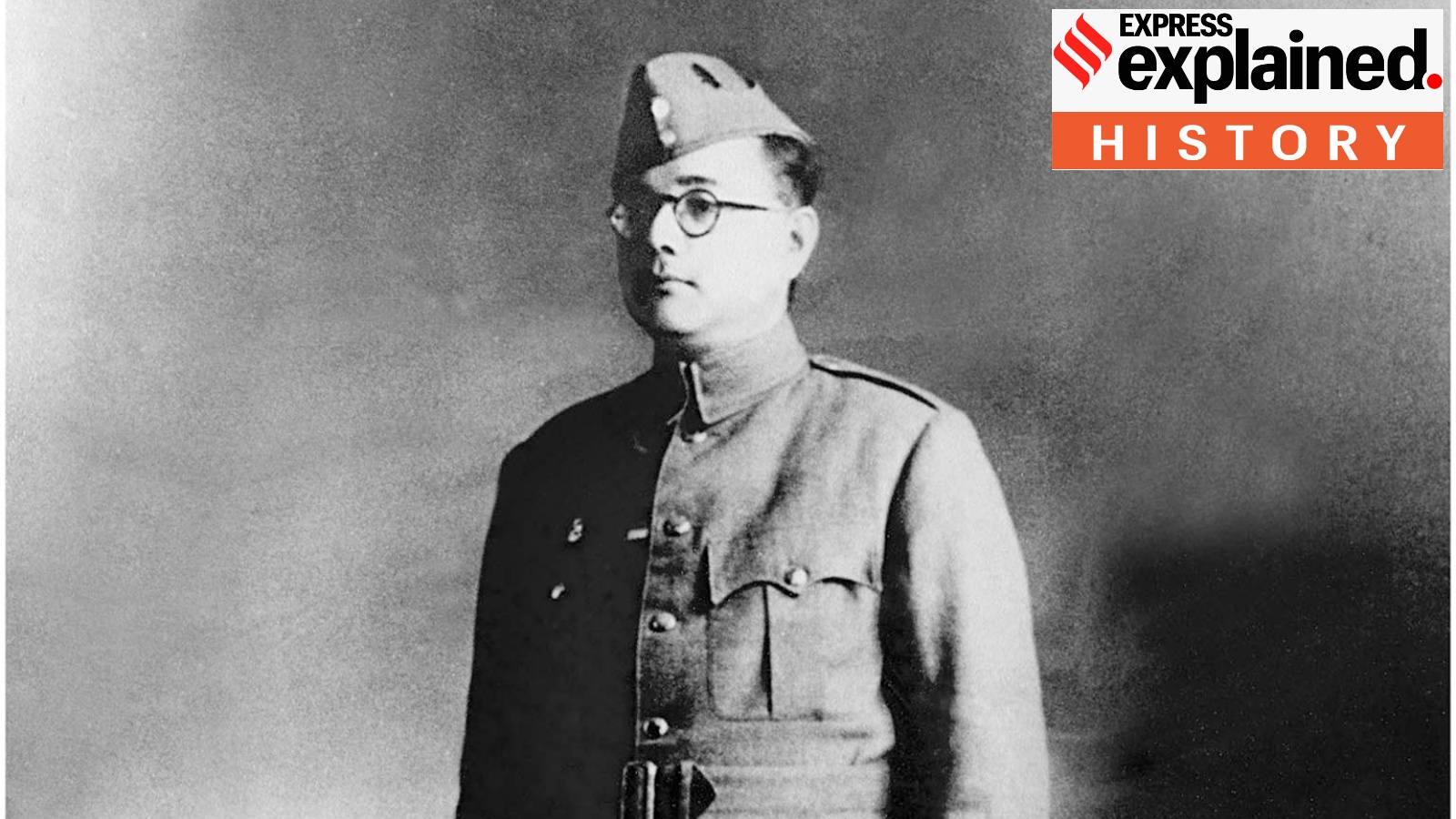
“India must in this grave crisis think of herself first,” declared Netaji Subhas Chandra Bose at the first plenary conference of his newly formed party, the All India Forward Bloc. Held in Nagpur from June 18 to 22, 1940, the conference was the occasion on which the Forward Bloc was formally declared a socialist party. Bose had founded the organisation a year earlier after his dramatic split with the Congress leadership.
The upheaval in global politics caused by the Second World War was seen by Bose as a historic opportunity for India to secure its freedom from British rule. His stance, however, found little support within the dominant Gandhian leadership of the Congress.
Convinced that the party needed a more militant anti-imperialist programme, Bose established the Forward Bloc in 1939 to rally the Congress’s left-wing and radical nationalist elements and build what he called an “alternative leadership”. In that context, the Nagpur conference marked an important turning point in the transformation of the Forward Bloc from a faction within the Congress into an independent political force.
The crisis within Congress
In January 1939, when Bose put forward his candidature for the presidency of the Congress, he saw himself as the spokesperson of militant politics and radical groups. As noted by historian Bipan Chandra in India’s Struggle for Independence, Bose saw himself as representing the “new ideas, ideologies, problems and programs” that had emerged within the anti-imperialist struggle in India. Although his ideas were opposed by sections of the party, including Mahatma Gandhi, Bose won the election and became Congress president. The victory, however, did nothing to resolve the ideological conflict within the party.
To begin with, Bose adopted a line of criticism against Sardar Vallabhbhai Patel and several members of the top Congress leadership, whom he branded as rightists. He openly accused them of seeking a compromise with the British government. “As Congress President, the writer did his best to stiffen the opposition of the Congress Party to any compromise with Britain and this caused annoyance in Gandhian circles who were then looking forward to an understanding with the British Government,” he wrote in his autobiography, as cited by Chandra.
The accusation was resented by the Congress leadership. In protest, 12 members of the Working Committee resigned. Although Jawaharlal Nehru was not among them, he too disapproved of Bose’s allegations. In a letter to Bose, Nehru wrote: “I do not know who you consider a leftist and who is a rightist. The way these words were used by you in your statements during the presidential contest seemed to imply that Gandhiji and those who are considered as his group in the Working Committee are the rightist leaders. Their opponents, whoever they might be, are the leftists. That seems to me an entirely wrong description.”
The basic premise of the Bose-Gandhi debate stemmed from Bose’s belief that the Congress was ready to launch an immediate struggle against the British Raj and that the masses were prepared for it. In his presidential address at the Tripuri session of the Congress in March 1939, he proposed giving the British six months to grant India independence, failing which a mass civil disobedience movement would be launched.
Story continues below this ad
Gandhi’s views were different. Although he too believed that another round of mass struggle would eventually become necessary, he felt that the time was not right. “He (Subhas Bose) holds that we possess enough resources for a fight. I am totally opposed to his views,” Gandhi said in an interview in May 1939.
The conflict reached a boiling point at the Tripuri session, where Govind Ballabh Pant moved a resolution expressing full faith in Gandhi’s leadership and asking Bose to nominate a Working Committee in accordance with Gandhi’s wishes. Bose refused to do so.
Chandra explained the situation in his book: “He (Bose) wanted Gandhiji to be the leader of the coming struggle, but he wanted Gandhiji to follow the strategy and tactics laid down by him and the left-wing parties and groups. Gandhiji, on the other hand, would either lead the Congress on the basis of his own strategy and style of politics or surrender the position of the leader.”
Bose was left with little choice but to resign. Consequently, in May 1939, he formed the Forward Bloc as a new grouping within the Congress.
Story continues below this ad
Bose and the Second World War
Bose announced the formation of the Forward Bloc at a public rally in Calcutta. Some later accounts suggest that he asked supporters to pledge their commitment to the organisation by signing in their own blood, although the historical accuracy of these accounts remains debated. At this stage, however, the Forward Bloc was intended to remain an integral part of the Congress.
According to historian Sugata Bose in his biography of Netaji, “his political aim was to convert the majority within the Congress to a radical point of view.” “He sought to provide the Indian people with an alternative leadership at the national level in place of the old guard. This alternative was based on a commitment to uncompromising anti-imperialism in the current phase of Indian politics and undiluted socialism once freedom was achieved,” wrote Sugata Bose.
In this respect, Bose differed from other leftists within the Congress, some of whom wanted a complete break from the party, while others did not wish to risk putting pressure on the existing leadership.
Consequently, Bose decided to go directly to the people and advocate his radical programme. Between May and July 1939, he toured Bengal, the United Provinces, Punjab, the North-West Frontier Province, the Central Provinces, Bombay and Karnataka, drawing large crowds.
Story continues below this ad
On September 3, 1939, while he was addressing a public gathering at Marina Beach in Madras, Bose was handed an evening newspaper. Britain had responded to Germany’s invasion of Poland by declaring war. “Bose immediately described the European war as an opportunity that was rare in the history of a nation—a chance that India could not afford to lose,” wrote Sugata Bose.
He analysed the unfolding international situation primarily through the lens of India’s freedom struggle. Once again, his position differed sharply from that of the Gandhian leadership.
For Bose, the war was an imperialist conflict, with each side fighting to defend its own colonial interests. Rather than supporting either camp, India should take advantage of the situation and launch a civil disobedience movement.
At the Nagpur session of the Forward Bloc, Bose provided his most elaborate statement on the duties of anti-imperialists in the context of what he called a “war between rival imperialisms”. The Nagpur address was also the first comprehensive articulation of a political path distinct from that of the Congress leadership.
Story continues below this ad
“Twelve months ago when the Forward Bloc was formed we were obsessed, as it were, with the idea of the coming struggle and how to prepare for it in advance. At that time we did not know how far, if at all, outside events and international developments would aid us in our efforts to win Purna Swaraj…Today, the situation has altered to some extent. In the war between rival imperialisms, the old ones have been faring very badly indeed,” Netaji said in his address.
He stressed that if India was to make the most of the situation, there had to be greater national unity and solidarity. To galvanise the people, he suggested a rallying cry: “All power to the Indian people.”
Bose also reminded delegates that the Forward Bloc had come into being as a result of historical necessity. The organisation, he argued, would have a role to play even after independence, helping to “build up a new India and a happy India on the basis of the eternal principles of liberty, democracy, and socialism.”
View original source — Indian Express ↗
Related stories

TechRadar
TechnologyJun 22, 2026 · 1 min
The Echo Dot 5th Gen is the best way to take advantage of Alexa+ for cheaper this Prime Day
TechRadar

TechRadar
TechnologyJun 22, 2026 · 1 min
Sonic Team head on where the franchise will be in another 35 years — 'Iizuka-san does not think he's going to be alive'
TechRadar

TechRadar
TechnologyJun 22, 2026 · 1 min
The Garmin Fenix 8 is as cheap as it's ever been
TechRadar

TechRadar
TechnologyJun 22, 2026 · 1 min
Got a Samsung phone? This is my highest-rated Samsung Galaxy Watch, and you should look out for it on Prime Day
TechRadar