Ars Technica
This former hacker saw the light—and now wants to collect all of it
Catching the light
“I don’t know of a bigger question we can answer as humans.”
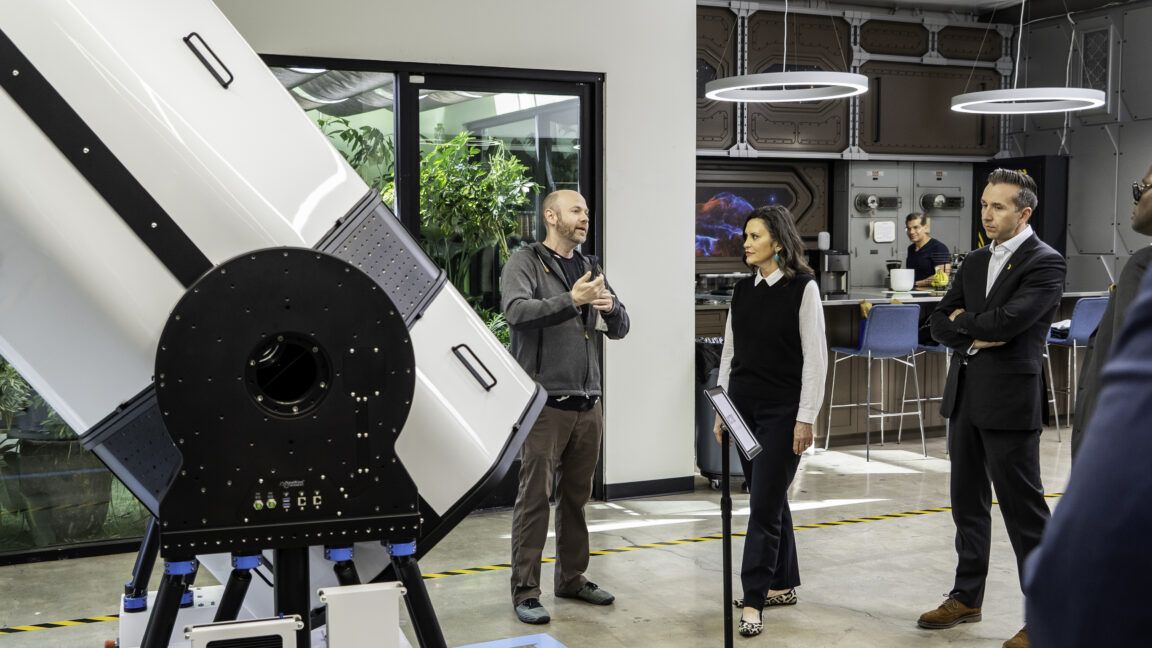
Observable Space CEO Dan Roelker speaks with Michigan Governor Gretchen Whitmer as she visits the company's offices in Los Angeles, in May.
Credit:
Observable Space
Observable Space CEO Dan Roelker speaks with Michigan Governor Gretchen Whitmer as she visits the company's offices in Los Angeles, in May.
Credit:
Observable Space
BLUEMONT, Va.—From an overlook in the foothills of the Blue Ridge Mountains, Dan Roelker gazed across the green splendor of the Shenandoah Valley. With the pleasant spring afternoon drawing toward evening, the Sun lazily crossed the sky, casting light all around.
The pleasing environs had put Roelker, who was drinking rye whiskey procured from a local distillery called Catoctin Creek, in an expansive mood to talk about one of his favorite subjects: light.
“If you can control light, you can control space,” he said. “So it’s basically a race for who is collecting the most light.”
And Roelker, now 48 years old, finds himself firmly in a race to collect the most light. He has followed an improbable career path, moving from hacker to video game coder to head of software development at SpaceX, then into crypto and NFTs, and now, of all things, to building telescopes and advanced optics while writing the software that brings them to life.
As he sipped whiskey, Roelker shared his vision for the future of spaceflight. Since the dawn of our existence, humans have observed light from distant stars and galaxies to make sense of the Universe. Later, we devised telescopes for deeper observations of the heavens, and as we took to the stars, we used their light for navigation.
More recently, our telescopes have carefully tracked the movement of a growing number of satellites buzzing around the planet to ensure they avoid collisions. And now, engineers have harnessed laser light to dramatically increase the amount of data that can be beamed down from space, a technology all the more urgent due to the advent of orbital data centers.
“The new space race is going to be on the ground,” Roelker said. And the winners, he believes, will be those who can harness the light in powerful new ways.
Engaging in cyberwarfare
To control the light, Roelker cofounded a company in 2025 called Observable Space. He struggled to explain how he wound up here. His parents didn’t go to college. His dad died when Roelker was fairly young. His mom cooked school lunches. When Roelker left this working-class life in small-town Pennsylvania to attend a private university in Maryland, his family was stunned when he said he would study mathematics and philosophy.
“My family was like, ‘What are you going to do with that? How are you going to be able to build a house with that?’” he recalled.
But beyond his formal classes, what intrigued Roelker most were computers, particularly hacking. This was the late 1990s, and he had grown up with books like The Anarchist Cookbook and realized the power of computers and the growing influence of the Internet on society.
Even before graduating, he took a research job at the nearby Johns Hopkins Applied Physics Laboratory. He could envision a four-decade career stretching out before him, providing the kind of financial stability he had not enjoyed growing up, a comfortable retirement with a 403(b) plan, and more. But this wasn’t enough. He sought adventure and excitement and, amid the dot-com boom, a chance at greater riches.
So he left academia for the private industry, working as a software engineer at a small networking company before becoming a founding developer at Sourcefire in May 2002, a startup focused on network security. It would later be acquired by Cisco for $2.7 billion. Seeking to move from cyber defense to offense, he took on cyberwarfare jobs at companies later acquired by BAE Systems and Raytheon. These activities brought Roelker to the attention of the US government.
In early 2011, the US Defense Advanced Research Projects Agency recruited him to manage its cyberwarfare initiatives. In his early 30s, he was one of the agency’s youngest-ever program managers. While working for the government, Roelker’s biggest project was called Plan X, which in military parlance sought to dominate the cyber “battlespace.” For years, the US Department of Defense had spoken about defending itself in cyberspace, but now, for the first time, it was talking about offensive capabilities. Roelker helped develop the tools to automate the execution of cyberattacks.
“It was a pretty big deal because it was one of the first public acknowledgements that the military was engaging in offensive cyberwarfare,” Roelker said.
After three years at DARPA and more than a decade in cyberspace and hacking, Roelker was ready for a reset.
Space is the place?
At the beginning of 2014, Roelker left DARPA to try something rather different, working on the most popular PC game in the world. At the time, League of Legends had an enormous global player base but faced problems with the “client” used to join games. He moved across the country to the Los Angeles area to work on this software.
He liked the game (Roelker played mid, with Diana as a main), but found the workplace too laid-back, since its developer, Riot Games, was swimming in cash. So about a year after joining developer Riot, Roelker began looking around for something with a greater urgency. He’d been into space in his younger days and was an avid sci-fi reader, but he felt the field didn’t pay well. By 2015, SpaceX was starting to do some pretty interesting things with launch, however, and he lived near the company’s headquarters in Hawthorne. He made inquiries through connected friends and found out that the company needed someone to lead software engineering.
The hiring process at SpaceX is brutal; for software positions, it includes a six-hour coding test. But Roelker got through and was excited to join in September. Just a couple of months earlier, the company had blown up a Falcon 9 rocket for the first time, and it was all hands on deck to get the rocket flying again. But SpaceX founder Elon Musk didn’t just want to return to flight; he also wanted to do so with a significantly upgraded version of the booster (using densified propellant) and to attempt a land-based landing of the first stage for the first time.
On his first day on the job, Roelker met the Falcon 9 software team as their new manager. He was told the team was eight months behind schedule and represented the long pole for the vehicle’s return to flight, which Musk wanted to achieve before the end of the year. Half of the rocket’s software team was on the brink of quitting. “Good luck,” he was told.
The new vice president of software engineering took up the challenge, seeking to pare back the department’s scope to focus solely on Falcon 9 flight software and the first stage landing. The rocket ultimately returned to flight successfully on December 21, and the first stage did indeed land. After, Roelker earned the confidence of Musk and a key lieutenant, Mark Juncosa, who began entrusting him with increasingly important projects, including flight software for Falcon Heavy, Crew Dragon, early versions of Starship, and, of course, the Starlink Internet constellation. By the late 2010s, work on the Internet constellation became all-consuming.
“It was all in on Starlink because we had to get that revenue-generating engine going,” Roelker said.
During this time, Roelker learned all about the space industry, the importance of vertical integration, and the many technical challenges involved in launching and managing hundreds, and eventually thousands, of satellites. One of SpaceX’s greatest challenges, he realized, was simply knowing the precise location of both its satellites and everything else in orbit. Every day, the Air Force would send a list of about a thousand potential collisions, but most were false positives.
As the Starlink work piled up, Roelker left SpaceX in 2019. He was more interested in space exploration than building a massive telecommunications network in orbit.
For a couple of years, he dabbled in crypto and emerging areas like non-fungible tokens. He was one of the first employees at OpenSea, leading engineering there. The company was printing money, and in January 2022, it raised $300 million at a $13.3 billion valuation. He left near the peak of the market.
After the cryptocurrency side quest, he was ready to get back into space. And he knew the problem he wanted to solve.
Seeing the light
By this time, Roelker was in his early 40s, and he had already dabbled in a lot of areas. “I like to start companies, or join companies, where I learn something,” he said. At SpaceX, he’d learned about the importance of tracking the movement of satellites and that, in an increasingly crowded space environment, humans weren’t good enough at it.
So in October 2022, he co-founded a company called OurSky to leverage his software skills. He hired a computer scientist from the scooter company Bird, Connor Poole, to lead software engineering. They set about writing code to essentially mesh the observations of dozens of telescopes to track objects as they moved around the planet. The goal was to provide satellite operators the location of their spacecraft with sub-arcsecond precision within 90 seconds of a request.
This worked well enough, but Roelker and Poole soon realized that to really do this right, they needed more than good software; they had to build hardware as well. Neither had much experience with telescopes, and by then, most telescope manufacturing had moved offshore, primarily to China, including big players like Celestron.
Eventually, they connected with a small Michigan company called PlaneWave Instruments. It was founded in 2006 by a senior engineer from Celestron, Richard Hedrick, who had watched as that company’s manufacturing base was slowly moved to China. PlaneWave made its telescopes in Adrian, a small town in southeastern Michigan.
About 18 months ago, OurSky and PlaneWave essentially merged into a company cofounded by Roelker, Poole, and Hedrick, known as Observable Space. The company has quietly grown into a powerhouse by offering sophisticated software, developing advanced adaptive optics, and becoming the largest US-based telescope manufacturer.
The company’s instruments are useful to astronomers and are often found in remote observatories like Starfront. Additionally, in January, former Google chief executive Eric Schmidt announced plans to fund several large observatories, including an array of 1,200 telescopes, each with 11-inch mirrors, to mimic the effect of an 8-meter optical telescope. It will image the entire Northern Hemisphere sky. Observable Space won the contract to build all 1,200 telescopes for this project, called Argus Array.
But for all that, astronomical telescopes remain a fairly niche industry.
Tracking moving objects
“Everything we know about the universe comes from telescopes,” Roelker said. “So while the total addressable market of that is not super big or attractive to VCs, I don’t know of a bigger question we can answer as humans outside of that. So we kind of want to have it both ways. We want to build this amazing technology that helps us understand the Universe, but we also know that same technology can be used for extremely big markets that are powering the space ecosystem.”
The ways in which the US military tracks satellites are changing quickly, largely in response to a rapidly growing number of satellites. Over the last half-decade, the number of active satellites has grown from about 3,000 in low-Earth orbit to more than 15,000, and the number continues to grow with each launch of Starlink satellites, Amazon Leo satellites, and China’s Guowang and Qianfan constellations.
This explosive growth has led the US military to increasingly rely on commercial data and to integrate it directly into routine military operations. The Space Force has also been seeking to acquire more ground-based sensors of its own to maintain coverage of crowded orbits.
Last month, the US Space Force awarded a $94 million contract to Observable Space to expand its production of high-performance optical telescopes. “The Department is acting on the urgent need for mobile, off-grid robotic telescopes,” said Jeremy Verbout, assistant secretary for mission capabilities, in a statement. “These systems will provide the Joint Force with high-fidelity space domain awareness.”
Observable Space is also developing new, lower-cost optics for use on spacecraft in orbit. Its Iguana space telescope, with a 200 mm aperture, allows operators to perform space domain awareness and astronomical observations and navigate for rendezvous and proximity operations.
The first of these Iguana telescopes is set to fly on a spacecraft bus built by Apex later this year as part of its Project Shadow mission to demonstrate space-based interceptors.
Psyche calls home
Nearly three years ago, a Falcon Heavy rocket launched the Psyche mission for NASA. The fairly small spacecraft needed a high-energy launch because its destination was an orbit around the distant, metal-rich asteroid 16 Psyche in the asteroid belt.
As a secondary part of its mission, the NASA spacecraft also carried a laser transceiver. It would be the space agency’s first test of truly long-distance optical communications, using photons to transmit more data than conventional radiofrequency transmissions. The benefits are significant: 10 to 100 times as much data from a transmitter that is smaller than an RF one, and it requires less power. But there’s a catch: These lasers can’t transmit through clouds back on Earth.
About one year into its mission and far from Earth, in October 2024, the Psyche spacecraft linked up communications with the 5-meter aperture Hale Telescope at Caltech’s Palomar Observatory in San Diego County. With this breakthrough, NASA had just successfully used laser communications to talk to a spacecraft 290 million miles (460 million km) away, about the distance Mars reaches at its farthest point from Earth.
“The milestone is significant,” Meera Srinivasan, the project’s lead at NASA’s Jet Propulsion Laboratory, said at the time. “The techniques we use to track and point have been verified, confirming that optical communications can be a robust and transformative way to explore the Solar System.”
Companies like Observable Space are now racing to commercialize this technology.
Gathering light, decoding data
At a high level, the concept is fairly straightforward. A spacecraft encodes data onto a laser, which sends a narrow beam toward Earth. Large optical telescopes on the ground collect the incoming photons, and detectors convert the light back into electrical signals. Sophisticated error-correction software reconstructs the original message as many photons are lost.
The greater the distance, the more daunting the challenge. A laser beam from geostationary orbit, about 22,000 miles (36,000 km) above Earth, starts out about the diameter of a coffee cup, and when it reaches Earth, it’s about 1km across. The farther away, the farther the beam spread, so ground-based telescopes can capture only a tiny fraction of the signal from distant spacecraft.
The future of communication throughout the heavens will therefore probably be based on relay spacecraft, which are essentially like Internet routers here on Earth. “We’re going to be building the systems that get deployed in space and become the fiber optics infrastructure of communication across the Solar System,” Roelker said.
That’s the vision, at least.
But it is starting to happen. Observable Space played a key role in facilitating optical communications on Artemis II in April as it flew around the Moon. This type of high-bandwidth communications is expected to become standard for future Artemis missions and will enable lunar landings in high definition.
Observable Space is also talking to SpaceX and everyone else interested in developing orbital data centers because that technology needs high-bandwidth links from space to ground. And the way to get around clouds is to have lots of ground stations around the planet. That’s why Observable Space is focused on scaling up telescope production and lowering costs.
Investors are buying in. In late May, the company announced it had closed a $90 million Series A funding round and would use that money largely to accelerate its laser communications business.
Roelker is happy to leave it to other companies to launch into space. He’s seen SpaceX from the inside and knows he could never compete with that. Likewise, there are many companies building spacecraft and satellite buses.
What those vehicles all need is the command of light. Rockets, and particularly spacecraft, need it to navigate. They need to see objects to avoid collisions. And somehow, with all of the data they are collecting and processing, they need to get it back to Earth. Because, otherwise, what’s the point?
Eric Berger is the senior space editor at Ars Technica, covering everything from astronomy to private space to NASA policy, and author of two books: Liftoff, about the rise of SpaceX; and Reentry, on the development of the Falcon 9 rocket and Dragon. A certified meteorologist, Eric lives in Houston.
24 Comments
View original source — Ars Technica ↗
Related stories

Portugal Resident
TechnologyJun 22, 2026 · 1 min
Farewell to HPA: Algarve healthcare group adopts CUF name
Portugal Resident

TechRadar
TechnologyJun 22, 2026 · 1 min
The Echo Dot 5th Gen is the best way to take advantage of Alexa+ for cheaper this Prime Day
TechRadar
TechRadar
TechnologyJun 22, 2026 · 1 min
Got a Samsung phone? This is my highest-rated Samsung Galaxy Watch, and you should look out for it on Prime Day
TechRadar

TechRadar
TechnologyJun 22, 2026 · 1 min
Sonic Team head on where the franchise will be in another 35 years — 'Iizuka-san does not think he's going to be alive'
TechRadar