Indian Express
How Pune’s 1897 plague led the Chapekar brothers to assassinate a British officer
On the night of June 22, 1897, a grand celebration to mark Queen Victoria’s Diamond Jubilee was wrapping up at Governor’s House in Ganeshkhind, at what is today Pune University. Guests were beginning to leave on horse-drawn coaches. On a dark street, a cry rang out: “Gondya ala re (Gondya is coming)”.
Moments later, two coaches were attacked, and two men were killed. One of them was Walter Charles Rand, an Oxford University alumnus and an Indian Civil Service officer, who had been appointed that year as the Assistant Collector and Chairman of the Poona Plague Committee.
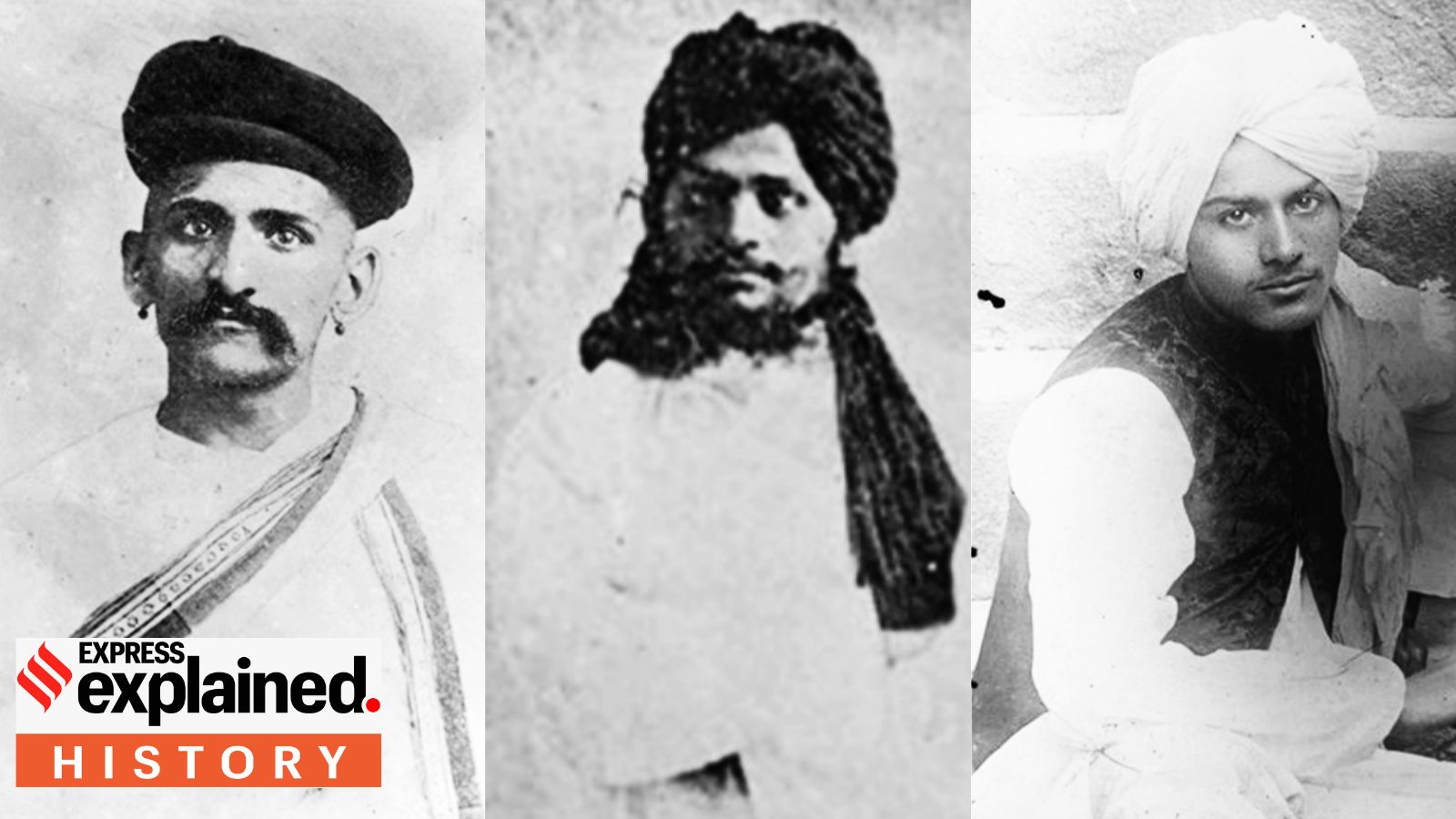
The assassins were three brothers, Damodar Hari Chapekar, 28, Balkrishna Hari Chapekar, 24, and Vasudeo Hari Chapekar, 18. The revolutionaries of the Indian freedom movement were arrested and imprisoned.
In his autobiography, Musings from the Gallows, Damodar wrote, “Now, the question arises, why should such a murderous and terrible deed be undertaken?… Just as Prahlad worshipped the Almighty with boundless devotion, so my love for my country is unwavering… undying. I shall relinquish all happiness and sacrifice my life for my country”. Damodar was hanged on April 18, 1898, Vasudeo on May 8, and Balkrishna on May 12.
“This is, perhaps, the only instance anywhere in the world of three brothers being hanged in the service of their country’s independence. What is significant is that the Chapekars had written a letter to Rand, informing him that he would be killed on the night of June 22. They were not going to kill him like cowards, without a warning,” says Pune historian Mohan Shete, and the playwright-director of a play on the brothers, titled Swatantryacha Krantiyadna.
Rooted in religion
The Chapekar community comes from the Konkan region, but Haripant Chapekar, the father of the brothers, had moved to Chinchwad, which was little more than a village at the time.
Haripant was a well-known kirtankar, who was invited to places as far away as Bhopal, Indore and Nagpur to perform songs of the scriptures. He moved his family to a rented accommodation in Sadashiv Peth of Pune to be closer to the devotees in whose homes he would perform.
Story continues below this ad
Shete says that according to Damodar’s writings, the stories of Ram and Krishna would inspire him to wonder why his generation could not take on the Ravan and Kansa of their times — the British oppressors.
Growing up, the Chapekars were encouraged by the patriotic stories of Vasudev Balwant Phadke, who had led armed struggles against British interests and was shipped off to Aden in Yemen to be incarcerated. The brothers were ardent followers of Lokmanya Tilak, whose paper Kesari was raising its voice for independence and sociopolitical causes.
By 1896, however, another enemy was rearing its head over Poona in the form of the bubonic plague, which had travelled from Yunnan in China through Hong Kong and Bombay.
Oppression during the plague
On October 2, 1896, Poona recorded its first cases of plague. In four months, 271 people died of the disease, and 308 were infected. Tens of thousands of people were fleeing Poona to return to their villages. The Indians and the British began to demand a strong leader to clean up the city before things spiralled out of control.
Story continues below this ad
Shete says that Rand, 34, who was posted in Satara, was found to be a fit candidate for the job. Bombay Presidency Governor William Mansfield Sandhurst appointed him. In a report written before his death, Rand describes that “stringent measures” were needed in Poona to control the plague.
According to Shete, these measures were extreme and insensitive. Soldiers would enter houses to check for plague-infected patients, angering the local people. For a people who did not wear shoes into the house, let alone leather shoes, the sanctity of spaces such as kitchens and small temples was seen as being violated.
“People were so frightened that they began to hide family members. Even dead bodies were hidden in the garden and cupboards. People were afraid that, if detected as a plague-infected family, they would be turned out of their homes, city and village,” says Shete.
He adds that it was particularly horrifying when men and women were made to stand in public and bare parts of their bodies for soldiers to check for symptoms of plague infection. In a confession that Damodar later retracted, he said that these search operations and other measures triggered him to plot Rand’s assassination.
The wrong target
Story continues below this ad
The assassination was meant to challenge the British Crown, too. The brothers had carried out recces of the route and studied Rand’s movements minutely. The code of Gondya ala re was finalised.
“Govind Londe was the maternal uncle of the brothers. An employee of the British government, he used to discourage the brothers’ revolutionary ideas. Every time their uncle was nearby, the brothers used the sentence Gondya ala re as a signal to change the topic of discussion,” says Shete.
On June 22, 1897, the site of the assassination was carefully chosen. After a bridge over the Mutha river, the road turned, and carriages needed to slow down, allowing the assassins to jump on top of it. At the critical moment, however, the younger brother, Vasudev, made a mistake. His battle cry made Balkrisha attack a coach carrying Lieutenant Charles Ayerst and his wife, not Rand. Ayerst died immediately.
The signal shout went up again. Damodar realised their mistake and attacked the second carriage, which was carrying Rand. Following the attacks, the victims were taken to Sassoon Hospital. Rand died on July 3.
The aftermath
Story continues below this ad
The police were led to the brothers by two other brothers, Ganesh Shankar Dravid and Ramchandra Shankar Dravid. Tilak, too, was tried for inciting people through his writings in Kesari. He was sent to 18 months of imprisonment.
“In later years of the freedom struggle, the revolutionaries who killed British officers would become well-known heroes. But, the Chapekars came long before this. The fire they lit, however, would inspire many. Veer Damodar Savarkar was a young boy in Nasik when the Chapekars were killed. He would take an oath before the family devi, the eight-armed Durga, to complete their unfinished work,” says Shete.
View original source — Indian Express ↗
Related stories

TechCrunch
TechnologyJun 22, 2026 · 1 min
Amazon is testing Alexa+ in India with Hindi support
TechCrunch

The Guardian
TechnologyJun 22, 2026 · 1 min
Canadian healthcare staff decry ‘cruel hoax’ after scam email promises paid day off
The Guardian

Indian Express
TechnologyJun 22, 2026 · 1 min
Youngster selling guns through Instagram calls arrested, 5 pistols seized
Indian Express

TASS
TechnologyJun 22, 2026 · 1 min
Actual work on peace between US-Iran just beginning — Turkish ruling party
TASS