The Guardian
A history of World Cup red cards: high feet, lost heads and a covered mouth
After a fairly pedestrian first half of the opening match of the 2026 World Cup, the game burst into life in the second period. South Africa midfielder Sphephelo Sithole, who had been at fault for Mexico’s opening goal, compounded his error by being sent off in the 49th minute for denying a goalscoring opportunity. When Themba Zwane was dismissed, South Africa became the 15th team to have two players sent off in the same World Cup match.
There was time for one more red card before full-time, the Mexico centre-back César Montes seeing red in stoppage time and following in the footsteps of his manager, Javier Aguirre, who was sent off while playing for Mexico in the 1986 quarter-final against West Germany in Monterrey.
The Mexico v South Africa match was the seventh World Cup game to feature more than two dismissals. Referees have been unusually trigger happy with their cards so far at this tournament. When Belgium defender Nathan Ngoy received his marching orders in a goalless draw with Iran on Sunday, he became the eighth player to be sent off – already matching the total in the previous two tournaments combined (four in Russia and four in Qatar).
One of the four red cards in Russia four years ago came during a chaotic quarter-final penalty shootout, with Denzil Dumfries – penalised for taunting Argentina – becoming the eighth Dutchman to be sent off at a World Cup. Given their national team is associated with the finer points of the game, it is perhaps surprising that the Netherlands have been at the centre of so much rancour and controversy over the years.
They were involved in the only World Cup match that has featured four red cards – the Battle of Nuremberg, their 1-0 defeat to Portugal in 2006. The last-16 match featured 16 yellow cards, with the first booking coming when Mark van Bommel scythed down Cristiano Ronaldo with a robust challenge in the second minute. The Netherlands were not very subtle about targeting Ronaldo; only a few minutes later, his thigh felt the imprint of Khalid Boulahrouz’s studs and the second yellow of the match followed.
Ronaldo just about survived this twin assault, but he did not make it to half-time. He left the pitch in tears just after Maniche scored the only goal of the match, as some football broke out briefly. The ferocity soon returned and the first red card arrived just before half-time, when Costinha’s deliberate handball leading to his second yellow. Any hopes of the second half being less violent were quickly dashed. Petit, a half-time substitute, was booked minutes after arriving on the pitch. Amazingly, the total number of red cards could have been higher; Luís Figo was lucky that his head-butt on Van Bommel during a heated fracas was deemed merely a yellow.
The Netherlands were also involved in the World Cup match with the most yellow cards: that quarter-final against Argentina in 2022. The referee issued 18 yellows (16 for players and two more to coaching staff) during a physical, bruising contest that Argentina won on penalties after a 2-2 draw. There was not much love between the teams by the end, with Argentina players infamously celebrating in the faces of the Dutch after the penalty shootout.
The Netherlands also adopted an aggressive approach in the World Cup final in 2010, when they tried to unsettle a fluid Spain side with a series of rough challenges. There were 14 yellow cards in the match, with eight of the Netherlands’ starting XI booked. Maarten Stekelenburg, Wesley Sneijder and Dirk Kuyt were the only Dutch starters who did not go into the referee’s book.
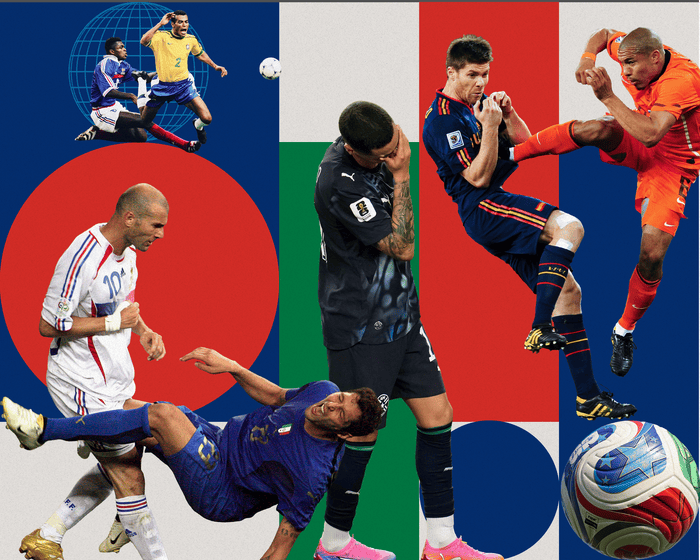
If anything, the referee was too lenient. John Heitinga was sent off for two bookable offences, but Howard Webb decided not to show Nigel de Jong a red card for planting his studs on Xabi Alonso’s chest. The referee later reflected that it was a mistake. “One of the things I would change is the colour of the card for De Jong’s tackle,” said Webb. “Having seen it again from my armchair several times in slow motion and from different angles I can see that it was a red-card offence.” So much for Total Football.
Heitinga is the last player to be sent off in a World Cup final and the fifth overall. It was not until the 14th final, in 1990, that a player was dismissed, with Argentina making up for lost time in their defeat to West Germany. Pedro Monzón was sent off 20 minutes after he had come on as a substitute and Gustavo Dezotti soon joined him in having an early bath. In the 1998 final, the seemingly unflappable Marcel Desailly was sent off for a second yellow after he took out Cafu. Not to worry. France breezed to a 3-0 win against Brazil in Paris.
Zinedine Zidane scored twice in that final and went on to win the Ballon d’Or that year. Earlier in the tournament, as France were coasting to a 4-0 victory, Zidane was sent off for stamping on a Saudi player. That would not be his last red card at a World Cup. Eight years later he became the second Frenchman to be dismissed in a final after he head-butted the Italy defender Marco Materazzi (who had been sent off earlier in the tournament). It was an unsuitable epitaph for one of the most cultured, talented players the world has ever known. Zidane is not alone in being sent off twice at World Cups; Cameroon defender Rigobert Song saw red in 1994 and 1998.
The first sending off at a World Cup came on the second day of the inaugural tournament in 1930 in front of a crowd of a few thousand people in Montevideo. Plácido Galindo, the inaptly named Peru captain, received his marching orders (he was not shown a red card as they were not introduced until 1970) in a 3-1 defeat to Romania. The game was apparently littered with fights, one of which had to be broken up by the police.
Nearly a century later, players are still breaking new ground. Miguel Almirón made history when he was sent off in Paraguay’s 1-0 win over Turkey. There were no big fights in that match. Instead, Almirón saw red for the heinous misdemeanour of “covering his mouth while speaking to an opponent in a confrontational situation”.
This is an article by Richard Foster, who presents the It Started With A Kick podcast and is writing a daily World Cup quiz on the Seventh Heaven app, on Apple and Google Store.
View original source — The Guardian ↗
Related stories

The Punch
SportsJun 22, 2026 · 1 min
Ghanaian priest vows to ‘work on’ Harry Kane ahead of England clash
The Punch

ESPN
SportsJun 22, 2026 · 1 min
World Cup live updates: Argentina take on Austria ...
ESPN
Sky Sports
SportsJun 22, 2026 · 1 min
Can 'familiar face' Maresca carry on Guardiola's work at Man City?
Sky Sports
BBC Sport
SportsJun 22, 2026 · 1 min
'He is human' - Messi misses from the spot as he chases scoring record
BBC Sport