Times of Israel
Fiercely critical High Court seems poised to annul keystone judicial overhaul law
Analysis
Conservative justices are joining their liberal colleagues in assailing the bid to politicize the appointment of judges, placing the government’s signature reform in jeopardy
By Jeremy Sharon
You will receive email alerts from this author.
Manage alert preferences on your profile page
You will no longer receive email alerts from this author.
Manage alert preferences on your profile page
Today, 9:22 pm
Edit
Jeremy Sharon is The Times of Israel’s legal affairs and settlements reporter
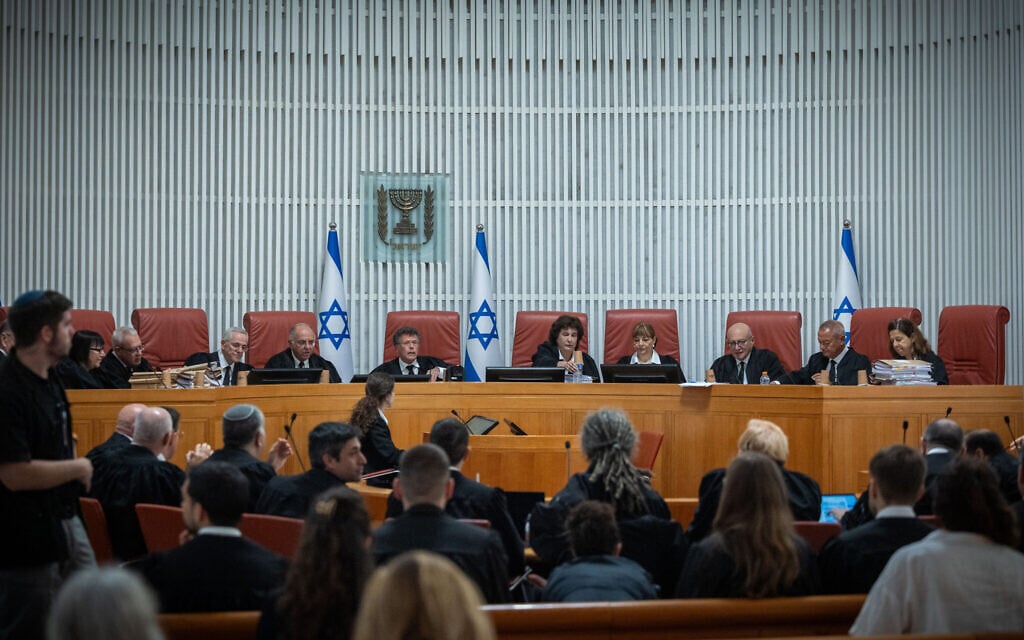
The hearing in the High Court of Justice on Sunday, about legislation that will greatly increase political influence over the judicial appointments process, appeared at times more like a roasting of the government’s lawyers than a traditional court proceeding.
Practically every single justice on the 11-member panel lambasted one component or another of the law, with numerous justices using harsh language to describe the measure and painting it in truly dystopian hues.
The law, which will come into effect after the upcoming election, gives politicians on the Judicial Selection Committee an unprecedented veto over lower court appointments, and total control over all Supreme Court appointments. In certain situations, politicians could even handpick a Supreme Court judge without a vote in the committee.
Some justices on the panel were so appalled at the legislation that they appeared to take it almost as a personal insult, pointing out — in response to the argument that the government was “merely” trying to increase political diversity on the court — that their political positions were completely irrelevant to their professional conduct as judges.
The ferocity of the justices’ onslaught against the government representatives left little doubt as to how the court will rule on the highly contentious legislation.
Get The Times of Israel's Daily Edition
by email and never miss our top stories
By signing up, you agree to the terms
The fact that the law is the centerpiece of the government’s multi-pronged bid to constrain the judiciary’s ability to check executive power will mean that any decision by the court to strike down the law will be highly contentious.
Compounding the potential controversy is the fact that the law was passed as an amendment to a quasi-constitutional Basic Law, namely Basic Law: The Judiciary. The government, the Israeli right, and advocates of judicial restraint argue that the court derives its very authority for judicial review from Basic Laws, and therefore has no authority to review them, or amendments to them.
But out of the 11 justices hearing the petitions on Sunday, five have already crossed that bridge when they ruled to strike down the government’s reasonableness limitation law in 2024, which was also an amendment to Basic Law: The Judiciary.
They did so on the basis of the doctrine of the unconstitutional constitutional amendment laid out by then-Supreme Court president Esther Hayut, who argued in her opinion on the reasonableness law that any Basic Law that violates the principles laid out in the Declaration of Independence, which defines Israel as both a democratic and a Jewish state, would be unlawful.
Indeed, right at the beginning of Sunday’s hearing, current Supreme Court President Isaac Amit, a liberal who ruled with Hayut to strike down the reasonableness law, urged the legal representatives of all sides not to argue this principle, since it had “already been decided.”
In addition, four of the justices hearing the current case had written in their opinions on the reasonableness law that the High Court has the authority to strike down Basic Laws if they violate core democratic principles, while determining that the reasonableness law itself did not reach that threshold.
Thus, fully nine out of the 11 justices reviewing the government’s Judicial Selection Committee law believe that the court can strike down Basic Laws.
Even Deputy President Noam Sohlberg, an arch-conservative, muttered objections to the naked politicization of the judicial appointments process under the new law.
Given that five of the 11 justices are liberals, it would take just one of the moderate conservatives to rule along with them to form a majority on the bench to strike the law down.
But the egregiousness of some of the components of the law is such that a far greater consensus than a simple majority may be mustered to annul the legislation, which is why the comments of the conservative justices were more interesting than Amit’s caustic attacks on the law in its entirety.
In contrast to Amit, many of the conservative justices focused their ire on the so-called “deadlock” mechanism, whereby if coalition and opposition representatives on the Judicial Selection Committee cannot come to agreement over Supreme Court appointments, both sides can handpick a justice for the court once every Knesset term.
Justice Yael Willner, a conservative, ripped into the government lawyers over this issue, rightly pointing out that the formula is an almost certain recipe for both sides to refuse to compromise in order to handpick their most ideologically committed candidates to the highest court in the land.
Justice Yechiel Kasher, a moderate conservative, said the deadlock mechanism would prompt both coalition and opposition to nominate only the most extreme judges for the Supreme Court for fear of losing the balance of power on the court, and noted that excellent judges whose political leanings were unknown would stand “zero” chance of getting appointed to the court.
Justice Alex Stein, another conservative, took issue with a chilling effect on the entire judiciary that he said would result from the law, arguing that judges in search of promotion would sway their decisions for the approval of one political side of the aisle or another.
Even Sohlberg, who wrote in his decision on the reasonableness law that the court does not have the authority to strike down Basic Laws, appeared shocked when one of the government lawyers all but acknowledged that the law was designed to create “ideological,” meaning political, diversity on the court.
The consensus on the panel therefore seems clear: a large majority of the justices appear convinced that the government’s judicial appointments law harms the democratic principle of judicial independence.
It seems highly likely that, with five of the current 11 justices having already struck down the reasonableness law, which was a more borderline case of democratic injury, a majority and even a large majority will be formed on the court to strike down the judicial appointments law as well.
The only real questions that remain are whether the court will issue its decision before or after the upcoming elections, and whether the government will comply or choose instead to trigger an unprecedented constitutional crisis.
If you’d like to comment, join
The Times of Israel Community.
View original source — Times of Israel ↗
Related stories
The Guardian
PoliticsJun 22, 2026 · 1 min
Burnham prepares for power as an emotional Starmer bows out
The Guardian

The Punch
PoliticsJun 22, 2026 · 1 min
PDP candidate, Oluyede, rejects Ekiti gov poll result
The Punch

France 24
PoliticsJun 22, 2026 · 1 min
Turnover at 10 Downing Street raises questions about 'whether Britain is indeed governable'
France 24

SBS News
PoliticsJun 22, 2026 · 1 min
'Unprecedented': Is this the moment US-Israel ties stopped being 'special'?
SBS News