CNA
Does a degree mean job security? Recent retrenchment data challenges that assumption, say experts
SINGAPORE: For 46-year-old Steven Neo, losing his job as a senior programme manager at a global tech giant was more than a financial shock – it was a profound loss of an identity that he tied to his work.
“As a dad in an Asian community, I think there are a lot of societal expectations of what a guy and a dad should be as a breadwinner,” he said, adding that he got through the initial grief at his retrenchment with the help of his wife and young daughter.
Like most Singaporeans, he had been conditioned to a traditional Singaporean script.
“The traditional route that Singaporeans are being educated on is you study hard, get a good degree, and then you are able to get a job,” said Mr Neo, who has a bachelor’s degree in information systems and a master's degree in business administration.
So when told in mid-2025 that he was being laid off, Mr Neo was stunned because of the lifetime of education and effort that had gone into his 25-year career.
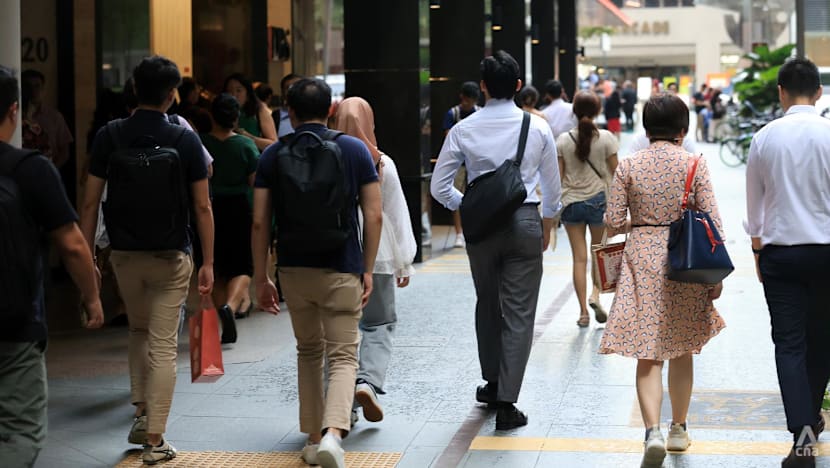
Mr Neo’s experience embodies a shift observed in retrenchment trends in recent years that is challenging long-held expectations about what gives a worker job security, said experts speaking to CNA.
In the latest quarterly market data, degree holders experienced a sharply higher retrenchment incidence, rising from 2.6 to 3.1 retrenched per 1,000 resident employees – higher than those with lower educational qualifications.
The Ministry of Manpower (MOM) said this figure from the first quarter of 2026 suggests that company restructuring remains concentrated among higher-educated workers, reflecting ongoing restructuring in professional and knowledge-intensive sectors.
Older workers in their 50s also faced a higher retrenchment incidence, rising from 2.8 to 3.1 retrenched per 1,000 resident employees – topping all age groups.
WHAT MAKES A JOB SECURE?
The shifts in retrenchment incidence indicate that traditional ideas that higher qualifications and more seniority lead to job security may no longer hold true in the evolving jobs landscape.
Retrenchment data has actually been consistent over time, in that more educated, higher-skilled workers and older workers have generally been at higher risk of retrenchment in recent years, said Associate Professor Walter Theseira of the Singapore University of Social Sciences.
The labour economist pointed out that retrenchment happens when organisations have excess staff for their business needs, and does not happen when they struggle to hire and maintain staff.
In Singapore, it is lower-skilled jobs for which organisations struggle to hire and maintain workers. This is because the job conditions are seen as relatively poor and Singaporeans tend not to be keen on them, he said.
"A job that people want is going to have higher retrenchments, compared to jobs that people do not want," said Assoc Prof Theseira.
"So we may have secure jobs or careers that people do not want (for other reasons including poor pay, prospects, difficult work), and insecure jobs or careers (with high pay and prospects as long as the industry is expanding) that people want."
He pointed to the recent example of higher pay and sign-on bonuses for bus captains: “Bus operators are struggling to recruit drivers, but that's because the working conditions are challenging.”
What this means is that workers may have to think about job security as a "quite different construct from job value or career paths".
"One might have traditionally thought that high education and skills lead to both job security and a good career path," he said.
"But with high specialisation and seniority, it also becomes very difficult to find comparable jobs if there is retrenchment, especially if it is a wider industry trend."
HARDER TO RE-ENTER JOB MARKET?
This can also explain the "paradox" of the more highly educated and skilled finding it harder to re-enter the job market after retrenchment, while those with less education and skills find it easier to get comparable jobs, according to Assoc Prof Theseira.
An important indicator is the percentage of retrenched workers who are able to re-enter the job market within six months after losing their job. This re-entry rate has risen for two consecutive quarters.
Degree holders' re-entry rate of 58.3 per cent lags behind the 60.7 per cent overall re-entry rate for retrenched resident workers in Q1 2026.
It is also lower than that of retrenched workers with secondary school (60.4 per cent) and diploma and professional (69.4 per cent) qualifications, though above that of workers educated below secondary school level (57.6 per cent).
Almost a year into his job search, Mr Neo has applied for close to 180 jobs but not received any offers.
Although he is open to junior positions and a correspondingly lower salary, in a few instances when he applied for such roles, recruiters told him they did not know where to place him.
At the other end of the spectrum, he has noticed that highly experienced AI-related engineering roles are in demand, but require advanced skills he estimated would take years to hone, by which time those skills might already be obsolete.
Adding to that, Mr Neo’s sense was that companies that have open positions may not hire for them if they are able to trudge along without filling the vacancy.
“It’s not that I’m not getting job interviews, it’s just that things are changing so rapidly right now in this environment that everybody is tightening their purses,” he said
The lower re-entry rate for degree holders may be because higher-earning workers have built up more wealth and savings, buying time to consider their next career moves, while lower-earning workers may be forced to take the next available job out of necessity, said Assoc Prof Theseira.
But other structural factors might also explain this.
The specialisation of higher-skilled jobs, particularly for older workers, makes it much less likely that similar jobs requiring the same specialisations exist, especially if the entire industry is shifting, said the labour economist.
"On the other hand, workers with lower skills tend to have less desirable jobs, but because the returns to their skills are lower, they also have a wider range of comparable opportunities," he said.
This view was echoed by those involved in AI skills training for workers.
“Diploma and trade-trained workers tend to occupy roles with stronger physical, relational or applied components,” which are augmented rather than replaced by AI, said Mr Tan Weng Han, head of policy and partnerships at training outfit Vertical Institute.
“Their roles are also more standardised and transferable, meaning there are more similar openings to move into when displacement happens. The demand is always there.”
Mr Tan added that those who entered the workforce through “competency-based pathways” such as the polytechnics, Institutes of Technical Education and professional qualifications “were never given the luxury of an ultimate credential”.
“They learned on the job, proved capability through applied output, and built a habit of iterative skill acquisition from the start,” he said.
“That habit is now having a structural advantage in a market where employers are increasingly asking ‘can I train this person to use a new tool?’ rather than ‘what did this person graduate with?’”
WHAT THE LABOUR STATISTICS SHOW
While the breakdown of the data reveals how retrenchment is impacting groups differently, overall retrenchment figures still remain broadly within norms in the first quarter of the year, said analysts.
Total retrenchments inched up from 3,690 to 3,830, and the overall incidence of retrenchment edged up from 1.5 to 1.6 retrenched per 1,000 employees in Q1 2026.
This remains within what MOM considers non-recessionary norms – a pre-pandemic quarterly average of 1.7 retrenched per 1,000 employees.
Observers were sanguine about the retrenchment indicators, which remain below what Singapore experienced in past crises.
During the global financial crisis, retrenchments numbered 16,880 in 2008 and 23,430 in 2009, with retrenchment incidence of 10.6 and 14.2 per 1,000 employees respectively.
In 2020, the first year of the COVID-19 pandemic, there were 26,110 retrenchments and the retrenchment incidence reached 12.8 per 1,000 employees.
"Some churn is usual for a dynamic economy," OCBC chief economist Selena Ling said of the latest quarterly snapshot of Singapore’s labour market.
"As long as structural or long-term unemployment is not rising, graduate unemployment is not increasing unchecked, and labour displacement by AI or technology is managed, the labour market condition should remain supportive."
For a more holistic picture, the quarterly uptick in retrenchments must be interpreted together with job openings, net employment and the unemployment rate, she added.
Job vacancies in March fell to 73,300. This meant there were 1.46 vacancies for every unemployed person, compared with 1.58 vacancies in December 2025.
Employment growth weakened to 9,400 in Q1 2026, although jobs growth was stronger for resident workers compared to the last quarter.
Overall unemployment stayed unchanged at 2 per cent, and resident long-term unemployment also remained at 0.9 per cent.
"The mood on the street as evidenced by reader reactions and talk online is definitely far dimmer than what the data indicates," said Assoc Prof Theseira.
"That could be because of high-profile retrenchments, as well as retrenchments hitting more senior and higher-skilled workers who were traditionally expected to have more job security.”
LOW TURNOVER
Assoc Prof Theseira added that over time, there has been a clear increase in the rigidity of Singapore's labour market, with the recruitment and resignation rates as well as re-entry rate falling steadily over the last 20 years.
He said this was likely due to the workforce becoming more specialised and highly skilled, as these characteristics are associated with less churn in the labour market.
A historical low average monthly resignation rate of 1 per cent was recorded in Q1 2026.
The average monthly recruitment rate of 1.6 per cent was also among the lowest since 2020, during the pandemic.
Singapore's generally declining turnover rates reflect its economic transformation to become more manpower-lean and a shift towards professional, manager, engineer and technician jobs, which tend to have more stable turnover, MOM has said.
The more cautious hiring and wage intentions picture in Q1 2026 also reflects external headwinds and uncertainties, OCBC's Ms Ling said.
"Policy can also play a part to help mitigate some of the downside risks, for example through skills upgrading, reskilling," she added.
As for Mr Neo, he has since written and self-published two books about his experience with retrenchment and unemployment.
“I view myself more importantly than my work, and work is just what I do as fuel for the lifestyle that I want,” he said.
“I will never default back to ‘my identity is the job title that I have’.”
Source: CNA/dv(nj)
Related stories

The Punch
BusinessJun 23, 2026 · 1 min
Tinubu names Ogundipe NUC chair
The Punch

Bloomberg
BusinessJun 23, 2026 · 1 min
CFTC Seeks Input on 24/7 Futures, Energy Perpetuals Trades
Bloomberg
Bloomberg
BusinessJun 22, 2026 · 1 min
Yen Intervention Risk Rises on Reports of Katayama-Bessent Talks
Bloomberg

Bloomberg
BusinessJun 22, 2026 · 1 min
Bloomberg This Weekend 6/20/2026
Bloomberg