Indian Express
20 years after Krrish, Hrithik Roshan is still caged by his superhero image
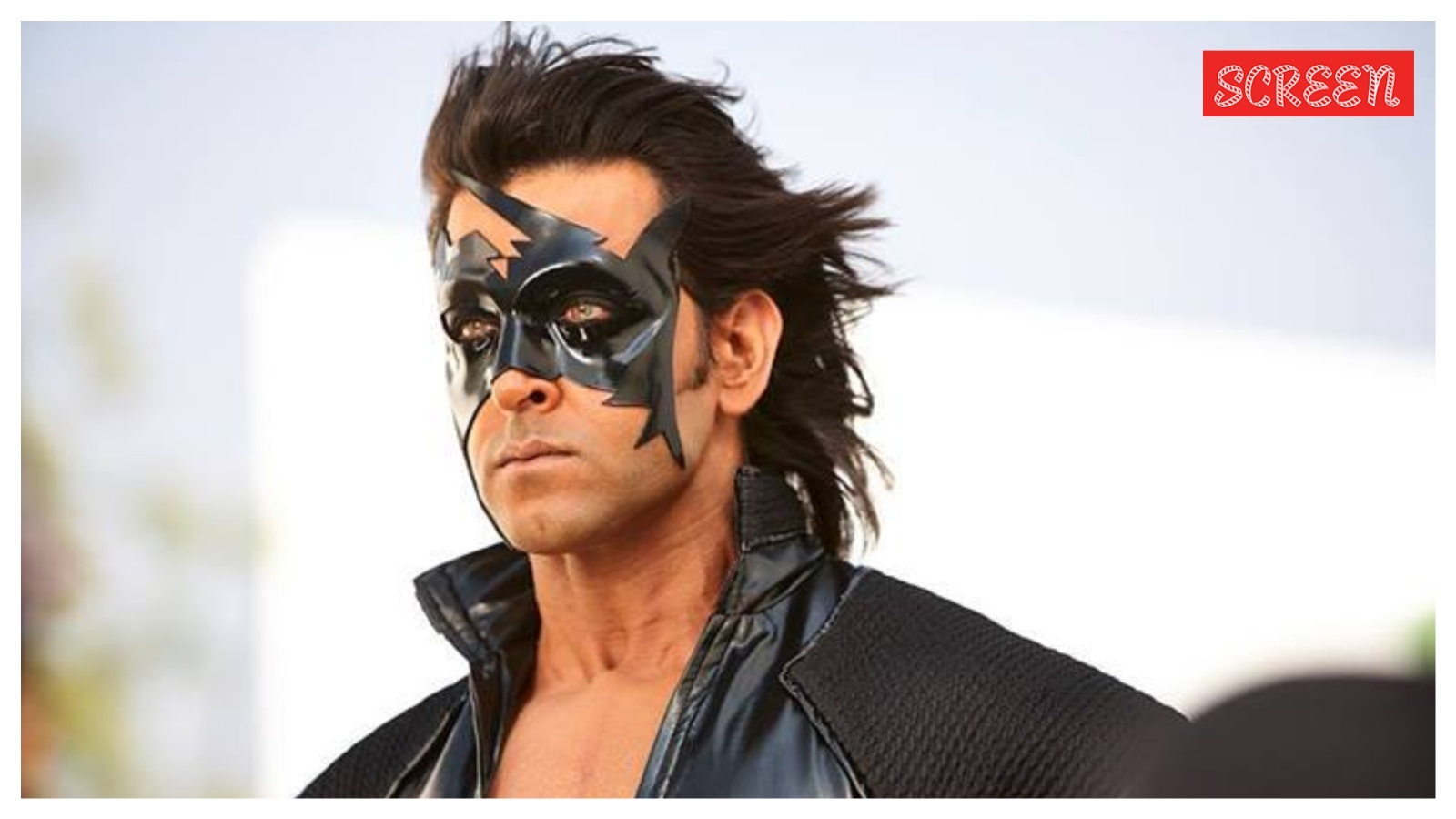
Twenty years ago on this day, June 23, 2006, Hrithik Roshan took a massive leap and never set foot on the ground again. As he transformed from the naïve and sheltered Krishna to the invincible Krrish, he took an invisible oath to return as the superhero to save the day whenever needed. But in the process, Hrithik Roshan, the actor, also underwent an irrevocable metamorphosis — he transcended even the superstardom he achieved overnight with his debut movie to evolve into a myth that will continue to weigh him down for the rest of his career.
Krrish was a sequel to Hrithik and father Rakesh Roshan’s 2003 sci-fi drama Koi… Mil Gaya. That film came at a crucial juncture in the actor’s career, when he desperately needed to snap out of the romantic hero persona that he got associated with right since his debut movie, Kaho Naa… Pyaar Hai (2000), also helmed by his father. After the path-breaking success of Kaho Naa… Pyaar Hai, which made Hrithik the only actor ever to win the Filmfare Awards for both Best Actor and Best Debut, none of his romantic dramas worked.
From Subhash Ghai’s Yaadein (2001), Vikram Bhatt’s Aap Mujhe Achche Lagne Lage (which reunited him with Kaho Naa… Pyaar Hai co-star Ameesha Patel), Na Tum Jaano Na Hum (title borrowed from the popular romantic track of his debut movie), and Kunal Kohli’s Mujhse Dosti Karoge! (2002). In fact, Kohli told SCREEN last year that Hrithik turned down the hit romantic comedy Hum Tum (2004), which fetched Saif Ali Khan a National Award, because not only their last collaboration didn’t work, but also he wasn’t sure of how his character would be received in Sooraj Barjatya’s Main Prem Ki Diwani Hoon (2003). Meme culture has told us how that one went down in the books.
Hrithik Roshan in Kaho Naa Pyaar Hai. (Express archive photo)
Despite working with the most promising filmmakers of that time, Hrithik just couldn’t score a box-office success after his debut film, with the exception of Karan Johar’s 2001 family drama Kabhi Khushi Kabhie Gham, which had Amitabh Bachchan and Shah Rukh Khan in the lead roles. No director could successfully position as a leading star. He played a terrorist in the first two films after Kaho Naa… Pyaar Hai — Fiza and Mission Kashmir (2000) — which he’d signed before his frist film. Those were too dark for his chocolate boy image, but the films that followed were even bigger failures despite falling into a similar zone as his dreamy debut.
It was only his father Rakesh Roshan who could come to his rescue again. With Koi… Mil Gaya, he gave Hrithik the range and arc that he enjoyed only in Kaho Naa… Pyaar Hai’s double role. In the second collaboration with his father, Hrithik managed to play the ultimate underdog with the character of Rohan, who would go on to become a conventional bicep-flexing, smooth-dancing hero, thanks to extra-terrestrial intervention by friendly alien Jaadu. It was as wholesome a leading part as Kaho Naa… Pyaar Hai, fetching Hrithik the Filmfare Awards for the Best Actor in both Popular and Critics categories.
Hrithik Roshan in a still from Koi Mil Gaya.
Having bounced back from a string of debacles, now was Hrithik’s chance to choose better. He had to strike a balance between doing something new and sticking to what he knew best. Tracing the arc of a hopeless youngster becoming a Kargil soldier in Farhan Akhtar’s Lakshya (2004) sounded on paper exactly the kind of film he should bet on next. But it was his childhood friend Farhan Akhtar to experience what Hrithik already had — a major setback after a seminal debut film, in Dil Chahta Hai (2001). Even though it became a cult film over time, Lakshya failed at the box office, which prompted Hrithik to not waste any more time and go back to where he does when all else fails — his father.
Rakesh Roshan’s risk to introduce sci-fi to India paid off with Koi… Mil Gaya. So, he decided to take another leap and kick off a superhero franchise in the country. Even though Krrish emerged as a hallmark success, it couldn’t recreate for Hrithik what their previous collaboration did. Krrish served as an effective origin story, but it lacked the underdog arc or the scope of performance that Hrithik enjoyed in the first two films with his father. It also established him as one of the leading action stars of India, with the actor pushing the envelope on that front to an extent that he’d never be able to escape the pigeonholing that inevitably came with it.
Story continues below this ad
Priyanka Chopra and Hrithik Roshan in Krrish.
Luck by Design?
The action training for Krrish came in handy for Hrithik in Aditya Gadhvi’s Dhoom 2 later that year, but that film worked wonders because he played the antagonist, a far cry from the all-white superhero. In arguably one of the finest performances of his career, Hrithik submitted himself completely to taking on the role of the titular king in Ashutosh Gowariker’s 2008 period romance Jodhaa Akbar, milking the most both his acting chops as well as that towering physique.
One of his most daring risks came after these three diverse blockbusters — Zoya Akhtar’s Luck By Chance (2009). His special appearance as Zafar Khan, an insecure Bollywood star, was both telling and touching, as demonstrated in the scene where he rolls up his car window to avoid contact with street kids, only to entertain them from the other side of the glass wall. Hrithik recently confessed that it’s a role he’d “jump at” again, but it’s “sad” that “directors only wanna see me play the good guy.”
Hrithik Roshan in Luck By Chance.
But his career trajectory is proof that as soon as a risk like Luck By Chance backfires, he swiftly returns to a familiar zone. That’s when he reunited with Rakesh Roshan for the 2010 action romance Kites. Although it was directed by Anurag Basu and not his father, it did put an end to the Roshans’ lucky streak. When even his safe bet failed to resurrect him, Hrithik opted for a risk that was almost designed to fail, but gave him one of his career’s most praised roles.
Having sustained injuries on his action films, Hrithik was told by doctors he may permanently lose his knee. A younger, more enthusiastic Hrithik, who was overweight, used to stammer, and was diagnosed with scoliosis, refused to believe medical science and worked day in and day out tirelessly to write his own story in the form of Kaho Naa… Pyaar Hai. But a more worn-out Hrithik decided to just submit to Sanjay Leela Bhansali’s vision of a paraplegic in Guzaarish (2010), coming completely to terms with his mortality.
Story continues below this ad
Hrithik Roshan and Aishwarya Rai in Guzaarish.
That must’ve seeped into his next performance of Arjun in Zoya’s 2011 buddy road movie Zindagi Na Milegi Dobara. A workaholic’s coming-of-age also resonated with an actor who was saturated with putting himself through the wringer in order to just prove his worth. But soon, he was back to doing what he knew best — put his body on the line — with self-admittedly, one of his most gruelling filming experiences — Karan Malhotra’s 2012 action crime drama Agneepath.
That film’s success gave him the confidence to reunite with his father again and resume the Krrish franchise with the third instalment. His next, Siddharth Anand’s 2014 action thriller Bang Bang! was also a box office success, which only emboldened his image and resolve as an action star. So, when he went back to the roots and did Mohenjo Daro (2016) with Gowariker, it was rejected instantly. And yes, a token action sequence with a crocodile in an ancient civilization only made it worse.
As soon as he encountered a setback, Hrithik went back to his father’s 2017 production Kaabil, Sanjay Gupta’s action thriller. Playing a visually challenged character and working with many such real-life inspirations ironically helped him see acting very differently. So, a couple of years later, when he did Vikas Bahl’s Super 30 and Anand’s War in 2019 — two roles like chalk and cheese — he admitted he could get both right because he’s no longer chased by the shadow of his failures. He drew an analogy to being chased by a mad dog throughout his career, only to then find the dog missing when he turned around while running.
So, when he eased into the pandemic, lived a little, and chose to strike back with the crime thriller Vikram Vedha, his deeply felt performance made perfect sense. But when that didn’t yield the desired box-office results, Hrithik concluded that it’s not the kind of a role his fans want to see him in. So, he returned to what served his assumption of what fans want from him — War 2. But when Ayan Mukerji’s spy thriller bombed at the box office, Hrithik couldn’t help but return to his safe space — the Krrish franchise.
Story continues below this ad
Hrithik Roshan in Vikram Vedha.
He even announced that he’d turn director with Krrish 4, but the partnership deal falling out with Yash Raj Films has cast a doubt on the film’s fate. But given Hrithik’s recent confession, is directing and headlining a Krrish film what he actually wants? Or is it just a desperate move to redeem his box-office glory? If he considers Luck By Chance his gold standard, he did that when he was at the peak of his success, not afraid to lose it all. More than a franchise that aids his growth, Krrish has now just become his go-to stop-gap as soon as he faces a setback.
Also Read — ‘Was pushed into a corner’: Shekhar Suman on why he joined and quit BJP within 24 hours
Hrithik admitted that he felt War 2 was “too easy” because testing physical limits no longer springs a new challenge for him. He’s braved medical issues and countless injuries over the course of his 25-year-plus career. What he wants now is a challenge to stare that complacency in the eye and take a risk that’s as informed as brave. Maybe stepping back and doing a smaller role away from the spotlight would help, a la Shah Rukh Khan in Dear Zindagi or Aamir Khan in Secret Superstar. He’s turned producer now, putting his might behind smaller projects like Storm and Mess on Prime Video India. Instead of climbing the next big mountain in Krrish 4 (that too, with the added responsibility of directing it), maybe Hrithik would do well with taking it easy, going smaller, and trusting the actor within instead of servicing the star he’s always perceived to be.
View original source — Indian Express ↗
Related stories
Indian Express
EntertainmentJun 23, 2026 · 1 min
‘Pay me Re 1 more than Akshay Kumar’: Sanjeev Kapoor on why he rejected MasterChef India
Indian Express
Dawn
EntertainmentJun 23, 2026 · 1 min
Breathing in Karachi comes with a warning as air quality deteriorates
Dawn

Rolling Stone
EntertainmentJun 23, 2026 · 1 min
Diane Warren Pens Tribute to Clive Davis: ‘Losing You Today Feels Like Losing My Father’
Rolling Stone

Philippine Daily Inquirer
EntertainmentJun 23, 2026 · 1 min
Police: Tacloban school shooting suspect played ‘violent’ game
Philippine Daily Inquirer