VnExpress
VnExpress··3 min read
In Vietnam's largest cities, outdoor workers lose 2.4 hours of work per day due to extreme heat: study
Outdoor workers in Hanoi and Ho Chi Minh City lose an average of 2.4 working hours per day during heatwaves, a downtime that reduces their daily income at the time they need to increase living costs to adapt to rising temperatures, according to a study.
The study by the Institute for Sustainable Development at the National Economics University Vietnam in collaboration with the United Nations Development Program (UNDP) found outdoor workers primarily rely on their own coping strategies to manage health issues caused by extreme temperatures rather than waiting for external assistance.
When experiencing heat-related symptoms, the vast majority of these workers, or 86.8%, choose to temporarily stop working to avoid further exposure, according to the survey conducted on 734 workers across Vietnam's two largest cities in the study released last week.
In both cities, where heat impact is magnified by high building density, and a large concentration of informal workers, many ride-hailing drivers, construction workers, and street vendors are forced to seek shade and take breaks to avoid heat exhaustion on days when outdoor temperatures exceed 40 C.
Street vendors were the most severely affected group, losing an average of 2.9 hours daily.
A street vendor is seen resting in the shade in Hanoi, May 25, 2026. Photo by VnExpress/Tung Dinh
Extreme weather squeezing vulnerable populations
Geographically, the heat took a heavier toll in the north: 45.3% of outdoor workers in Hanoi had to cut their hours, compared to 18.1% in Ho Chi Minh City.
Financially, the heatwaves triggered adaptation costs for 66.2% of respondents and decreased the income of 46.4%. Among those who lost money, 56.4% reported an income drop of under 10%, while 32.1% experienced a loss of 10% to 20%.
"When driving under the heatwaves, I have to spend up to VND100,000 (US$3.80) each day on drinking water. As a motorbike taxi driver, you have to drink constantly; otherwise, you cannot endure it. The cost of water is also a significant daily expense," said a motorbike taxi rider.
A street vendor noted in the report of how it has seemed hotter each year. "Before, the heat didn't feel as stifling, but now there's more concrete and fewer trees. In the last three years, May and June have been very uncomfortable, much hotter and more scorching."
The danger of direct sun exposure is a daily reality. "That day, both my hands were burned, they were bright red... I was out all morning, and my skin was completely burned," a motorbike taxi driver shared.
For those performing heavy manual labor, the risks are even more severe. "In my team, last July, someone worked in the heatwaves for too long and got sunstroke. He fell from a scaffold; luckily, he was okay," a construction worker recalled.
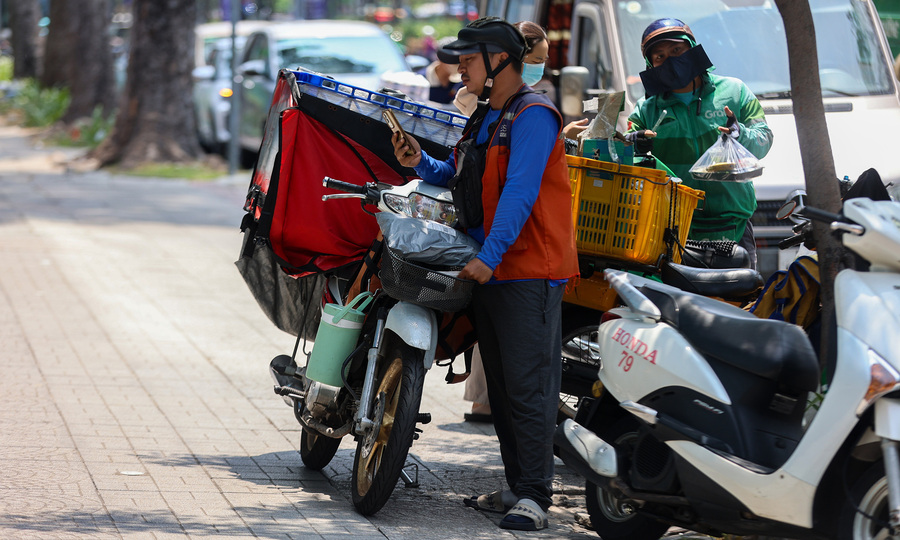
Delivery workers stand in the shade, waiting for customers in Ho Chi Minh City, April 2026. Photo by VnExpress/Quynh Tran
Gaps in social protection
The study highlights significant gaps in the current social safety net. More than 41% of surveyed outdoor workers stated they had never received any form of assistance. Those who did receive support primarily accessed short-term emergency relief rather than preventive or long-term protective policies.
Experts are recommending the development of dedicated infrastructure to support outdoor laborers. This includes establishing public cooling centers at the commune and ward levels, installing accessible drinking water stations, and creating "Water–Rest–Shade" zones.
The researchers suggest funding these initiatives through public, private, or public-private partnerships. They also advocate for developing community-supported "heat-friendly cooling centers," integrating these safe zones into broader urban planning, and expanding urban green spaces to mitigate the heat island effect.
The report calls for the implementation of stronger heat-wave warning systems, temperature-threshold response protocols, and the immediate expansion of formal social protection mechanisms to cover the informal workforce.
View original source — VnExpress ↗
Related stories

The Punch
NewsJun 23, 2026 · 1 min
Military rescues 47 ISWAP captives in Borno
The Punch
The Punch
SportsJun 23, 2026 · 1 min
Haaland scores twice as Norway beat Senegal to reach last 32
The Punch
The Punch
SportsJun 23, 2026 · 1 min
World Cup: Mbappe scores twice as France beat Iraq 3-0
The Punch

ESPN
SportsJun 23, 2026 · 1 min
Haaland is on a collision course with Mbappé, and ...
ESPN