CNA
Erosion of major-power deterrence could spur adventurism, make world more dangerous: Chan Chun Sing
Singapore
"The impulse to resort to force to resolve disputes reflects a worrying trend of breakdown in diplomacy," says Singapore's defence minister at the Middle East Institute's annual conference.
New: You can now listen to articles.
This audio is generated by an AI tool.
23 Jun 2026 01:08PM
(Updated: 23 Jun 2026 02:33PM)
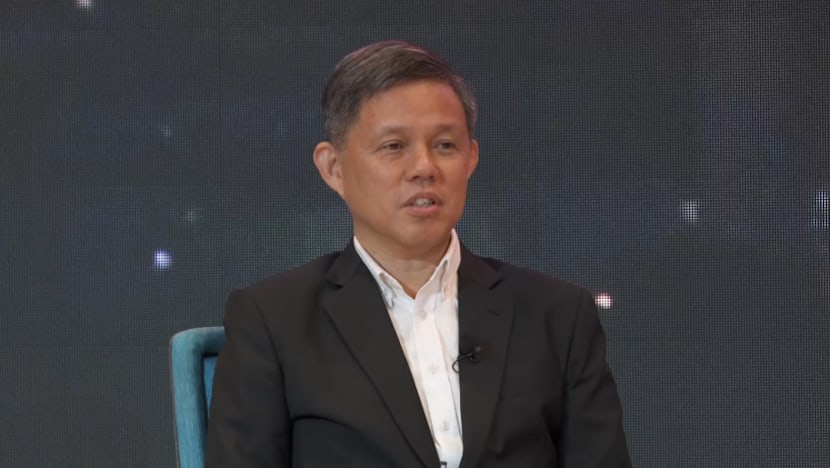
SINGAPORE: The erosion of strategic deterrence by major powers could encourage greater adventurism by states and non-state actors, creating a more dangerous and challenging world, Defence Minister Chan Chun Sing said on Tuesday (Jun 23).
"For decades, the international rules-based order was undergirded by major powers projecting their power and influence for the common good," said Mr Chan at the Middle East Institute's annual conference.
"However, in the recent conflicts including the ones in the Middle East, supposedly weaker actors have shown that they can hold up conventionally stronger ones through the use of asymmetric warfare, including new, affordable, and scalable technologies such as armed drones."
The world has also seen the weaponisation of economic supply chains, and even of geography, to "hold the world to ransom".
Many states and non-state actors, including those outside the Middle East, will be watching and taking note," he added.
"Those who seek to capitalise on uncertainty to foment further instability and disruption to achieve their own objectives will certainly be cheered."
Such a transition is dangerous and challenging for everyone, he added.
The recent conflicts raise broader questions about the justification for war and the thresholds for initiating one, he said.
"The impulse to resort to force to resolve disputes reflects a worrying trend of breakdown in diplomacy.
"If the world moves towards a fractured global order where might increasingly becomes right, the remnants of the rules-based order could be further eroded – to all our detriment.
"All states will pay the price, even those who have done the least to cause it."
UPDATING UNCLOS
Mr Chan also stressed the importance of preserving international law, particularly the United Nations Convention on the Law of the Sea (UNCLOS), amid concerns over disruptions to vital maritime chokepoints such as the Strait of Hormuz.
"Keeping our sea lanes open is not simply a matter of principle or adherence to international law. It is in the enlightened self-interest of all stakeholders to do so, given that these waterways carry critical flows of trade, energy, and data," he said.
During the question-and-answer session, Mr Chan was asked if UNCLOS should be updated.
He replied that it should be updated to address developments that did not exist when the convention was negotiated in the 1970s and 1980s.
"The critical waterways in the world today don't just carry trade, they also carry electrons and data," he said, pointing to the growing importance of undersea cables that carry digital communications and electricity.
He highlighted Singapore's efforts at the recent Shangri-La Dialogue to bring together like-minded countries to strengthen protections for critical underwater infrastructure.
Mr Chan said countries needed clearer rules governing the building, maintenance and protection of such systems, noting that an attack on one part of a network could affect users.
Responding to another question about the Strait of Hormuz and international law, Mr Chan said UNCLOS was founded on a balance of rights and obligations.
While littoral states have certain rights over where their territorial waters and exclusive economic zones go up to, they also have an obligation to allow safe passage through critical straits, he said.
"If you say that this is my right, and you forget that this is also my obligations, then we are back to the pre-UNCLOS days, and I think we will be all worse off," added the minister.
DANGERS OF MISREADING INTENTIONS
Asked what the evolving Middle East situation meant for Singapore, whether the United States remained a reliable security partner and how China might respond, Mr Chan cautioned against jumping to "certain short-term" conclusions.
He said it was for historians to decide whether the US had lost credibility through recent events.
Mr Chan reiterated that Singapore has always believed in taking responsibility for its own defence rather than assuming others would come to its aid.
“In Singapore, we never make the assumption that somebody will come and save our skin if anything goes wrong,” he said.
“We believe that if we want to be the masters of our destiny, we have to take responsibility for it, and that's why we consistently invest in our defence, and will continue to do so – not just in terms of budget, but in terms of the allocation of manpower, talent, and time from our entire population."
More broadly, however, he said the greatest danger in international security is not simply a question of military might.
"The biggest danger in the world of security is not just about capabilities. It's about intentions, and whether people read the intentions correctly," he said.
"Sometimes nothing might have changed, but because perception has changed, and people think that A or B has become less effective, then people change their calculations, and that becomes dangerous."
He added: "When the world is in flux and people are not clear about each other's intention, it is a dangerous world, or people miscalculate each other's intention and/or capabilities, it is a dangerous world."
Source: CNA/vl
Related stories

RNZ
PoliticsJun 23, 2026 · 1 min
Left bloc leads in latest poll despite Labour slump
RNZ

TASS
PoliticsJun 23, 2026 · 1 min
Russian Guardsmen destroy two Ukrainian army’s relay stations in Kharkov area
TASS
The Guardian
PoliticsJun 23, 2026 · 1 min
Jim Chalmers accuses Angus Taylor of trying to ‘out-One Nation One Nation’ – video
The Guardian

Stuff
PoliticsJun 23, 2026 · 1 min
Coalition out in new poll, Opportunity nudging so close to 5%
Stuff