Indian Express
Indian Express··6 min read
79 to 100: How Delhi student’s board exam results jumped after CBSE re-check
4 min readNew DelhiJun 23, 2026 01:03 PM IST
This year saw an unprecedented volume of post-result requests.
For weeks, 17-year-old Kushal Jain believed he had underperformed in Chemistry. The student from Dwarka in Delhi had scored 97 in Physics and 97 in Mathematics in the CBSE Class XII Board examinations. But his Chemistry score was 79 — a result he found difficult to accept considering his performance through the year.
“I had expected above 95,” he said. “When the results were declared, I assumed there had been a mistake.”
When the outcome of CBSE’s post-result verification process arrived this week, it revealed just how large that mistake may have been.
Kushal’s Chemistry marks had jumped from 79 to 100.
The revision transformed his Physics-Chemistry-Mathematics (PCM) aggregate from 91% to 98%, a seven-percentage-point increase that he described as “massive”. “The 7% margin is very massive,” he told The Indian Express.
Glitches left students in limbo
His case is one of several that have emerged from CBSE’s first year of On-Screen Marking (OSM), a digital evaluation system introduced across Class 12 board examinations with the promise of reducing human error and improving efficiency.
Instead, several issues were flagged. Many students questioned discrepancies they observed after obtaining scanned copies of answer books. Some even wondered whether the scripts uploaded to them belonged to them. Principals, evaluators and senior teachers who spoke to The Indian Express had alleged that the rollout was rushed, inadequately tested and difficult for many evaluators to navigate.
Kushal said after the Class 12 results were declared on May 13, he tried accessing his evaluated answer book through CBSE’s portal. But the platform malfunctioned, he said, while deadlines for obtaining answer scripts and applying for re-evaluation were repeatedly extended.
Story continues below this ad
On May 29, CBSE announced that its Post-Result Activities portal would become operational only from June 1, saying additional time was needed to ensure a “transparent and glitch-free process” and maintain the “highest standards and protocols of evaluation”.
Students worried that the delays were colliding with college admission timelines.
“The registration for Joint Admission Counselling (JAC) Delhi was to close on June 9. My counselling was supposed to start on June 2. CBSE kept extending the dates and students were stuck in limbo,” Kushal had said at the time
The revised marks ultimately did not affect his immediate admission prospects, as he is pursuing engineering admissions through JEE Main rankings and hopes to secure a seat in a government institution in Delhi.
Story continues below this ad
But he said the change underscored how significantly an evaluation error could alter a student’s academic record.
“If I wanted admission in a private university, my PCM aggregate would matter a lot,” he said. “For higher studies later, whether MTech or MBA, these marks could matter.”
Record re-evaluation rush
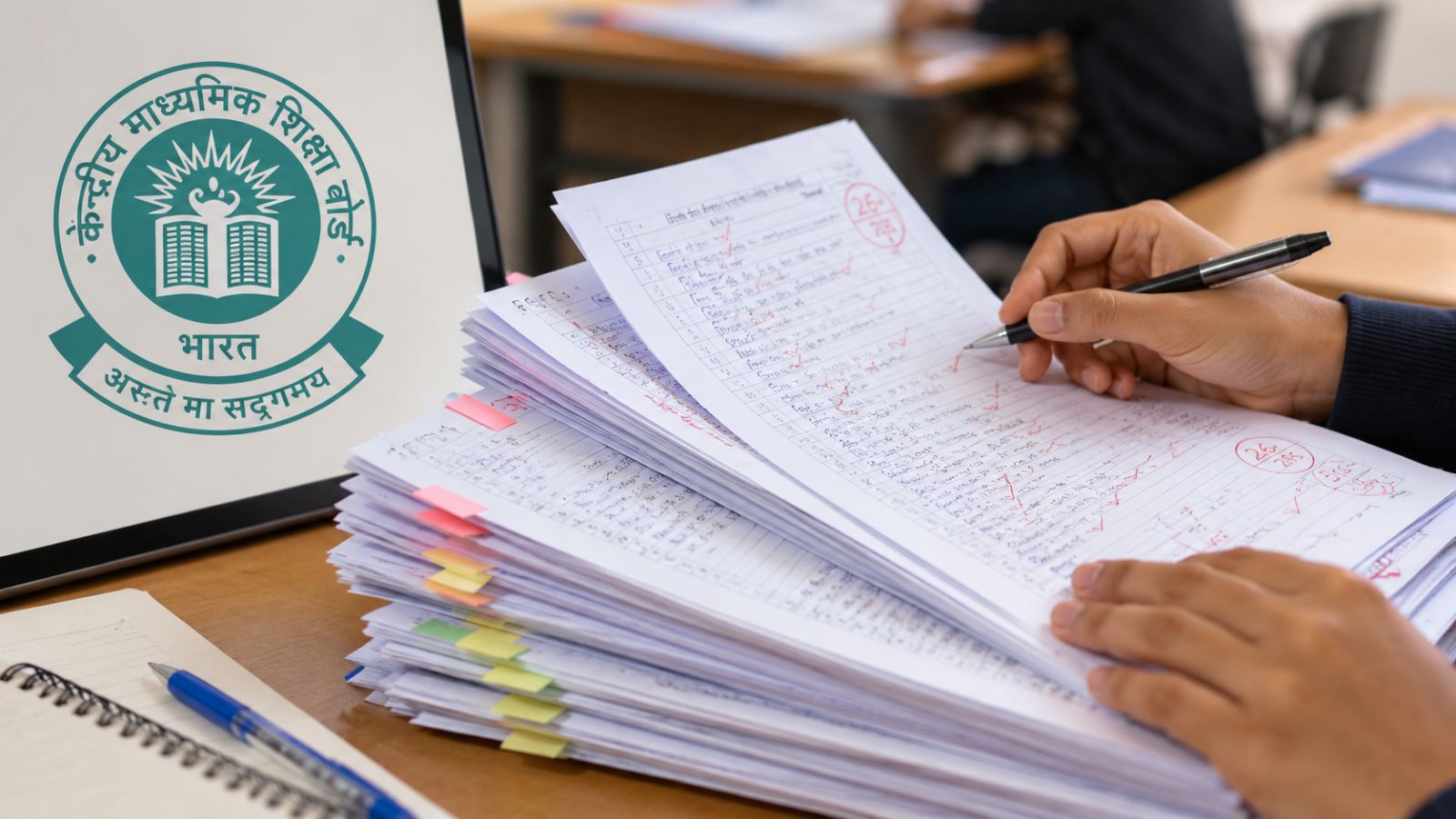
This year saw an unprecedented volume of post-result requests. More than 4 lakh students applied for over 11 lakh scanned copies of answer books after results were declared. Over 1.60 lakh students subsequently sought verification of marks or re-evaluation covering more than 3.80 lakh answer books.
On Sunday, CBSE announced the outcomes of post-result services for nearly 1.47 lakh students, about 87% of the approximately 1.68 lakh candidates who had applied for verification and re-evaluation. Revised marksheets are being issued through DigiLocker, while remaining cases will be processed in phases.
Story continues below this ad
Students whose applications show “no change” will be allowed to inspect their answer books at regional offices, with schedules to be announced separately.
The CBSE has maintained that the process was conducted under the supervision of technical experts from the Digital India Corporation, IIT Kanpur and IIT Madras to safeguard the integrity of the system and prevent unauthorised access.
Among classmates and fellow applicants of Kushal, he said, most revisions he has heard about involved three to five additional marks.
“As far as I know, most students saw an increase of three or five marks,” he said. “Only I had such a huge gap.”
© The Indian Express Pvt Ltd
Vidheesha Kuntamalla is a Senior Correspondent at The Indian Express, based in New Delhi. She is known for her investigative reporting on higher education policy, international student immigration, and academic freedom on university campuses. Her work consistently connects policy decisions with lived realities, foregrounding how administrative actions, political pressure, and global shifts affect students, faculty, and institutions.
Professional Profile
Core Beat: Vidheesha covers education in Delhi and nationally, reporting on major public institutions including the University of Delhi (DU), Jawaharlal Nehru University (JNU), Jamia Millia Islamia, the IITs, and the IIMs. She also reports extensively on private and government schools in the National Capital Region.
Prior to joining The Indian Express, she worked as a freelance journalist in Telangana and Andhra Pradesh for over a year, covering politics, rural issues, women-centric issues, and social justice.
Specialisation: She has developed a strong niche in reporting on the Indian student diaspora, particularly the challenges faced by Indian students and H-1B holders in the United States. Her work examines how geopolitical shifts, immigration policy changes, and campus politics impact global education mobility.
She has also reported widely on:
* Mental health crises and student suicides at IITs
* Policy responses to campus mental health
* Academic freedom and institutional clampdowns at JNU, South Asian University (SAU), and Delhi University
* Curriculum and syllabus changes under the National Education Policy
Her recent reporting has included deeply reported human stories on policy changes during the Trump administration and their consequences for Indian students and researchers in the US.
Reporting Style
Vidheesha is recognised for a human-centric approach to policy reporting, combining investigative depth with intimate storytelling. Her work often highlights the anxieties of students and faculty navigating bureaucratic uncertainty, legal precarity, and institutional pressure. She regularly works with court records, internal documents, official data, and disciplinary frameworks to expose structural challenges to academic freedom.
Recent Notable Articles (Late 2024 & 2025)
1. Express Investigation Series
JNU’s fault lines move from campus to court: University fights students and faculty (November 2025)
An Indian Express investigation found that since 2011, JNU has appeared in over 600 cases before the Delhi High Court, filed by the administration, faculty, staff, students, and contractual workers across the tenures of three Vice-Chancellors.
JNU’s legal wars with students and faculty pile up under 3 V-Cs | Rs 30-lakh fines chill campus dissent (November 2025)
The report traced how steep monetary penalties — now codified in the Chief Proctor’s Office Manual — are reshaping dissent and disciplinary action on campus.
2. International Education & Immigration
‘Free for a day. Then came ICE’: Acquitted after 43 years, Indian-origin man faces deportation — to a country he has never known (October 2025)
H-1B $100,000 entry fee explained: Who pays, who’s exempt, and what’s still unclear? (September 2025)
Khammam to Dallas, Jhansi to Seattle — audacious journeys in pursuit of the American dream after H-1B visa fee hike (September 2025)
What a proposed 15% cap on foreign admissions in the US could mean for Indian students (October 2025)
Anxiety on campus after Trump says visas of pro-Palestinian protesters will be cancelled (January 2025)
‘I couldn’t believe it’: F-1 status of some Indian students restored after US reverses abrupt visa terminations (April 2025)
3. Academic Freedom & Policy
Exclusive: South Asian University fires professor for ‘inciting students’ during stipend protests (September 2025)
Exclusive: Ministry seeks explanation from JNU V-C for skipping Centre’s meet, views absence ‘seriously’ (July 2025)
SAU rows after Noam Chomsky mentions PM Modi, Lankan scholar resigns, PhD student exits SAU
A series of five stories examining shrinking academic freedom at South Asian University after global scholar Noam Chomsky referenced Prime Minister Narendra Modi during an academic interaction, triggering administrative unease and renewed debate over political speech, surveillance, and institutional autonomy on Indian campuses.
4. Mental Health on Campuses
In post-pandemic years, counselling rooms at IITs are busier than ever; IIT-wise data shows why (August 2025)
Campus suicides: IIT-Delhi panel flags toxic competition, caste bias, burnout (April 2025)
5. Delhi Schools
These Delhi government school grads are now success stories. Here’s what worked — and what didn’t (February 2025)
‘Ma’am… may I share something?’ Growing up online and alone, why Delhi’s teens are reaching out (December 2025) ... Read More
Stay updated with the latest - Click here to follow us on Instagram
Tags:
delhi
View original source — Indian Express ↗
Related stories

The Punch
NewsJun 23, 2026 · 1 min
Police arrest officers caught extorting Rivers motorists in viral video
The Punch
The Punch
NewsJun 23, 2026 · 1 min
Nigeria records rise in gas output
The Punch
The Punch
NewsJun 23, 2026 · 1 min
Turkey arrests over 200 suspects linked to ISIS ahead of NATO summit
The Punch
The Punch
NewsJun 23, 2026 · 1 min
Petrol import bill drops from N2.3tn to under N90bn – FG
The Punch