CNA
CNA··5 min read
From giveaways to repairs, Singaporeans find ways to keep items out of landfills
Singapore
Community-led initiatives are helping Singaporeans extend the lifespan of unwanted and broken items, as more people embrace giving, reusing and repairing instead of throwing things away.
New: You can now listen to articles.
This audio is generated by an AI tool.
23 Jun 2026 03:45PM
SINGAPORE: When mother-of-two Magdalene Liaw moved to a new home, she faced a familiar dilemma: what to do with dozens of items she no longer needed.
Instead of selling them online or donating them in bulk, she chose a more personal approach. Through community platform GoodHood, she gave away nearly 50 household items to people who could use them.
“Why would I want to throw away something especially when it's working fine? It's such a waste when there are people who actually need it more,” she told CNA.
Among the items she has passed on are books, clothes, electrical appliances, printers, a washing machine and a refrigerator.
She had considered donating to organisations such as The Salvation Army but found it difficult to transport larger items to collection points.
GoodHood offered a simpler alternative – allowing users to connect directly with recipients via an app and arrange for items to be collected.
“I wanted to give back to the community, and also (prevent usable items) from reaching the landfill too quickly,” Ms Liaw said.
BRINGING BACK THE KAMPUNG SPIRIT
GoodHood was founded six years ago by Mr Nigel Teo with the aim of reviving neighbourly generosity through the sharing of pre-loved items.
“It started off with wanting to bring back the kampung spirit. One of the ways that people do that is by giving away pre-loved items,” he said.
The app quickly gained traction. One of its earliest success stories involved a woman who gave away a S$500 (US$390) juicer that was less than six months old.
“She chose to give it away (rather) than sell it … because she saw the value of community,” said Mr Teo.
“That item ended up blessing another person, (who) would then be inspired to pay it forward for others. It's a virtuous cycle.”
The platform added about 15,000 users over the past year, bringing its total user base of both gifters and beneficiaries to around 120,000.
More than 120,000 items have been listed on the platform, with over S$6 million worth of goods given away to date.
To strengthen trust and transparency, GoodHood has introduced features such as Singpass and CHAS (Community Health Assist Scheme) verification. Users can choose to prioritise recipients who are blue or orange CHAS cardholders, representing lower-income households.
“That gives people giving away items a lot more satisfaction because they know exactly who's receiving it, rather than giving to a general entity, and not being sure what happens to it,” said Mr Teo.
“The ability to directly benefit someone makes the act of giving a lot more meaningful.”
The platform is also expanding beyond the digital space. It organises community giveaway events and works with charities, volunteers and corporate partners to collect and redistribute pre-loved items.
Ms Liaw has since gone from being a user of the platform to a volunteer. She now helps out at community events, including a recent Neighbour's Day event in Bishan, where residents donated pre-loved items to those in need.
“It's rewarding,” she said. “There are actually quite a lot of people who need stuff, and we also see that there are people who are very generous as well.”
SHIFT TOWARDS REPAIR & REUSE
The rise of platforms like GoodHood comes as Singaporeans are producing less waste than they did a decade ago.
According to numbers released by the National Environment Agency last week, daily waste generated per person in 2025 was 21 per cent lower than in 2015.
Ground-up groups say more people are embracing alternatives to disposal by reusing and repairing items they already own.
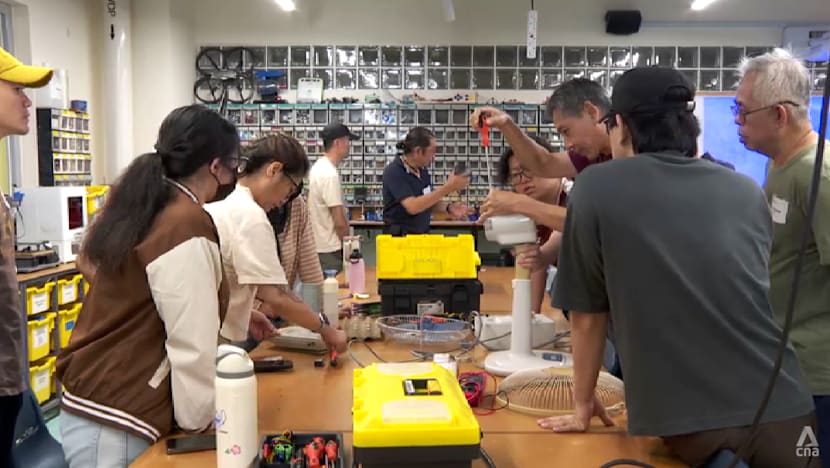
One such initiative is Repair Kopitiam, a volunteer-driven programme that helps residents repair broken household appliances instead of throwing them away.
The organisation hosts repair sessions on the last Sunday of every month at 10 locations across Singapore. Residents can bring faulty items such as fans, vacuum cleaners, blenders and kettles to be repaired with the help of volunteer repair coaches.
Interest has been growing – the number of items brought in for repair has surged by more than a third over the past two years, from about 1,700 items in 2023 to 2,329 items last year. Its repair success rate stands at 64 per cent.
Co-founder Veerappan Swaminathan said the appeal goes beyond sustainability.
“For a lot of (attendees), it's about sentimental value that they may hold to the things that they have, maybe a sense that they don't want to be wasteful,” he said.
“It may also come from a sense of trying to save some money, as Singapore has a tough economic climate. It may also come from a standpoint where they enjoy the act of problem solving.”
He believes many people would prefer to repair items before discarding them but often lack the resources to do so.
“A lot of items don't have repair services for them, like if you have a kettle or a fan that is not working. You can go to YouTube, but then discover you don't have the tools,” he said.
“What we try to do is to bring all these together – the knowledge, the tools. You need to have the equipment in order to do all these repairs.”
INCREASING INTEREST IN REPAIRS
Repair Kopitiam now has a pool of about 4,000 volunteer repair coaches. The organisation conducts training programmes three times a year, where aspiring coaches learn about electrical safety, appliance repair and mechanical troubleshooting before assisting at repair sessions.
Mr Veerappan says the most effective learning happens on the ground, where newcomers work alongside experienced volunteers.
Repair Kopitiam is also seeing growing participation from seniors, many of whom view repairs as both a hobby and a social activity.
“We have a large group of seniors who really enjoy repairing. (They see it as) more of a problem-solving activity and an opportunity to work on something purposeful with their peers and friends,” he said.
To support this interest, the organisation has a new initiative called Repair Club, which empowers seniors to run community-based repair groups within their own neighbourhoods. The programme is currently being piloted at three active ageing centres, with plans to expand further.
With more than 280 active ageing centres across Singapore, Mr Veerappan believes there is significant potential for growth.
Source: CNA/dn(mp)
Related stories

The Punch
NewsJun 23, 2026 · 1 min
Police arrest officers caught extorting Rivers motorists in viral video
The Punch
The Punch
NewsJun 23, 2026 · 1 min
Nigeria records rise in gas output
The Punch
The Punch
NewsJun 23, 2026 · 1 min
Turkey arrests over 200 suspects linked to ISIS ahead of NATO summit
The Punch
The Punch
NewsJun 23, 2026 · 1 min
Petrol import bill drops from N2.3tn to under N90bn – FG
The Punch