Times of Israel
Netanyahu can’t run the playbook he used to fight the 2015 Iran deal — and Trump knows it
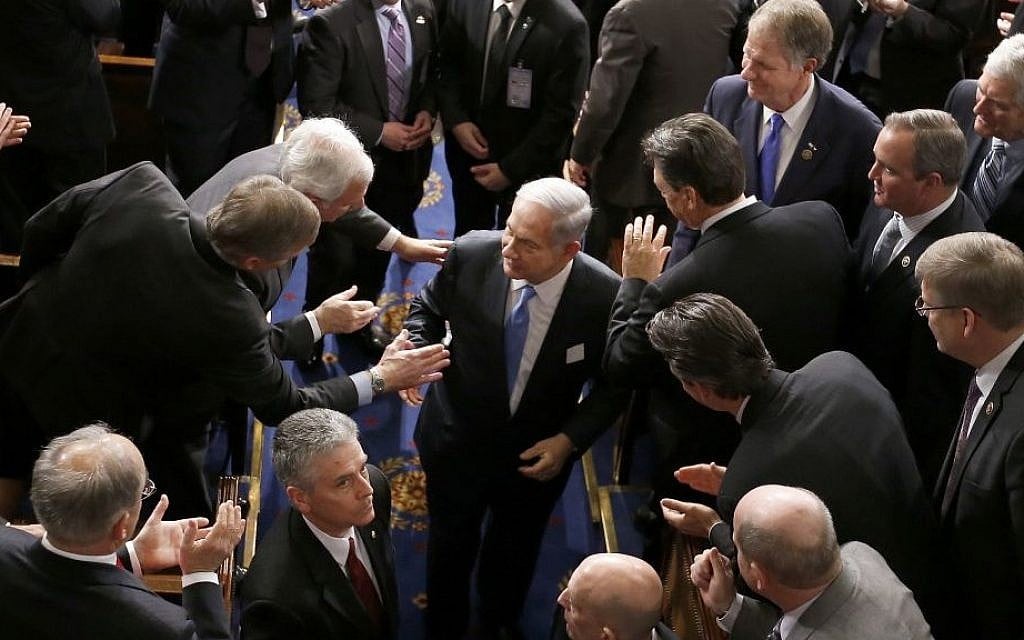
When Benjamin Netanyahu decided to address the US Congress in 2015 to mount a no-holds-barred attack on then-US president Barack Obama’s Iran nuclear deal, it alienated Democrats, energized Republicans, and put US Jews in an uncomfortable position. It also placed the prime minister on the world’s biggest stage two weeks before a bruising Israeli election.
One thing the speech didn’t do: achieve its stated goal.
Netanyahu could hardly have been more explicit: Obama’s deal to curb Iran’s nuclear program, the prime minister argued at the time, actually “paves Iran’s path to the bomb.” He implicitly compared the danger to the Holocaust, singling out Elie Wiesel in the gallery, and called on Congress to prevent the agreement from going through.
“My friends, for over a year, we’ve been told that no deal is better than a bad deal,” he said. “Well, this is a bad deal. It’s a very bad deal. We’re better off without it.”
Less than a year later, the deal did go into effect. An effort to stop it in Congress failed, despite a full-court press by the Israeli government, the Republican Party, the pro-Israel lobby AIPAC and a lineup of American Jewish organizations.
Get The Times of Israel's Daily Edition
by email and never miss our top stories
By signing up, you agree to the terms
A decade on, the Netanyahu government is again confronting an Iran deal negotiated by a US president. Again, Israeli security officials fear it because it lifts sanctions on the Islamic Republic, may leave much of its nuclear infrastructure in place, and doesn’t address other threats posed by Iran.
But this time, there’s no speech to Congress, no national campaign by Jewish groups, and the outcry from AIPAC is far more timid.
Anyone who’s surprised by that difference shouldn’t be. In 2015, Netanyahu’s campaign went as far as it did because he was somewhat popular in the United States; commanded the loyalty, if not the affection, of many US Jewish organizations; and was able to leverage a Republican-led Congress against a Democratic president. And he still failed.
This year, basically none of those conditions exist, and many of them have flipped. That’s left Netanyahu, facing an emerging agreement that many Israelis view as a grave danger, with few options to mount a robust attack. And the problem for the prime minister is that Trump knows it.
“Bibi actually went to Congress and pleaded with them, and he got nowhere,” Trump said last week at the G7 summit of global leaders. “And they had this horrible deal. It was horrible for Israel.”
At the same press conference, he quipped, “We’re the big partner, and he’s the very small partner.”
Netanyahu styles himself a keen observer of American political dynamics, but it doesn’t take a sleuth to spot the difference between how Congress responded to the 2015 deal and how it’s responding to this one.
“There is a serious threat that exists in the world, and the president last night kind of papered over it,” John Boehner, who was then the Republican speaker of the House, said in 2015 in defense of his invitation to Netanyahu. “And the fact is, there needs to be a more serious conversation in America about how serious the threat is from radical Islamic jihadists and the threat posed by Iran.”
Here’s the current Republican speaker, Mike Johnson, when asked whether he believes Trump is still committed to denying Iran nuclear weapons in the wake of the memorandum of understanding signed by Tehran and Washington: “I’m very confident,” he said. “He’s as resolute as he’s been from the beginning… His number-one condition has been that Iran cannot have a nuclear weapon.”
But the key change is an obvious difference in the political calculus. In 2015, the Iran deal was a can’t-miss opportunity for Republicans in Congress to attack a Democratic president. It didn’t hurt that at the time, 70 percent of Americans viewed Israel favorably, including majorities of both parties.
A plurality of Americans also viewed Netanyahu favorably. Inviting the prime minister gave Republicans the perfect opportunity to show how Obama was throwing a beloved ally under the bus.
But this year, the realities are starkly different. Republicans control both Congress and the White House, and it would be an understatement to say the speaker of the House isn’t likely to invite a foreign leader to the rostrum to bash a president from his own party just months ahead of crucial midterm elections.
This year, the speaker of the House isn’t likely to invite a foreign leader to the rostrum to bash a president from his own party just months ahead of crucial midterm elections.
Israel’s standing also isn’t what it once was. As of February 2026, according to Gallup, just 46% of Americans viewed Israel favorably — and that was before Israel joined the US in launching a deeply unpopular war that has jacked up prices.
Nor can Netanyahu count on the opposition party to take up his cause in the halls of Congress this time: Polls show that Israel’s ratings among Democrats have plunged underwater.
Netanyahu’s personal popularity has also tanked: In 2015, 38% of Americans liked him and 28% disliked him. Now, 52% view him unfavorably.
Jewish groups are also relatively muted in their opposition, with a few signaling that they’re waiting for US-Iran negotiations to produce a final deal before mounting a campaign, according to an extensive JTA report.
They may also be reading the tea leaves. Antisemitism is rising. Israel is getting less and less popular — and its supposed influence on US policy, along with AIPAC’s, has become the central issue in several Democratic congressional primaries.
Republicans support Trump, and Democrats oppose the war. According to a March poll by the liberal Israel lobby J Street, most US Jews do, too. Members of both parties — including the lead American negotiator, Vice President JD Vance — are publicly attacking Israel. Across that landscape, it’s hard to imagine a national Jewish advocacy campaign against a deal with Iran gaining traction.
Netanyahu, so far, has distanced himself from the deal but refrained from attacking it. That could be because he’s terrified of Trump, who hasn’t been shy about criticizing or even humiliating the premier when the mood strikes. It could be because he has tied his reputation so closely to Trump’s — and relied on the US president’s outspoken support in a brazen bid to waive his corruption trial — that an attack on the president could end up as a political suicide mission.
It’s also possible that Netanyahu is still hoping for the best. After all, Obama spearheaded the 2015 Iran deal shortly after tangling with Netanyahu over a failed bid for Israeli-Palestinian peace. Trump’s deal is coming after he led the US, for the first time ever, into a joint war with Israel against its chief adversary.
The common denominator for Netanyahu is that both deals preceded a tough Israeli election. In 2015, the speech was seen by some as an attempt to boost his campaign, which he ended up winning.
Now, it seems like Netanyahu’s best bet is, somehow, to talk about this year’s Iran deal as little as possible.
A Channel 12 poll found that 52% of Israelis feel Netanyahu’s conduct harmed Israeli interests in the US-Iran agreement. A Hebrew University survey found that 92% of Israelis say Iran won the war, and 72.5% don’t believe Netanyahu’s statements about the war’s achievements.
The level of concern in Israel about this deal is so broad and so significant that Netanyahu presumably is also alarmed. But if he does decide to broadcast that message, it’s unclear who — in the US or in Israel — will still want to listen to what he has to say.
View original source — Times of Israel ↗
Related stories

The Hill
PoliticsJun 23, 2026 · 1 min
Are you ready for JD vs. AOC?
The Hill

The Hill
PoliticsJun 23, 2026 · 1 min
Iran-US peace deal faces various threats, from Lebanon, Israel and Trump
The Hill

The Hill
PoliticsJun 23, 2026 · 1 min
Democratic socialists battle progressives in New York House primaries
The Hill

The Hill
PoliticsJun 23, 2026 · 1 min
Reflecting Pool saga becomes unwelcome distraction for Trump
The Hill