Indian Express
Indian Express··5 min read
ITBP man removed over ‘affair’ with senior’s wife gets Himachal High Court relief
6 min readNew DelhiUpdated: Jun 23, 2026 03:06 PM IST
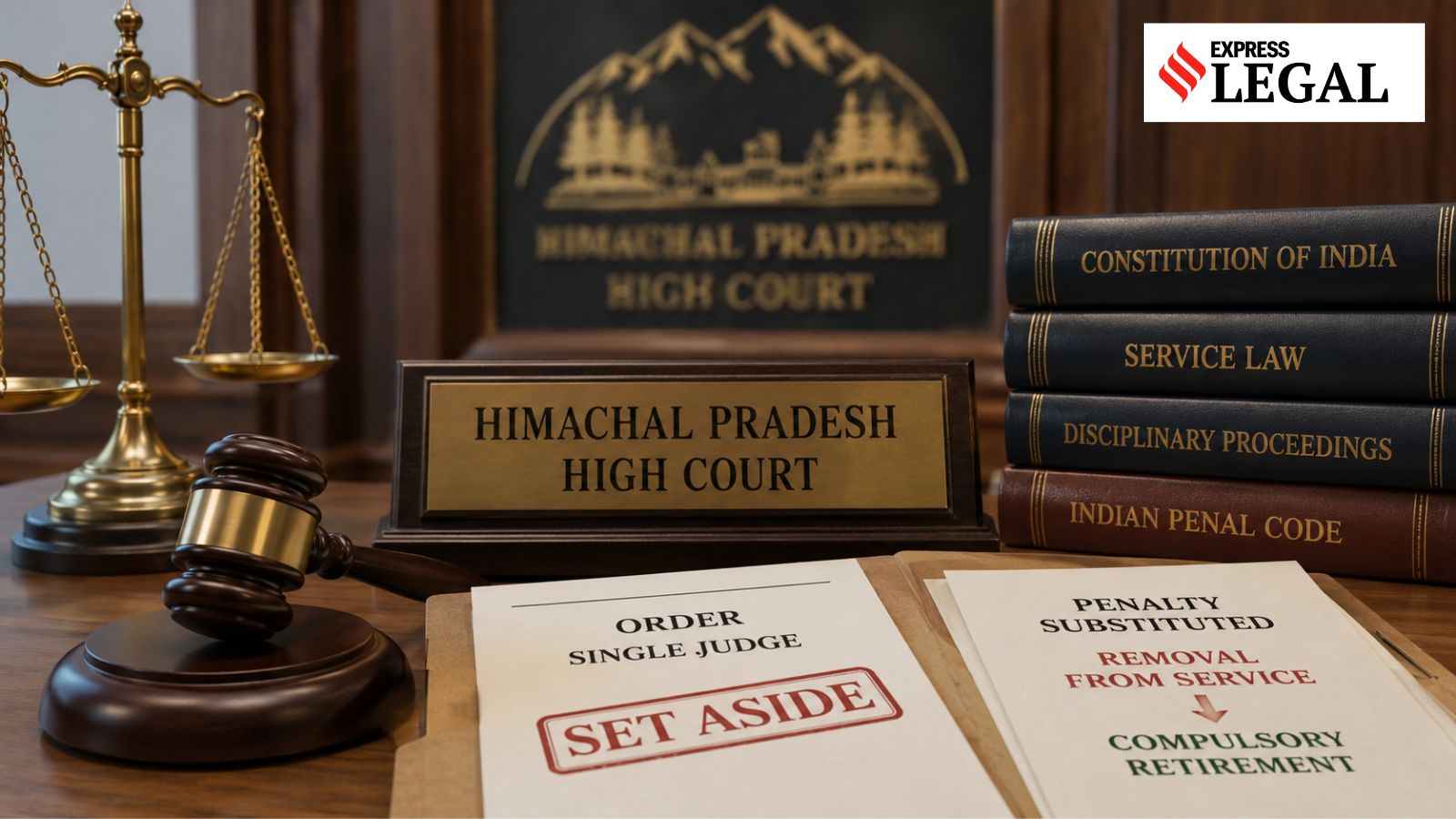
The court noted that the constable and his superior officer’s wife entered into the illicit relation at the superior’s behest, and the constable’s attempts to resist were met with threats. (AI-generated image)
The Himachal Pradesh High Court has set aside a single judge’s order and substituted an Indo-Tibetan Border Police (ITBP) constable’s removal from service with compulsory retirement, observing that he was dismissed over an illicit relationship with a superior officer’s wife, while the senior officer, who was found guilty of recording the sexual act, was awarded a much lighter penalty.
A bench of Chief Justice G S Sandhawalia and Justice Bipin Chander Negi was hearing the constable’s appeal contending that the quantum of punishment imposed on him was disproportionate as compared to that awarded to the senior officer.
“The superior officer had been held guilty of preparing the CD with the help of his laptop and forcing his junior to enter into the acts of misdemeanour; the present appellant cannot be imposed a grave punishment of removal from service. Therefore, in the given facts and circumstances, we are of the considered opinion that the order of compulsory retirement would redress the issue,” the June 19 order said.
Chief Justice G S Sandhawalia and Justice Bipin Chander Negi noted that as a member of the disciplined ITBP force, the petitioner was expected to have control over his passions.
Discipline backbone of ITBP: Court
The high court said that discipline and character are the backbone of the ITBP, and all serving in the force are expected to act and behave in a manner befitting their respective positions.
Besides, everyone serving in the force is at all times responsible for ensuring that good order and discipline are maintained.
As a member of the disciplined force, the petitioner was expected to have control over his mind and passions.
The petitioner had given an indecent burial to self-control, diligence and strength of will power, the court said.
Moreover, it highlighted that it is generally understood that acts, whether in personal or professional life, if they involve the possibility of domestic discord, have the potential to adversely impact operational efficacy, given that mental/psychological stability is the key.
It was observed that if an act of an employee reflects upon his character and integrity, the employer can legitimately raise a plea of losing confidence in the employee, warranting his non-continuance in the employment.
‘2 different punishments’
The ITBP constable was posted as a security assistant to an assistant commandant.
During this period, the constable developed a sexual relationship with the assistant commandant’s wife.
The senior officer filed for divorce, after which the wife lodged a complaint with the ITBP alleging sexual harassment and recording of the act.
Departmental proceedings were initiated, and the constable was found guilty of misconduct and violating discipline.
The constable was removed from service in 2010, and his subsequent petitions were dismissed, leading to the present appeal.
The superior officer, who was accused of forcing his wife to have a sexual relationship with the constable and recording it, was cleared of the first allegation but was found guilty of the second and was punished with forfeiture of two years’ past service for pension purposes.
Constable’s punishment ‘too harsh’
Advocate Vinod Kumar Sharma, on behalf of the constable, argued that there was a disproportion in the punishment imposed on him. The counsel contended that his removal from service was harsh, particularly given that the superior officer involved in the same case had received a lighter sentence.
Relying on precedents, the counsel said that a penalty imposed in pursuance of a disciplinary enquiry can be assailed on the ground of being disproportionate to the proven misconduct.
It was contended that in the matter of imposition of sentence, the scope for interference by the court is very limited and restricted to exceptional cases.
While examining the issue of proportionality, the court can also consider the circumstances under which the misconduct was committed, he added. The counsel submitted that in a given case, the prevailing circumstances might have forced the accused to act in a certain manner, though he had not intended to do so.
Story continues below this ad
‘Wife forced to take liquor’
The Himachal Pradesh High Court observed that while deciding the punishment, the authorities failed to properly consider the constable’s position, duties and circumstances in which the misconduct occurred.
The court said that while assessing whether a penalty is disproportionate, the court should take into account the circumstances under which the misconduct was committed, influence or pressured into acting in a particular manner.
It noted that the constable and his superior officer’s wife entered into the illicit relation at the behest of the superior officer, and attempts made by the constable to resist were shunned with the dire threat of penal action.
The court considered the fact that the wife had stated that her husband had given her liquor against her consent and forced the constable to perform illicit acts with her and made a film of the same and then threatened her with dire consequences not to reveal the same.
Story continues below this ad
In the view of the material on record, the court opined that once the superior officer had been held guilty of preparing the CD with the help of his laptop and forcing his junior to enter into the acts of misdemeanour, the present appellant cannot be imposed a grave punishment of removal from service.
Therefore, in the given facts and circumstances, the court quashed the constable’s penalty in the interest of justice and substituted by a penalty of compulsory retirement with all consequential benefits.
© IE Online Media Services Pvt Ltd
Somya Panwar works with the Legal Desk at The Indian Express, where she covers the various High Courts across the country and the Supreme Court of India. Her writing is driven by a deep interest in how law influences society, particularly in areas of gender, feminism, and women’s rights.
She is especially drawn to stories that examine questions of equality, autonomy, and social justice through the lens of the courts. Her work aims to make complex legal developments accessible, contextual, and relevant to everyday readers, with a focus on explaining what court decisions mean beyond legal jargon and how they shape public life.
Alongside reporting, she manages the social media presence for Indian Express Legal, where she designs and curates posts using her understanding of digital trends, audience behaviour, and visual communication. Combining legal insight with strategic content design, she works on building engagement and expanding the desk’s digital reach.
Somya holds a B.A. LL.B and a Master’s degree in Journalism. Before moving fully into media, she gained experience in litigation and briefly worked in corporate, giving her reporting a strong foundation. ... Read More
Tags:
Himachal Pradesh High Court
illicit relationship
ITBP
View original source — Indian Express ↗
Related stories

The Punch
BusinessJun 23, 2026 · 1 min
Taraba sanitation chair defends salary cut for street sweepers
The Punch
The Punch
NewsJun 23, 2026 · 1 min
Police arrest three over armed robbery, murder in Bauchi
The Punch
The Punch
PoliticsJun 23, 2026 · 1 min
Leave royal fathers out of politics, 10 aggrieved Kwara aspirants warn
The Punch
The Punch
NewsJun 23, 2026 · 1 min
Wiretapping: El-Rufai to file no-case submission as DSS closes case
The Punch