BBC
BBC··1 min read
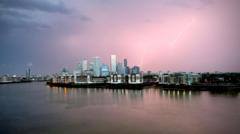
Thousands of lightning strikes light up sky across southern England
The Met Office confirmed that there were 29,000 flashes of lightning on Monday night and early on Tuesday morning in southern England.
That included lightning that went from cloud to cloud as well as the more "striking" cloud-to-ground fork lighting.
The number of lighting strikes is not particularly uncommon for storms developing after a hot and humid day, but the frequency and intensity of the lighting was spectacular.
While thunderstorms were forecast to track east across southern England last night, there is always going to be some uncertainty about the exact location of where - and how intense - they might be.
As well as lightning, very heavy rain in some areas lead to flash flooding.
The intense thunderstorms developed due to a couple of factors.
The first is that it was very warm if not hot across southern England on Monday afternoon and temperatures soared into the high 20s and low 30s.
This heat transfers into the atmosphere, giving it a lot of energy. That energy is then primed for a trigger to covert it into big cumulonimbus - thunder - clouds.
The trigger was an atmospheric disturbance higher in the atmosphere - which essentially allowed all that stored energy to be released, resulting in the intense thunderstorms.
Related stories

The Punch
NewsJun 23, 2026 · 1 min
Police arrest three over armed robbery, murder in Bauchi
The Punch
The Punch
PoliticsJun 23, 2026 · 1 min
Leave royal fathers out of politics, 10 aggrieved Kwara aspirants warn
The Punch
The Punch
NewsJun 23, 2026 · 1 min
Wiretapping: El-Rufai to file no-case submission as DSS closes case
The Punch
The Punch
BusinessJun 23, 2026 · 1 min
Baba-Ahmed disowns politician claiming PRP sold 69 forms to Kwankwaso
The Punch