Times of India
FOMO about US stock market? How Indians can invest - routes, benefits, risks & tax implications
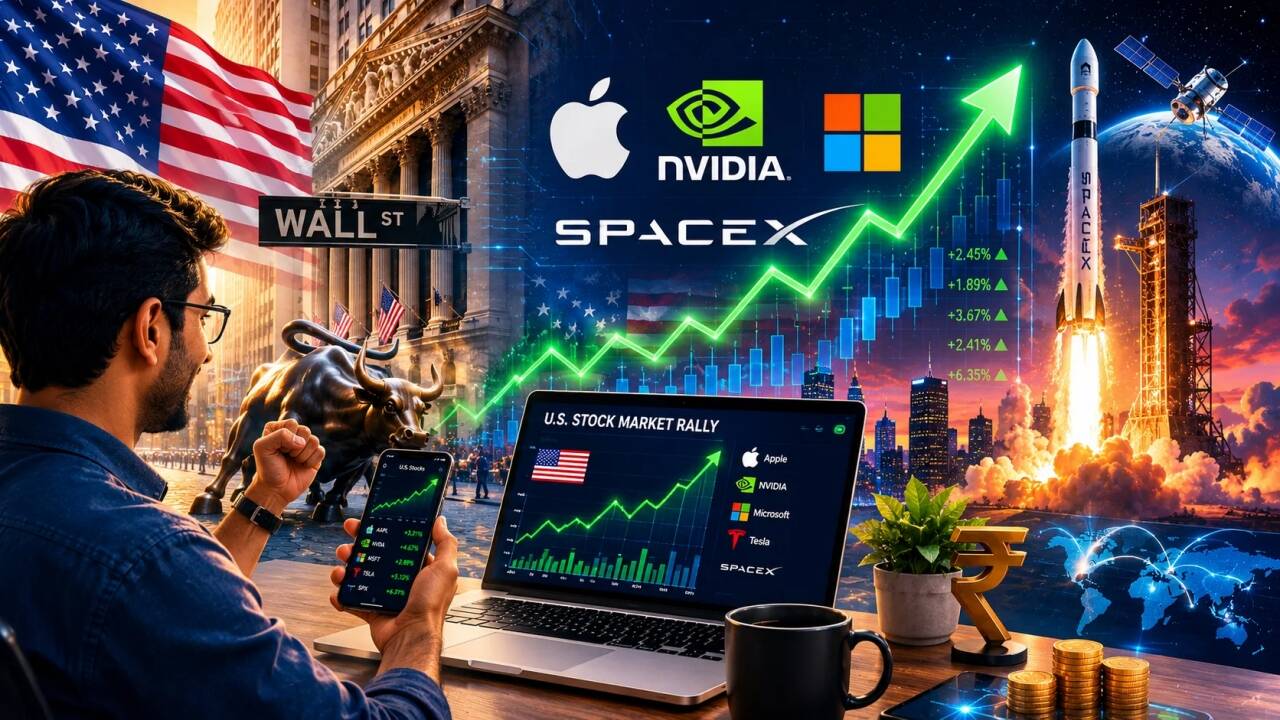
The attraction of US equities extends well beyond a handful of technology companies. (AI image)
A few weeks ago SpaceX’s listing on the US stock market made Elon Musk the world’s first trillionaire. The US stock market remains the biggest in the world, with several of its companies having over trillion dollar valuations.
In fact, the market capitalisation of the world’s most valuable company - Nvidia - is more than the market cap of India’s stock market! It’s no surprise then that Indian investors are increasingly looking to get a bite of the US stock market.But the attraction of US equities extends well beyond a handful of technology companies. For many investors, the appeal starts with the size and composition of the American market, which remains the dominant component of global equity benchmarks."The honest case for US equities starts with a simple fact of scale," Viram Shah, CEO of Vested tells TOI."India's a genuinely large, fast-growing economy but we are around 3.5% of global GDP but on a market-cap-weighted global index we're only about 2%. The US, by contrast, is roughly half the world's listed market value and close to 70% of the developed-market index."Apple, Microsoft, Nvidia and Amazon don’t trade on Indian exchanges, and for investors looking to diversify beyond the rupee and beyond Indian equities, the US market remains the deepest and most liquid in the world, says Tanvi Kanchan, Associate Director & Head - NRI Business, Anand Rathi Share and Stock Brokers Limited.
The good news: it is entirely legal for resident Indians to invest there. The fine print, however, matters as much as the access itself.Planning to invest in US stocks? There are several routes and benefits, but there are also risks and tax implications. We take a look:
How to invest in US stock market
Direct Routes:The most straightforward path is the Liberalised Remittance Scheme (LRS), under which the RBI permits each resident individual to remit up to $250,000 in a financial year for permissible capital account transactions, including overseas equity investments.
Once funds are transferred through an authorised dealer bank, they can be deployed via a US-registered brokerage account.“The most direct is opening an account with a global brokerage platform — either an Indian broker’s international tie-up or a foreign broker that accepts Indian residents — and remitting funds via an authorised bank under LRS. This gives full ownership of individual US-listed shares and the flexibility to build a custom portfolio, with fractional investing widely available so even high-priced stocks can be bought in small dollar amounts,” explains Tanvi Kanchan of Anand Rathi Share and Stock Brokers Limited.Several Indian brokerages have built this capability into their existing platforms through partnerships with US-based custodians and broker-dealers. These brokers permit clients to place orders in US-listed securities without leaving the domestic platform ecosystem.“A parallel category of purpose-built fintechs — Vested Finance, INDmoney, Stockal, and Winvesta being examples, the systems which have grown rapidly to serve this demand.
Operating within RBI and SEBI guidelines, these platforms offer fractional share investing, which meaningfully lowers the ticket size required to access high-priced US names,” says Thomas V Abraham, Research analyst at Mirae Asset ShareKhan.
Ways to invest in US markets
Indirect RoutesFor investors who prefer to stay entirely within the rupee ecosystem, domestically registered mutual funds offer an entry point. Several AMCs — Mirae Asset, Motilal Oswal, Franklin Templeton, and PGIM India among them — run schemes that invest in US equities, either directly or through Fund of Funds structures that hold global ETFs.
This route eliminates currency remittance complexity while still providing economic exposure to US markets.A newer and increasingly relevant avenue is NSE IFSC at GIFT City in Gandhinagar, where certain US stocks and ETFs are listed on the NSE International Exchange. Transactions here do not require LRS remittances, making it a structurally simpler option as the platform continues to mature.“The GIFT City route’s real advantage is operational rather than tax-related.
It removes the need to open and navigate a foreign brokerage account, deal with an unfamiliar onboarding process, or resolve disputes under a foreign legal system — everything happens through an Indian-registered broker, under IFSCA’s regulatory framework, with holdings sitting in an individual demat account that is segregated and protected even if the broker were to fail.
Transaction-level costs are also lower: GIFT City trades carry no Securities Transaction Tax, no stamp duty and no GST, unlike trades on Indian domestic exchanges,” says Tanvi Kanchan.The GIFT City route is also witnessing a rapid expansion in participation from India's largest retail brokerages.According to disclosures by the International Financial Services Centres Authority (IFSCA), Zerodha, Groww, Upstox and Angel One have secured approvals to expand international investing offerings through Gujarat's financial hub, potentially widening access to overseas equities for Indian retail investors.
Type of investor matters
Groww, Upstox and Angel One have received Global Access Provider (GAP) licences, while Zerodha has been approved as a broker-dealer. Groww and Zerodha received approvals on June 2, while Angel One secured its approval on June 12.A GAP licence holder connects directly with overseas brokers for trade execution and settlement, while broker-dealers typically route transactions through GAP-licensed entities that in turn work with overseas brokers.The approvals bring India's largest retail investing platforms into a space that was until recently largely occupied by specialist international investing players such as Vested and INDmoney, both of which already offer access to US stocks and ETFs.
How the access differs:
With direct US stocks or ETFs bought via the LRS route, the investor owns the actual US-listed share or ETF unit. This gives full control over which companies to hold and the ability to pick individual names — Nvidia, Apple, or anything else — rather than a basket.
The trade-off is that funding requires an LRS remittance, a forex conversion, and an overseas brokerage account, along with the compliance load that comes with it: Schedule FA disclosure, TCS on remittances, Form A2, and US tax forms like the W-8BEN for dividend purposes, says Tanvi Kanchan.With an Indian mutual fund or ETF that holds US exposure — for instance, a Nasdaq 100 Fund of Funds — the investor actually owns units of an Indian fund, which in turn buys the US ETF; the underlying US stock is never held directly.“This route is far more convenient operationally: it’s a pure rupee investment with no LRS, no forex paperwork, and none of the foreign-asset compliance burden, since it’s treated as a domestic Indian investment even though the underlying exposure is foreign,” she says.In short: for an investor who wants a low-maintenance, rupee-only way to get broad US index exposure, the domestic fund route wins on simplicity.
For someone comfortable with LRS formalities and wanting to hold specific stocks rather than a basket, direct investing remains the only real option.
Benefits of investing in US stock market
Experts note that investing in US stocks allows Indian investors to participate in the growth story of the world's biggest economy. This acts as a diversification and hedge.Jugal Kajaria, Tax Partner, EY India tells TOI, “Investing in US securities (stocks / ETFs) provides diversification beyond India, access to global innovators (technology, healthcare, etc), and participation in mature, high-growth sectors.
It also enhances USD exposure and long-term wealth creation potential.”“However, investors must evaluate global market volatility, tax implications, and regulatory limits (e.g., LRS cap). A balanced allocation should consider risk appetite, investment horizon, and portfolio diversification objectives,” he says.Financial planner Rohit Shah says that the benefit lies in Indian investors stepping into a different economic engine, currency zone and innovation cycle.
“The big advantage is diversification: part of your wealth sits in dollars, in another country, across sectors India doesn’t fully offer (global tech platforms, AI leaders, consumer brands, healthcare, etc.),” says Rohit Shah, financial planner.“This can cushion your portfolio if India or the rupee hits a rough patch, while giving access to unique business models and truly global companies,” he tells TOI.Investors should pay close attention to onboarding and regulatory requirements before beginning overseas investments, says Vivek Mimani, Partner at Khaitan & Co."From an onboarding standpoint, investors are required to complete KYC, PAN validation, bank verification, and FATCA/CRS declarations, along with US tax documentation, typically Form W-8BEN, prior to commencing any trading activity," Mimani tells TOI.He added that investors should account for operating costs, management fees and platform charges while evaluating expected returns.
Tax implications
While diversification benefits are there, the taxation angle cannot be ignored.The holding period threshold that determines capital gains classification for overseas equity investments is 24 months.
Gains realised within this window are treated as short-term and taxed at the investor’s applicable income tax slab rate. Gains beyond 24 months are classified as long-term and taxed at 12.5% without the benefit of indexation, following the rationalisation introduced in Union Budget 2024, explains Thomas V Abraham.
Tax implications of investing in US markets
Dividend income from US-listed stocks is subject to a withholding tax of 25–30% at source in the United States.
Under the India-US Double Taxation Avoidance Agreement (DTAA), investors can claim credit for this withholding against their Indian tax liability by filing the appropriate schedule in their ITR. Without this step, the effective tax burden is higher than necessary, he says.Investors remitting funds under LRS for purposes beyond basic travel and education — including overseas investment — are subject to Tax Collected at Source (TCS) at 20% on amounts exceeding Rs 7 lakh in a financial year.
This is a prepayment, adjustable against final tax liability at the time of ITR filing, but it represents a real cash-flow drag that can lock up capital for twelve months or more.“For investors choosing the domestic mutual fund or Fund of Funds route, the same capital gains tax structure applies, but TCS on remittances and direct dividend withholding are not relevant since the fund manages the underlying compliance,” Thomas V Abraham says.
What are the risks?
The biggest point that experts raise is this: you may be investing in one of the biggest stock markets, but risks associated with stocks and the market itself remain. It’s the geography that is changing.Rohit Shah cautions that the risks are easy to ignore. “Most investors lack the time or expertise to analyse individual US stocks or judge where we are in that market’s valuation cycle. Estate tax exposure for foreign investors is a serious but often missed risk,” he tells TOI.“There’s also a tendency to crowd into a few mega‑cap tech names, creating concentration instead of real diversification. And with talk of de‑dollarisation and shifting global power, assuming the dollar will forever be risk‑free is dangerous,” he cautions.
Don't ignore risks
“For most Indians, a modest allocation via diversified US or global funds - built gradually over time and mapped to goals and overall asset allocation - is usually wiser than sudden, large shifts or stock‑picking adventures,” he advises.Experts stress that overseas exposure should complement, rather than replace, domestic equity allocations."The benefits are real - diversification across geographies, exposure to sectors we're light on at home, and a dollar component that tends to behave differently from your rupee assets," Shah of Vested said, cautioning that investors often underestimate some of the risks associated with international investing.The Mirae Asset ShareKhan research analyst lists some risks that investors should keep in mind:US Estate Tax Exposure: Non-resident Indians are subject to US estate tax on directly held US securities above a threshold of just $60,000. For investors building meaningful positions in US stocks through direct brokerage accounts, this creates a real estate planning liability. Holding exposure through Irish-domiciled ETFs or domestic Indian mutual funds sidesteps this risk entirely.FEMA Compliance: All overseas investments must remain within the RBI’s permissible framework under FEMA. Exceeding LRS limits without specific RBI approval is a regulatory violation, not merely a technical breach.Reporting and Disclosure Obligations: Indian residents with foreign assets are required to declare them under Schedule FA in their annual ITR. Additionally, foreign account holdings must be reported under FATCA-related disclosures.
Failure to comply exposes investors to significant penalties under the Black Money (Undisclosed Foreign Income and Assets) and Imposition of Tax Act, 2015 — a statute with genuinely punitive provisions.
US market risks
Platform Continuity Risk: For newer fintech intermediaries facilitating LRS-based US investing, investors should understand that while underlying securities are legally segregated from platform balance sheets, a wind-down or regulatory action against a platform creates operational complexity in accessing those assets.
Preference for established, better-capitalised intermediaries is prudent.According to Tanvi Kanchan: a staggered allocation to the US, 10-15% of an equity portfolio, still makes sense for diversification and access to companies India doesn’t have. But anyone investing right now should go in expecting more currency and rate volatility than usual, not less, given where the Fed cycle currently stands.Finally, the bottom line to understand is this: US markets are not insulated from macroeconomic and geopolitical disruption. Like in the case of India, several economic factors that are specific to the US may lead to ups and downs.Factors such as trade policy shifts, regulatory actions targeting dominant technology platforms, and US Federal Reserve rate decisions all transmit quickly into equity valuations. As Thomas V Abraham says: Indian investors should not assume that overseas diversification eliminates risk — it changes the nature of the risk.(Disclaimer: Recommendations and views on the stock market, other asset classes or personal finance management tips given by experts are their own. These opinions do not represent the views of The Times of India.)
View original source — Times of India ↗
Related stories

TechCrunch
TechnologyJun 23, 2026 · 1 min
Meta debuts new, cheaper smart glasses under its own brand
TechCrunch

TechRadar
TechnologyJun 23, 2026 · 1 min
From research to reality: fighting industrialized financial crime
TechRadar

TechRadar
TechnologyJun 23, 2026 · 1 min
Meta investigates security concerns of internal mouse-tracking tech used to track employees and train AI
TechRadar

The Hindu
TechnologyJun 23, 2026 · 1 min
Congo’s Ebola outbreak has most cases in first month of any African outbreak, WHO says
The Hindu