VnExpress
English scores hit record high in Asia's third-largest economy
More than half of Japan's public junior high and high school seniors now meet the government's English proficiency targets, a record, the education ministry survey shows.
The share of third-year junior high students with English skills equivalent to Grade 3 or higher on the Eiken, Japan's main practical English proficiency test, reached 54.6%, while 52.4% of third-year high school students hit Grade Pre-2 or higher, according to the Ministry of Education, Culture, Sports, Science and Technology.
Kyodo News reported that both were the highest since the annual survey began in fiscal 2013, rising 2.2 percentage points for junior high and 0.8 points for high school from a year earlier, according to the suvey that count students who hold an external qualification such as the Eiken or were judged by teachers to have equivalent skills as of Dec. 1, 2025.
On the international CEFR scale used by the ministry, Grade 3 corresponds to A1, the ability to use basic everyday expressions, while Pre-2 maps to A2, handling familiar topics and exchanging simple personal information.
The Asahi Shimbun reported that despite the record, both figures remain below the government's goal of 60% by fiscal 2027, a target set under Japan's education promotion plan.
The Yomiuri Shimbun said the numbers have climbed more than 20 percentage points since the survey was first conducted in fiscal 2013.
The national averages hide a wide divide. Kyodo News reported that among prefectures and major cities, junior high students in the city of Saitama performed best at 88.9%, roughly 34 percentage points above the national average. The city's education board said it was the seventh straight survey in which Saitama topped the country.
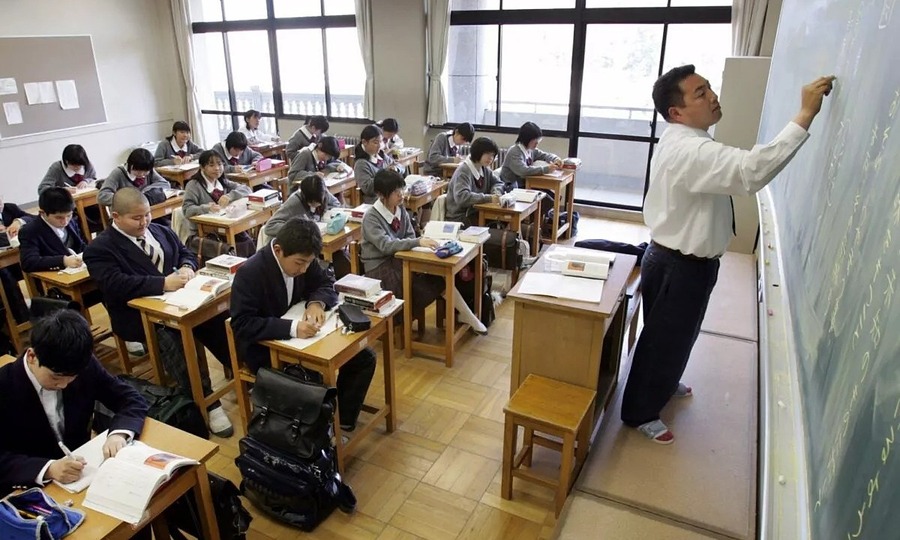
A class at a junior high school in Tochigi, north of Tokyo, Japan, April 14, 2005. Photo by Reuters
The Yomiuri Shimbun reported that the gap between the strongest and weakest regions topped 50 percentage points, and that 28 of the 67 prefectures and designated cities surveyed came in below 50% at the junior high level. It said the ministry credited Saitama's showing in part to its schools offering more English instruction than the national average.
Among the 47 prefectures, Tokyo posted the highest rate for high school students at 62.4%, according to Kyodo News, overtaking the Hokuriku-region prefectures of Fukui and Toyama that have traditionally led. The Yomiuri Shimbun reported that 21 prefectures failed to reach 50% at the high school level.
The ministry also found that 23.9% of high school seniors had reached Grade 2 or higher, up 2.7 points from the previous year.
It said students were more likely to reach higher proficiency when schools let them use English with assistant language teachers outside regular classes, such as in clubs or conversation practice, a pattern that showed a relatively strong correlation with the gains.
Japan ranks as Asia's third-largest economy, behind China and India, after India's gross domestic product overtook it, valued at about US$4.18 trillion, according to International Monetary Fund data. Japan had already slipped behind Germany globally in 2023.
Despite that economic weight, the country has long ranked low among major economies in international English proficiency surveys, and the government has made building a more globally competitive, English-capable workforce a national priority.
English became a formal subject in the upper elementary grades in 2020, and secondary classes have shifted toward running lessons mainly in English and building all four skills of reading, listening, speaking and writing.
View original source — VnExpress ↗
Related stories

Bloomberg
BusinessJun 23, 2026 · 1 min
SpaceX Loses $600 Billion in Value Over Three Days
Bloomberg

TASS
BusinessJun 23, 2026 · 1 min
Tokenization of goods in warehouses discussed with marketplaces
TASS

Bloomberg
BusinessJun 23, 2026 · 1 min
Supreme Court Puts New Curbs on Human-Rights Suits in Cisco Win
Bloomberg

MarketWatch
BusinessJun 23, 2026 · 1 min
Sons, brothers and husbands. More men are now caregivers for aging relatives.
MarketWatch