Indian Express
UPSC Key: Kheer Bhawani Mela, Right to Walk and Fire Safety in India
15 killed in Lucknow building fire; owners among three held
Syllabus:
Preliminary Examination: Current events of national and international importance.
Mains Examination: General Studies III: Disaster and disaster management
What’s the ongoing story: At least 15 people were killed after a massive fire tore through a three-storey commercial building in Lucknow’s upscale Aliganj area on Monday afternoon. While a pet shop was on the ground floor, the second floor, which bore the brunt of the blaze, housed Head Hopper Studios, a company involved in 3D art production and game development. Most of the victims worked there.
Key Points to Ponder:
• Lucknow building fire tragedy-Know the Story so far
• Lucknow building fire tragedy– Know the Causes of Fire Accidents in India
• Facts and Data’s given on Fire Safety in India by Ministry of Home Affairs, National Crime Records Bureau (NCRB) and India Risk Surveys-Know the facts
• Fire Services is a State subject or Concurrent Subject or Union Subject?
• What is the key to fire safety?
• National Building Code (NBC) of India, 2016 and Fire and Life Safety-Know the provisions
• Ministry of Urban Development, Model Building by Laws 2016 and Fire Safety-Connect the dot
• What National Disaster Management Authority (NDMA) says on Fire and Fire Safety?
• Supreme Court of India’s Guidelines on Fire Safety-Know in Detail
• Why are fire accidents emerging as a major urban governance challenge in India?
Key Takeaways:
• The fire department first received information about the blaze at the building on Usha Mehta Marg, under the Aliganj police station limits, around 3 pm, officials said. A fire department official said 14 fire tenders, including a hydraulic platform vehicle, were pressed into service.
• According to officials, firefighters had no way to enter the building since the only way in was engulfed in flames and smoke, and they had to break a side wall after reaching the terrace of the adjoining house to begin the rescue operation. It took another hour for constables to use sledgehammers to make two holes in the wall to enter the building. The families of several victims told The Indian Express that precious minutes were lost in the process.
• The only entrance to the building was a narrow staircase, which also served as the sole exit. There was no emergency exit on any floor, and no ventilation was found in any of the halls or rooms, officials said.
• The biggest trap for the victims was that entry to the studios was through biometric access, which got locked after the fire broke out, officials and the relatives of some of the victims said. There was also a lock on the terrace door.
Do You Know:
• According to a recent working paper by the PM-EAC, India’s “hidden urbanisation” phenomenon has meant that far more Indians live in urban clusters than most estimates suggest; going by the satellite data from the Global Human Settlements Layer, India was already 63 per cent urban in 2015.
• According to global standards, India would need about one firefighter for every 1,000 people to ensure adequate coverage. Given India’s population of 1.4 billion, this translates to approximately 1.8 million firefighters. However, the current number of firefighters in India is only around 3,00,000, meaning we are falling short by about 1.5 million firefighters — a staggering gap. On average, each state is short by 14,382 firefighters, and states like Uttar Pradesh, Bihar, and Maharashtra are facing the worst deficits.
• In addition to firefighters, a set of sophisticated fire-fighting equipment is essential to minimise large-scale loss of life and property. Fire trucks and equipment are the tools firefighters need to do their jobs, but even here, the numbers are shockingly inadequate. Uttar Pradesh needs 4,155 more fire trucks, making it the worst-hit state once again. Bihar (2,775 trucks short) and Maharashtra (2,640 trucks short) also face massive shortages. On average, each state is short by 707 fire trucks, indicating that, even when firefighters are available, they often lack the vehicles and tools needed to respond swiftly.
• A fire station is the central hub for firefighters — a trained force is stationed on high alert to respond fast in case a fire breaks out. But India doesn’t have enough of these either. Maharashtra is missing 917 fire stations, the highest in the country, followed by states like Rajasthan (748) and Bihar (543), which also face significant gaps. On average, every state is short by 144 fire stations.
Other Important Articles Covering the same topic:
📍In India, fire safety remains elusive. Why – and how to fix this?
Previous year UPSC Main Question Covering similar theme:
📍Discuss the recent measures initiated in disaster management by the Government of India departing from the earlier reactive approach. (UPSC, GS3, 2020)
Goyal-Greer talks start today, trade surplus with US down over 40%
Syllabus:
Preliminary Examination: Current events of national and international importance.
Mains Examination: General Studies II: Bilateral, regional and global groupings and agreements involving India and/or affecting India’s interests.
What’s the ongoing story: While Commerce Minister Piyush Goyal is scheduled to begin the two-day talks with United States Trade Representative Jamieson Greer to conclude a trade deal by next month, data shows that India’s trade surplus with the US has slipped by over 40% since the negotiations began last year, following Prime Minister Narendra Modi’s meeting with US President Donald Trump on February 13, 2025.
Key Points to Ponder:
• India-US Trade Deal-What you know so far?
• What is reciprocal tariff?
• Section 301 tariffs-what you understand by the same?
• What you know about ‘Non-tariff barriers’ and ‘Section 232 tariffs’?
• What is the difference between Section 301 and 232 tariffs?
• The United States has implemented final punitive tariffs on India under Section 301-True or False?
• What is meant by import duty?
• What is the role of import duties in managing trade relations?
• Why US targeted India over “structural excess capacity and production”?
• India-US tariff -know the background
• Know the impact of tariff disputes on bilateral trade relations
Key Takeaways:
• The high-level talks come as the US is set to complete its Section 301 investigation by next month and come out with a new tariff architecture, which could act as an alternative to reciprocal tariffs. After over a year of trade tension between India and the US, government officials said Goyal and Greer are expected to give “the final touch” to the first tranche of the trade agreement.
• Meanwhile, data released by the Commerce and Industry Ministry showed that India’s export surplus slipped over 40% to $2.94 billion in May this year, from $5.02 billion in May 2025. Data suggests that India’s surplus has been declining in multiple categories beyond energy.
• Ahead of Greer’s visit, several farm groups have reiterated that the US has one of the largest farm subsidy programmes, and the government should stick to its stance in the World Trade Organisation (WTO) and refrain from commitment on farm imports, which could hurt the interests of apple, almond, walnut, soybean, cotton and rubber growers.
• The fears of higher imports from the US come as India’s export surplus is already declining due to various concessions that India agreed to during the negotiations. Right before Modi’s visit to the US last year, India reduced duty on American bourbon whiskey and slashed tariff on Harley-Davidson motorcycles.
• Last November, Indian public sector refiners also signed a one-year deal for American liquefied petroleum gas (LPG) imports, marking the first structured contract of US LPG for the domestic market. The deal stated that India would import around 2.2 million tonnes per annum (MTPA) of LPG from the US, which is close to 10% of India’s annual imports. Amid disruption in LNG imports from West Asia, US turned into India’s top source for LNG in May, as per data shared by commodity market analytics firm Kpler.
Source: Commerce and Industry Ministry
• A push for higher imports from the US came as India, for the better part of 2025, was bargaining to get lower tariff rates. However, the US imposed 50% duty for months until the US Supreme Court declared it illegal in February this year.
Do You Know:
• Data showed that several Indian exports have been declining in the same categories where US imports are on the rise, signalling potential competition. Government officials have claimed that US goods are not price-competitive as compared to Indian manufacturers.
• The most sensitive element in the US-India trade dynamics continues to be agriculture trade. Modi, during his Independence Day speech last year, had said that India would not compromise on the well-being of its farmers, fisherfolk, and cattle-keepers.
• India was one of the worst hit by tariffs that resulted in a flight of foreign investment and resulted in steep depreciation of the domestic currency. The rupee has fallen almost 12% in the last one year. A formal trade deal remained aloof for months as the US demanded that India wind down imports of Russian oil and accept genetically-modified American agricultural products.
• The India-US joint statement of February said India will eliminate or reduce tariffs on all US industrial goods and a wide range of US food and agricultural products, including dried distillers’ grains (DDGs), red sorghum for animal feed, tree nuts, fresh and processed fruit, soybean oil, wine and spirits, and additional products.
Other Important Articles Covering the same topic:
📍From farms to factories, trade pact with the UK opens new opportunities in India
Previous year UPSC Prelims Question Covering similar theme:
1) Consider the following statements: (UPSC CSE, 2023)
Statements-I: Recently, the United States of America (USA) and the European Union (EU) have launched the ‘Trade and Technology Council’.
Statement-II: The USA and the EU claim that through this they are trying to bring technological progress and physical productivity under their control.
Which one of the following is correct in respect of the above statements?
(a) Both Statement-I and Statement-II are correct and Statement-II is the correct explanation for Statement-I
(b) Both Statement-I and Statement-II are correct and Statement-II is not the correct explanation for Statement-I
(c) Statement-I is correct but Statement-II is incorrect
(d) Statement-I is incorrect but Statement-II is correct
Previous year UPSC Mains Question Covering similar theme:
📍‘What introduces friction into the ties between India and the United States is that Washington is still unable to find for India a position in its global strategy, which would satisfy India’s National self-esteem and ambitions’. Explain with suitable examples. (2019)
The Second Page
Kashmiri Pandits visit Kheer Bhawani temple for mela, welcomed by residents, leaders
Syllabus:
Preliminary Examination: Current events of national and international importance
Mains Examination: General Studies I: Indian culture will cover the salient aspects of Art Forms, literature and Architecture from ancient to modern times.
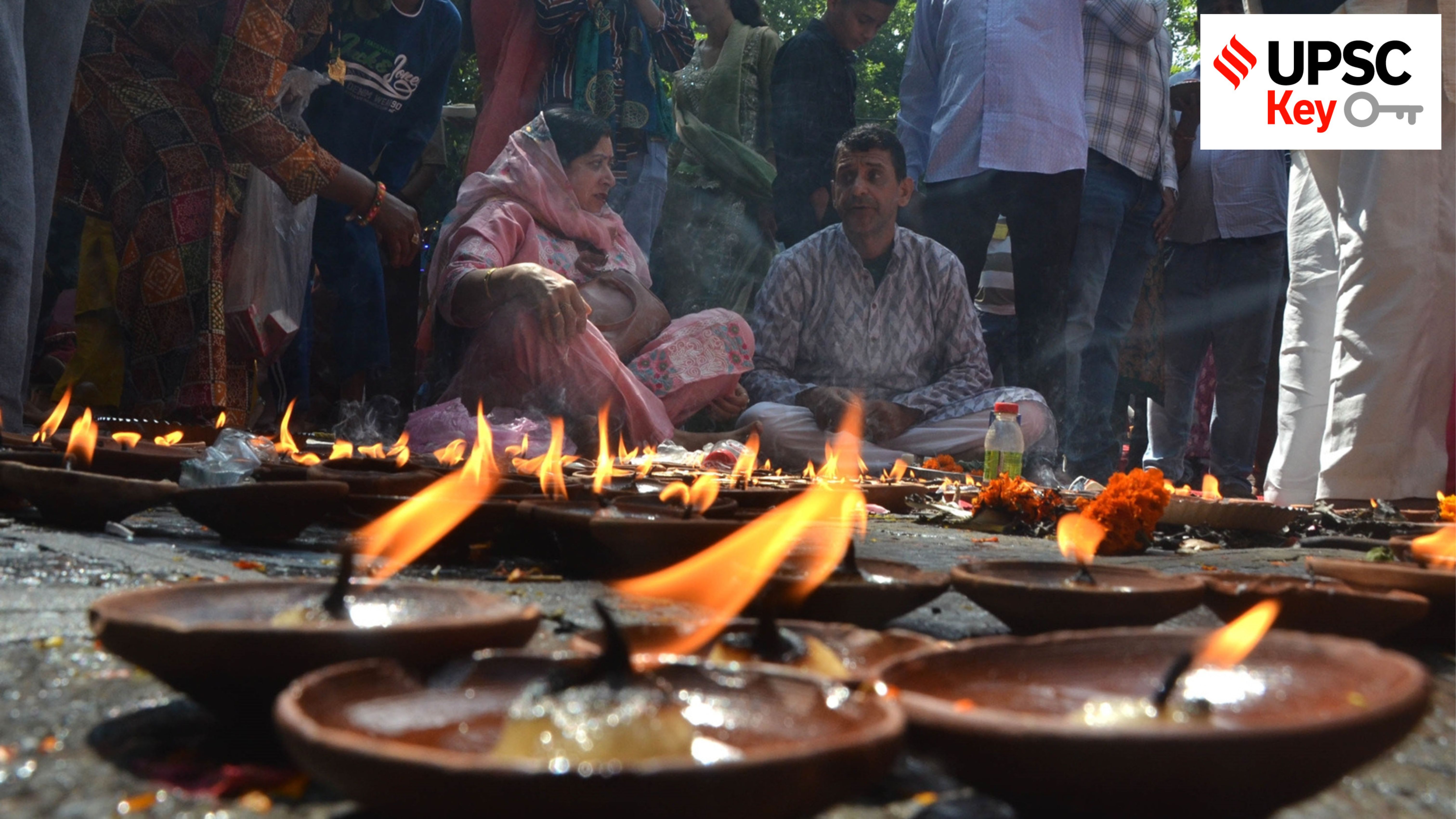
What’s the ongoing story: Thousands of people belonging to the Kashmiri Pandit community from different parts of the country assembled at Tulmulla, around 30 km from Srinagar, on Sunday to celebrate Zyeshtha Ashtami and take part in the Kheer Bhawani Mela.
Key Points to Ponder:
• Who are the Kashmiri Pandits?
• Map Work- Kheer Bhawani Temple, Martand Sun Temple and Shankaracharya Temple
• What is the significance of Jyeshtha Ashtami in Kashmiri Pandit traditions?
• What is the cultural importance of the Kheer Bhawani Temple?
• What is the significance of Kheer Bhawani Temple as a symbol of Kashmiri Pandit heritage?
• How do festivals and pilgrimage traditions contribute to preservation of India’s cultural diversity?
• Know the contribution of Kashmir to the development of Indian civilization, philosophy and literature.
• What is Kashmir Shaivism tradition and Sufiana Mausiqi?
• In which period Rajatarangini was written?
• Why is Rajatarangini considered unique among historical texts?
Key Takeaways:
• J&K Lt Governor Manoj Sinha and former chief minister Mehbooba Mufti visited the temple, and the Valley’s chief cleric Mirwaiz Umar Farooq greeted the Kashmiri Pandits on the occasion of Zyeshtha Ashtami.
• Tight security arrangements were in place as people poured into Tulmulla from early Monday morning and offered milk and kheer (rice pudding) to the goddess. A large number of tourists also arrived at the temple.
• The annual festival gives a rare opportunity to Kashmiri Pandits living outside the Valley to return for a few days and to pay obeisance at the sacred temple. The Kheer Bhawani Temple, dedicated to the Goddess Ragnya Devi, is one of the most sacred Hindu pilgrimage sites in Kashmir.
• Lt Governor Sinha offered prayers at the temple also interacted with the Kashmiri Pandit community. “Today, I prayed for the well-being, peace and prosperity of all. May the blessings of Mata Kheer Bhawani be upon everyone. This year, the number of devotees visiting the holy shrine is higher compared to previous years,” Sinha told reporters.
• Extending greetings on the occasion, J&K Chief Minister Omar Abdullah, who visited the temple a couple of days earlier, expressed hope that the festival would “further strengthen the bonds of harmony, brotherhood and rich composite cultural heritage of Jammu and Kashmir”.
• Former chief minister and People’s Democratic Party (PDP) president Mehbooba Mufti visited the temple on Monday and said, “I am happy that they (Kashmiri Pandits) are coming and that the people here are giving them a warm welcome.”
Do You Know:
• Zyeth Atham (Jyeshtha Ashtami), observed on the eighth day of Shukla Paksha (the waxing phase of the moon) in the Hindu month of Jyeshtha (May–June), which fell on June 3, holds profound importance for the Kashmiri Pandit community. On this day, devotees honour Goddess Ragnya Devi, also known as Kheer Bhawani, at her temple in Tulmulla, in the Ganderbal district of Jammu and Kashmir.
• The temple derives its distinctive name from kheer—a rice and milk pudding—which is offered to the goddess as the principal prasad. The Kashmiri Pandit community reveres Goddess Kheer Bhawani, an incarnation of Mata Durga, as their Kuldevi (family deity).
Tulmulla is approximately 25 kilometers northeast of Srinagar. The temple, nestled amidst chinar trees and built over a sacred spring, finds mention in numerous ancient texts, including Kashmiri historian Kalhana’s 12th-century chronicle Rajatarangini.
• “Mention of this place is made in the last chapter of the Ragnya Pradurbhava which is a section of the Bhringish Samhita,” writes Kashmiri educationist and ornithologist Samsar Chand Kaul in his book ‘The Mysterious Spring of Khir Bhawani’.
• The shrine features a hexagonal spring surrounding a marble temple that houses the idol of the presiding deity. The current marble structure was constructed by Dogra ruler Maharaja Pratap Singh in the early 20th century and was later renovated by Maharaja Hari Singh.
• According to a legend, Ragnya Devi was once worshipped in Lanka by King Ravana. Displeased with his tyranny, she left Lanka and, with the assistance of Lord Hanuman, relocated to Kashmir, choosing Tulmulla as her abode. “…the goddess, wrathful at Ravana’s misdeeds, cursed him and ordered Hanuman to take her to Sad Sar (Kashmir) on her vehicle along with 360 Nags.
Hanuman selected a spot in the northern side of the Valley within the space surrounded by the villages of Borus (Bhawanish), Ahatung (Tungish), Ladwun (Labdawan), Wokur (Bhageh). Here he installed the goddess with all her satellites. She was called Khirbhawani or Raji Ragyni, exclusively preferring milk, sugar, rice and all vegetarian forms of offerings,” Kaul writes.
• The mela at Kheer Bhawani Temple, managed by Jammu and Kashmir Dharmarth Trust, continues to draw thousands of devotees annually. “To mark the Ashtami, devotees perform hawan in reverence to Mata Ragnya, accompanied by rituals such as offering milk and dropping Kaand (sugar cones) into the sacred spring, scattering flowers and aromatic leaves known as Vyna Patar. The festival serves as a reunion for the Kashmiri Pandit diaspora, a reaffirmation of faith, and a symbol of resilience,” says retired IFS officer Poshkar Nath Pandit.
Other Important Articles Covering the same topic:
📍Explained: History and significance of Mela Kheerbhawani for Kashmiri Pandits, being held today
📍Jyeshtha Ashtami and the Kheer Bhawani temple: A sacred spring’s significance in Kashmiri Pandit heritage
Previous year UPSC Main Question Covering similar theme:
📍Safeguarding the Indian art heritage is the need of the moment. Discuss. (2018)
Explained
ESA for Western Ghats: Why conservation is key
Syllabus:
Preliminary Examination: General issues on Environmental ecology, Bio-diversity and Climate Change – that do not require subject specialization.
Mains Examination: General Studies III: Conservation, environmental pollution and degradation, environmental impact assessment.
What’s the ongoing story: The Western Ghats, a 1,500-km long chain of largely unbroken mountains which fringes off the western coast of India, is one of the country’s most famous natural ecosystems, next only to the Himalayas. Unlike the Himalayas, the Western Ghats are densely populated and have been an economic hub for states abutting India’s west coast, and is home to famous cash crops.
Key Points to Ponder:
• Map Work-Western Ghats (Starting point and ending point), Nilgiri Hills, Doddabetta, Anaimalai Hills, Palani Hills, Cardamom Hills, Agasthyamalai Hills.
• Where do the Western Ghats stretch from?
• Name the place where the Western and Eastern Ghats meet.
• What are the committees constituted on Western Ghats conservation?
• Why are local communities significant in the conservation and sustainable development of the Western Ghats?
• Compare the recommendations of the Gadgil and Kasturirangan Committees in the context of the Western Ghats.
• Why the Ghats need protection?
• What are the challenges posed by developmental activities such as mining, tourism, and infrastructure in the Western Ghats?
• What is an ecologically sensitive area?
• Which state has the highest number of ecologically sensitive zones in India?
• Which are the states where the areas to be demarcated as ESA?
• Who declares ecologically sensitive areas?
Key Takeaways:
• A special regime of legal protection, conservation, and sustainable development prescribed for this fragile ecosystem has been hanging fire due to objections and concerns of the six state governments — Gujarat, Maharashtra, Goa, Karnataka, Kerala, and Tamil Nadu — where the Ghats extend.
• Separate protections for the Ghats region were initially prescribed by the famous Madhav Gadgil-led expert panel, and later by a high-level working group, chaired by former Indian Space Research Organisation chief K Kasturirangan.
• It is in this backdrop of the Kasturirangan panel’s 2013 report that the Centre demarcated 56,825 sq km as ecologically sensitive area (ESA) in a draft notification. With a lack of consensus that continued till 2022, the Centre constituted a fresh expert committee with the task of re-examining the objections by the six states, keeping the Ghats’ conservation and needs of the region in mind.
• The expert committee appointed in 2022, under Sanjay Kumar, former Director General of Forests, Environment Ministry, has held several meetings with state governments, and has undertaken field visits in all states except Kerala. Sources aware of developments said that some of the fundamental issues the committee has sought to resolve are reconciliation of village-level data, names, revenue details, based on satellite imagery, and information provided by state governments.
• Kerala and Karnataka remain the two states where consensus is not any closer. Karnataka has been steadfast in its total rejection of the Kasturirangan panel recommendations. Kerala, meanwhile, has sought to reduce the earlier 9,993.7 sq km area by another 1,000 sq km or so, arguing to omit villages from Idukki due to plantation, agriculture activities, especially in Cardamom Hills.
• In Maharashtra, the state government has sought exclusion of 378 villages from the 2,133 notified in the draft notification, according to reliable sources. Sources said that the state has argued to omit villages for industries, mining, and because some villages are distant from ESAs.
Do You Know:
• The Kasturirangan panel’s report identified an area of 1,64,280 sq km, whereas the Gadgil panel identified 1,29,037 sq km as the Ghats’s extent. Compared with the Gadgil panel — which recommended that the entire area be designated as ESA with heavy cross-sectoral restrictions — the Kasturirangan panel adopted a different approach.
• Its analysis found that 60% of the Ghats region was already under “cultural landscape”, which was human dominated and where land was under settlements, plantations, or agriculture. The remaining 40% — 60,000 sq km — was classified as “natural landscape”, a high biological richness, low fragmentation, low population density, and inclusive of national parks, and tiger and elephant habitats.
• The panel proposed that this 60,000 sq km be notified as ESA along with a ban on mining, quarrying, red category polluting industries, thermal power plants, and large constructions and townships. In the past, ESAs have been notified in Dahanu, Mahabaleshwar-Panchgani, and Doon valley taking into account the area’s biological diversity and need to regulate activities.
The then United Progressive Alliance government accepted these recommendations in-principle. But on the back of concerns raised by state governments on wide restrictions on industries, it asked the six states time to submit their views before finalising the ESA boundaries in December 2013.
• Later, in March 2014, the Centre also issued a draft notification, demarcating 56,825.7 sq km as ESA. The area was reduced by over 3,000 sq km on account of Kerala’s submission, based on their own ground truthing exercise, that sought omission of several agricultural areas, orchards, horticultural plots, plantation and residential areas outside the remit of ESA.
Other Important Articles Covering the same topic:
📍Govt prepares to notify Western Ghats eco sensitive areas in at least three states
Previous year UPSC Prelims Question Covering similar theme:
2) ‘Gadgil Committee Report’ and ‘Kasturirangam Committee Report’, sometimes seen in the news, are related to (UPSC CSE, 2016)
(a) constitutional reforms
(b) Ganga Action Plan
(c) linking of rivers
(d) protection of Western Ghats
Right to walk on footpaths: Behind SC order, surge in pedestrian deaths
Syllabus:
Preliminary Examination: Indian Polity and Governance
Mains Examination: General Studies II: Indian Constitution—historical underpinnings, evolution, features, amendments, significant provisions and basic structure.
What’s the ongoing story: The Supreme Court Friday recognised walking on demarcated footpaths as a fundamental right that shall override the privilege of a motor vehicle. The court also urged the government to introduce a law to bring this right into effect.
Key Points to Ponder:
• ‘The right to walk’-under which article of the Constitution this provision comes?
• What is the meaning of pedestrians?
• What exactly Supreme Court said?
• What is the case?
• Who is the Motor Vehicles Act for?
• What is the significance of the Supreme Court’s recognition of the right to walk on footpaths as a Fundamental Right?
• What are the major causes behind rising pedestrian fatalities in India?
• What is meant by vulnerable road users?
• What is the role of urban local bodies in ensuring pedestrian-friendly infrastructure?
Key Takeaways:
• A law would be crucial to holding officials and departments accountable for addressing violations of pedestrian rights. The genesis of the case lies in the death of a 5-year-old boy who was struck by a tanker while walking to school with his father. “Who could have ever imagined that it would be the last walk with his son?” said the bench of Justices P S Narasimha and Atul S Chandurkar.
• The Supreme court struck down the order of the high court which had reduced the compensation awarded to the victim’s father by Motor Accident Claims Tribunal (MACT). On May 30, 2016, MACT had granted a compensation of Rs. 7.82 lakh with interest rate of 6% per annum from the date of the petition till realisation. This order was appealed by both the boy’s father and insurance company in the high court, which reduced the compensation to 4.70 lakh.
• The Supreme Court said that the High court committed an error in reducing the compensation granted by the MACT. The court recalculated the compensation to 11.44 lakh and said that it should be paid within two months.
• On the rights of pedestrians, the court said that the violation of the right to walk on demarcated footpaths will entitle the citizens to invoke constitutional and legal remedies apart from the remedies available in Motor vehicles act, 1988.
Do You Know:
• Pedestrians are among the most vulnerable road users in India. On the roads of almost any city in the country, people are often wary of walking even on footpaths. The little space available to pedestrians is frequently encroached upon by two-wheelers or shops.
• Pedestrian deaths in the country have more than doubled in 10 years and now account for the second highest road death share after two-wheeler fatalities.
• An Indian Express analysis shows that while total road fatalities increased by 21.24% between 2015 and 2024, pedestrian deaths surged by nearly 163%, or 2.63 times. The number of pedestrians killed in road accidents rose from 13,894 in 2015 to 36,526 in 2024. Their share in total road fatalities also more than doubled, from 9.5% to 20.61% during the period. Pedestrian fatalities continued to rise even during the Covid-19 pandemic years. (see box).
• In its judgment, the Supreme Court traced the issue back to the most basic human activity — walking. The court highlighted the irony that while walking predates wheeled transport by millennia, road infrastructure today is overwhelmingly designed for motorised vehicles. It further observed that the Motor Vehicles Act has, in many ways, impeded and undermined the rights of pedestrians.
• The court came down heavily on the Motor Vehicles Act, 1988, an exhaustive legislation governing the vehicles and rules of the road. The court said that the law is not for protecting the right to walk on footpaths and only lays down infrastructure for vehicles, which is its mainstay.
• In 2017, the Ministry of Road Transport and Highways (MoRTH) notified the Motor Vehicles (Driving) Regulations, which says that drivers should take special precautions to ensure safety of vulnerable road users such as pedestrians, cyclists, children etc.
Other Important Articles Covering the same topic:
📍Supreme Court declares right to walk on safe footpaths a fundamental right, seeks law
Previous year UPSC Main Question Covering similar theme:
📍National Urban Transport Policy (NUTP) emphasises on ‘moving people’ instead of ‘moving vehicles’. Discuss critically the success of the various strategies of the Government in this regard. (2014)
Keir Starmer steps down as British PM, leader of Labour Party: What went wrong
Syllabus:
Preliminary Examination: Current events of national and international importance
Mains Examination: General Studies II: Effect of policies and politics of developed and developing countries on India’s interests and Comparison of the Indian constitutional scheme with that of other countries.
What’s the ongoing story: Two years after routing the Conservatives, in an election that saw Labour win 412 seats, British Prime Minister Keir Starmer has resigned both as PM and leader of the Labour Party.
Key Points to Ponder:
• Why did British Prime Minister Keir Starmer resign?
• When might a new leader be selected?
• Does this mean a coronation?
• Will there be a general election?
• Is post-Brexit Britain too difficult to govern?
• What is the difference between the British Parliament and the Indian Parliament?
Key Takeaways:
• His election in 2024 had brought Labour back to power after 14 years. This kind of resounding electoral majority was last seen in 1997 when Labour had defeated John Major, the Conservative Prime Minister since 1990, by winning 328 seats under the leadership of Tony Blair.
• Although Starmer campaigned on the promise of “Change” to create a “fairer, healthier, and a more secure Britain”, he struggled to deliver on his electoral promises and fell to the same post-Brexit malady that has troubled British politics and economy for a decade now.
• Trouble began to brew in the very first 100 days, often considered the honeymoon period for new leaders, of his government when he and his other Cabinet Ministers were accused of accepting gifts and free tickets for football and concerts worth thousands of pounds.
• Dubbed as the “freebies gate”, Starmer had to face huge public backlash for his accepting of gifts resulting in his dwindling approval rating. Although he reimbursed the costs for the gifts and tickets and put in place strict donation rules, the damage was already done. Within two months of taking office, 43% of the electorate had started seeing him a bad PM. By June 15, 2026, that number had gone up to 73%.
• His attempts to strengthen the National Health Service at the cost of cutting subsidies for winter fuel to roughly 10 million pensioners, his decision to release 1,700 prisoners before the completion of their sentence, the controversy surrounding extravagant payments to Sue Gray for her service as the Chief of Staff, and promised spending cuts to the tune of approximately $8 billion for the next financial year were not received well among the public as well as party members.
• Another issue that brought him into conflict with his own party MPs was his decision to continue with the “two-child benefit cap”, a policy introduced by the Conservatives in 2017 and fiercely opposed by the Labour Party since then. The controversial policy, meant to limit child support for parents in the form of Universal Credit or Child Tax Credit only for the first two children, was hugely unpopular in Britain and was abolished by Starmer only in April this year.
Do You Know:
• Starmer’s resignation has come a day earlier when Britain will be observing ten years of its decision to exit the European Union (EU). A decade later, the mood in Britain about Brexit has significantly changed.
• Brexit supporters had mainly voted to exit the EU on issues of sovereignty, immigration and economic prosperity. Ten years down the line, Britain is still struggling. An estimated range from 2 to 8% contraction in the British gross domestic product, decreased revenue, high borrowing and tax hikes, a spectacular failure on non-EU immigration, struggling businesses, customs complications, and rampant inflation has made at least 57 % of Britons think that the UK was wrong to leave the EU.
• Although Labour opposed the Brexit referendum and supported the UK’s membership of the EU, Starmer’s position has been a UK-EU Reset without joining the bloc and thus, there was not much political space to manoeuvre especially at a time when the COVID-19 pandemic and the wars in Ukraine and Iran further impacted the already struggling British economy.
• A decade after Brexit, complex questions including trade, agriculture exports, youth mobility, border control, non-tariff barriers on British goods entering the EU, energy and other issues have continued to complicate the EU-UK Reset.
Other Important Articles Covering the same topic:
📍Knowledge Nugget | Keir Starmer’s exit: How the UK Parliamentary system differs from India’s
Previous year UPSC Main Question Covering similar theme:
📍Compare and contrast the British and Indian approaches to Parliamentary sovereignty. (2023)
Economy
‘Monsoon shortfall could weigh on growth, inflation’
Syllabus:
Preliminary Examination: Economic and Social Development
Mains Examination: General Studies III: Indian Economy and issues relating to planning, mobilization, of resources, growth, development and employment.
What’s the ongoing story: The Reserve Bank of India’s (RBI) ‘State of the Economy’ article has cautioned that an adverse south-west monsoon, if it materialises, could weigh on the domestic growth and inflation outlook.
Key Points to Ponder:
• The Reserve Bank of India’s (RBI) ‘State of the Economy’ article-what are the key takeaways?
• How Southwest Monsoon impacts the Indian economy?
• How does a monsoon shortfall affect agricultural production and rural livelihoods?
• What is the relationship between monsoon performance and food inflation?
• What is inflation targeting?
• How monsoon variability influences inflation dynamics in India?
Key Takeaways:
• As per the updated forecast of the India Meteorological Department (IMD) (released on May 29, 2026), the south-west monsoon (SWM) rainfall is likely to be below normal this year, it said. “The SWM arrived over Kerala on June 4, three days later than the normal date of onset (June 1). While the SWM has covered southern and parts of eastern regions so far, the cumulative rainfall (June 1-21) at the country level has been significantly lower than the normal,” the article authored by RBI researchers and published in the RBI monthly bulletin said.
• The reservoir position has slipped below last year. However, it remains above the decadal average, it said. “Given the good harvest last year, the public procurement of wheat has been robust. The public stock of rice and wheat with the Food Corporation of India (FCI) is well above the buffer norms which may serve as a strategic cushion against any supply disruption or spike in prices triggered by a likely El Niño weather phenomenon,” the article said.
• “Views expressed in this article are those of the authors and do not represent the views of the Reserve Bank of India,” the central bank said.
• The RBI’s Monetary Policy Committee had re-assessed both its growth and inflation projections, with risks emanating from elevated oil prices, uncertainty in global trade, adverse weather conditions and geopolitical tensions clouding the economic outlook. In its meeting held on June 5, it lowered the growth projection from 6.9% to 6.6% and hiked the inflation forecast from 4.6% to 5.1%.
• Any breakdown of the interim US-Iran peace agreement may reignite material risks in terms of inflationary expectations, disrupted critical energy infrastructure, delayed investment spending, food security concerns, adverse financial stability outlook and structurally lower growth, the article said.
Do You Know:
• The uncertainties could have an impact on the outlook through international trade, cost pressures, capital flows and commodity prices, it said. According to the article, the global economic landscape remains fragile despite some respite through the interim US-Iran peace agreement. “The Indian economy entered this turbulence with much better fundamentals relative to many other countries to sustain the shock,” it stated.
• It said India maintained a consistently high growth, anchored inflation expectations, sustained fiscal consolidation, manageable current account balance and foreign exchange buffers over the previous few years, which adds to its strength vis-à-vis similar other events in the past.
• Goods and services tax revenue growth moderated sequentially in May after recording strong growth in April. While petrol, diesel and aviation turbine fuel consumption recorded a positive growth in May, that of total petroleum products dipped due to a sharp fall in the consumption of LPG, petroleum coke and naphtha. Electricity demand clocked a double-digit growth (y-o-y) in May driven by heatwaves, it said.
• The article noted that domestic air passenger traffic rebounded year-on-year in May after three consecutive months of contraction. Meanwhile, new product launches and healthy order books accelerated growth in passenger vehicle sales, alongside rising electric vehicle penetration across all segments. Conversely, rural demand showed signs of moderation, reflected in slower retail automobile sales.
Other Important Articles Covering the same topic:
📍After war, rain: Below-average monsoon emerges as new inflation risk
Previous year UPSC Prelims Question Covering similar theme:
3) Which of the following statements is/are correct regarding the Monetary Policy Committee (MPC)? (UPSC CSE, 2017)
1. It decides the RBI’s benchmark interest rates.
2. It is a 12-member body including the Governor of RBI and is reconstituted every year.
3. It functions under the chairmanship of the Union Finance Minister.
Select the correct answer using the code given below:
(a) 1 only
(b) 1 and 2 only
(c) 3 only
(d) 2 and 3 only
4) If the RBI decides to adopt an expansionist monetary policy, which of the following would it not do? (UPSC CSE, 2020)
1. Cut and optimize the Statutory Liquidity Ratio
2. Increase the Marginal Standing Facility Rate
3. Cut the Bank Rate and Repo Rate
Select the correct answer using the code given below:
(a) 1 and 2 only
(b) 2 only
(c) 1 and 3 only
(d) 1, 2 and 3
Previous year UPSC Main Question Covering similar theme:
📍What are the causes of persistent high food inflation in India? Comment on the effectiveness of the monetary policy of the RBI to control this type of inflation. (2024)
PRELIMS ANSWER KEY
1.(c) 2.(d) 3.(a) 4.(a)
For any queries and feedback, contact [email protected]
Subscribe to our UPSC newsletter. Stay updated with the latest UPSC articles by joining our Telegram channel – IndianExpress UPSC Hub, and follow us on Instagram and X.
View original source — Indian Express ↗
Related stories

South China Morning Post
TechnologyJun 23, 2026 · 1 min
Construction stands to get an AI boost
South China Morning Post

TechRadar
TechnologyJun 23, 2026 · 1 min
I asked ChatGPT and Claude to do my grocery shopping — one felt like the future
TechRadar

TechRadar
TechnologyJun 23, 2026 · 1 min
As TechRadar's TV tester, the LG C5 OLED TV is at 'the very top of my recommended list'
TechRadar

TechRadar
TechnologyJun 23, 2026 · 1 min
Save $530 on this Dell Ryzen 7 laptop? Forget Amazon on Prime Day, check out these 5 laptops with huge price cuts
TechRadar