Times of Israel
IDF says it hit Hezbollah operatives in Lebanon, as new Jerusalem-Beirut talks begin in DC
The Israel Defense Forces said it struck armed Hezbollah operatives spotted near Israeli forces in southern Lebanon in two separate incidents on Tuesday, as Jerusalem and Beirut kicked off another round of direct talks in Washington.
In the first incident, the IDF said a cell of Hezbollah gunmen was spotted in the Ali Taher ridge area, close to Nabatieh and north of the Israeli-held security zone in southern Lebanon. It said the operatives were targeted by troops “to remove the threat.”
Lebanese media reported that Israeli fire in the area killed two and injured two in the incident.
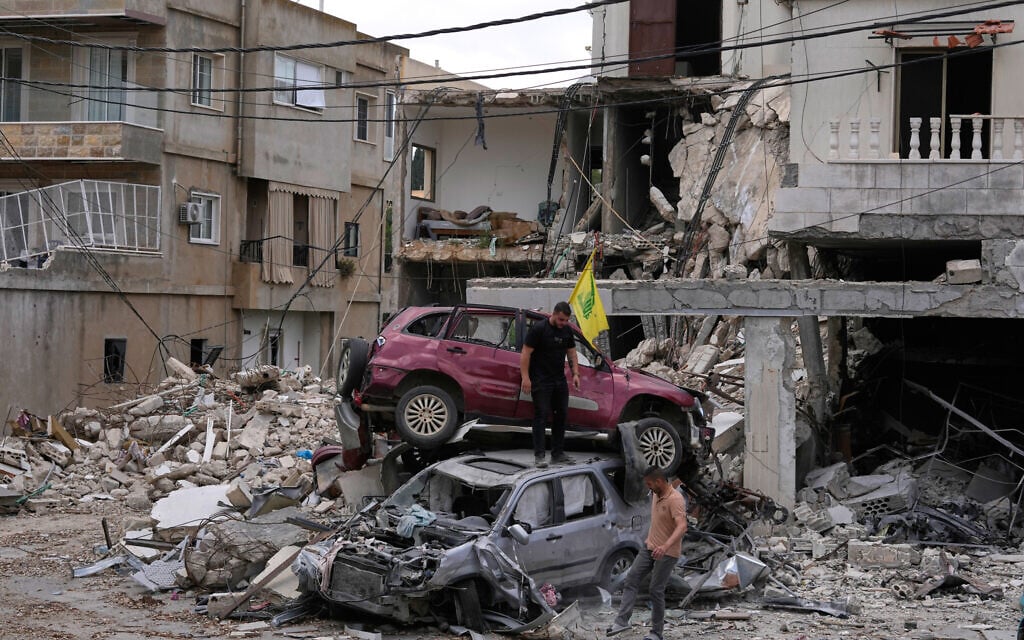
Hezbollah disputed the claim that the targets of the strike were terror operatives, and accused Israel of opening fire on a “group of civilians” who were “working to clear roads and recover the bodies of martyrs from beneath the rubble” near Nabatieh.
The Iran-backed terror group claimed that in doing so, Israel had violated the terms of a ceasefire that has largely held since Sunday.
Get The Times of Israel's Daily Edition
by email and never miss our top stories
By signing up, you agree to the terms
“What the enemy has done constitutes a blatant violation of the ceasefire, which [Hezbollah] has adhered to until now,” it added.
In a separate incident several hours later, the IDF said it fired on four Hezbollah operatives who crossed into Israel’s security zone in southern Lebanon.
According to the military, troops spotted the four Hezbollah operatives crossing into the zone in a bulldozer and on a motorcycle near the Ali Taher ridge, “in a manner that posed an immediate threat.”
After detecting the operatives, troops fired warning shots toward them.
“After the operatives continued to approach and did not respond to the forces’ calls, additional fire was carried out in order to remove the threat,” the military said, adding that at least one was hit.
The flare-up in southern Lebanon came as representatives from Beirut and Jerusalem gathered in Washington for another round of direct talks hosted by the US State Department.
Tuesday’s session was expected to focus on both political and security issues, before being split off into separate sessions on the two topics on Wednesday and Thursday, respectively.
Israel and Lebanon were represented at the talks by their respective ambassadors in Washington, while State Department Counselor Dan Holler and Assistant Secretary of Defense for International Security Affairs Dan Zimmerman represented the US.
The direct talks in Lebanon are not connected to the memorandum of understanding signed between the US and Iran, which dictates that hostilities are to cease across the region, including in Lebanon.
Israel has agreed to US President Donald Trump’s demand that it refrain from attacking Beirut, but has kept its troops stationed in southern Lebanon, which would appear to go against the terms of the US-Iran deal.
Israel had no part in negotiating the MOU reached last week, and Prime Minister Benjamin Netanyahu has distanced himself from it. Still, the terms of the opening clause, permanently ending the war and ruling out any resumption, indicate that it is binding on the US, Iran “and their allies.”
Israeli officials are bitterly opposed to the deal’s terms, which resolve none of the war’s key goals — notably, eliminating Iran’s nuclear and ballistic missile programs, and creating the conditions for the fall of the regime.
The Israeli security zone in southern Lebanon stretches across the entire length of the shared border, and extends up to 10 kilometers (six miles) into Lebanese territory, in some areas crossing the Litani River and reaching the outskirts of Nabatieh.
In a statement released by the Prime Minister’s Office late Monday, Netanyahu, Defense Minister Israel Katz and IDF Chief of Staff Lt. Gen. Eyal Zamir said that “the IDF will continue to act decisively to thwart threats to our soldiers and civilians, destroy terror infrastructure, and continue maintaining the security zone in southern Lebanon.”
Lebanese authorities are eager to keep their negotiations with Israel separate from the wider talks between the US and Iran, as Beirut continues to try to minimize the influence of Hezbollah and, by extension, its Iranian backers.
The Washington talks have been somewhat sidelined, however, after US Vice President JD Vance announced the creation of a deconfliction mechanism in Lebanon, similar to the one established by the Biden administration as part of the November 2024 ceasefire it brokered between Israel and Lebanon.
Unlike the 2024 framework, however, the mechanism being created by the Trump administration would reportedly exclude Israel from the oversight body while bringing in Iran, Pakistan and Qatar, and would limit Israeli military action to only responding to “imminent threats,” rather than the broader category of “emerging threats.”
In a statement published at the start of Tuesday’s talks in Washington, Lebanese President Joseph Aoun rejected the ongoing Israeli presence in southern Lebanon, as well as other foreign interference, alluding to Iran.
“We accept nothing less than an end to the Israeli occupation and at the same time, the fall of foreign tutelage, because our only option is our national sovereignty and our sole wager is on the Lebanese state,” Aoun said, according to his office.
He also expressed hope that the new round of talks would be “decisive along the path of achieving what we seek for the good of our nation and people,” namely, “the full restoration of Lebanon’s sovereignty over every grain of its soil.”
Times of Israel staff and agencies contributed to this report.
View original source — Times of Israel ↗
Related stories

ESPN
SportsJun 23, 2026 · 1 min
Rolapp to assume PGA Tour commish role Jan. 1
ESPN

ESPN
SportsJun 23, 2026 · 1 min
You Belong With Me: Taylor Swift makes Tight End U...
ESPN

The Punch
SportsJun 23, 2026 · 1 min
APC wins Lagos councillorship by-elections
The Punch

ESPN
SportsJun 23, 2026 · 1 min
Tiger makes first public appearance since arrest
ESPN