The Next Web
Stark Defence raises €500M led by Sequoia and Founders Fund at a valuation above €3.5 billion
TL;DR
Berlin drone startup Stark Defence raised €500M led by Sequoia and Founders Fund, pushing its valuation past €3.5 billion just two years after founding.
Stark Defence, the Berlin-based strike drone startup founded in 2024, has raised €500 million in a round led by Sequoia Capital and Peter Thiel’s Founders Fund, Bloomberg reported on Monday. The deal values the company at more than three and a half billion euros, roughly triple the €1 billion mark it crossed earlier this year. Other investors in the round include the NATO Innovation Fund, Döpfner Capital, Air Street Capital, 201 Ventures, and Project A.
The round makes Stark one of the best-funded defence tech startups in Europe. The company has now raised more than €660 million in total, according to Bloomberg, up from approximately €160 million before this latest injection. More than 80 percent of the new capital will go toward manufacturing and research expansion.
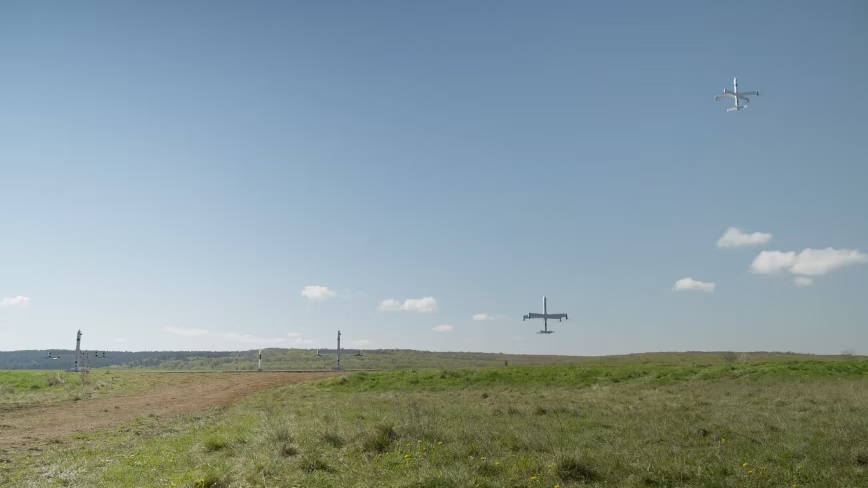
Stark builds loitering munitions, the military term for drones that hover over a target area, identify threats autonomously, and destroy them by self-detonating on impact. Its flagship product, the Virtus, has been deployed in Ukraine and can be assembled in ten minutes. The company operates in Germany, Ukraine, Sweden, and Greece, and opened a 40,000-square-foot production facility in Swindon, England, last year.
CEO Uwe Horstmann, who was appointed in October 2025, is also a founding partner at Berlin venture capital firm Project A, one of the investors in this round. Horstmann is a reserve officer in the German Armed Forces and had previously invested in defence tech startups including unmanned ground vehicle maker ARX Robotics. Stark was co-founded by Florian Seibel, who previously built rival German drone company Quantum Systems, and Johannes Schaback.
The fundraise comes after Germany awarded Stark and Munich-based rival Helsing initial contracts worth roughly €269 million each in February for kamikaze drones to equip the Bundeswehr’s 45th Armoured Brigade in Lithuania. Framework agreements could push the total value to €1 billion per company. Rheinmetall, Germany’s largest defence contractor, was excluded from the initial award after its in-house drone programme fell behind schedule.
Peter Thiel’s involvement in Stark has been politically sensitive in Germany. Ahead of the Bundestag vote on the drone contracts, the defence ministry told lawmakers in a confidential briefing that Thiel Capital held less than 10 percent of the company. After this latest round, Bloomberg reported that Thiel’s overall shareholding has decreased further, with the majority stake belonging to the founding team and employees and the remaining shares spread across roughly 50 different investors.
The European defence tech funding race has accelerated sharply. Helsing is raising one and a half billion dollars at an $18 billion valuation, and Quantum Systems raised €340 million in 2025. In the US, Anduril raised $5 billion at a $61 billion valuation in May, doubling its mark in under a year.
Global defence tech venture capital reached $49 billion in 2025, nearly double the prior year.
Government spending is driving much of the demand. The EU’s ReArm Europe plan aims to mobilise up to €800 billion in defence spending over four years, and Germany’s special defence fund, created after Russia’s invasion of Ukraine, has accelerated procurement of autonomous systems. The European Defence Industry Programme, adopted in March 2026 with a budget of nearly one and a half billion euros, earmarks specific funding for counter-drone and autonomous strike capabilities.
Stark’s challenge now is scaling production to meet military procurement requirements. The company has contracts and a deployed product but has not yet demonstrated manufacturing at the volumes that defence ministries require. Helsing has deeper AI integration across its platform.
Quantum Systems, Seibel’s earlier company, has more years of operational maturity. The competition for the same contracts, engineering talent, and investor capital across all three German-based firms is intensifying.
The valuation trajectory is extraordinary even by defence tech standards. Stark went from a $500 million valuation in August 2025, when Sequoia led its Series B, to more than three and a half billion euros less than a year later. Whether the company can convert that fundraising momentum into production-scale delivery will determine if it becomes a lasting European defence champion or a cautionary example of how fast capital can flow into a sector reshaped by war.
View original source — The Next Web ↗
Related stories

The Verge
TechnologyJun 23, 2026 · 1 min
Xteink’s tiny e-readers are 20 percent off for Prime Day
The Verge

TechRadar
TechnologyJun 23, 2026 · 1 min
Cracks in the crypto world? This top data center provider is spending $500 million to turn former cryptomining sites…
TechRadar

ZDNet
TechnologyJun 23, 2026 · 1 min
Looking for a good deal on a new ThinkPad? I found one that's $830 off
ZDNet

MIT Technology Review
TechnologyJun 23, 2026 · 1 min
Opening a door to mental-health help online
MIT Technology Review