Ars Technica
A curious crossover: The Toyota C-HR review
Skip to content
bZ SWB
Although it’s on the smaller side, this electric vehicle is not very chill.
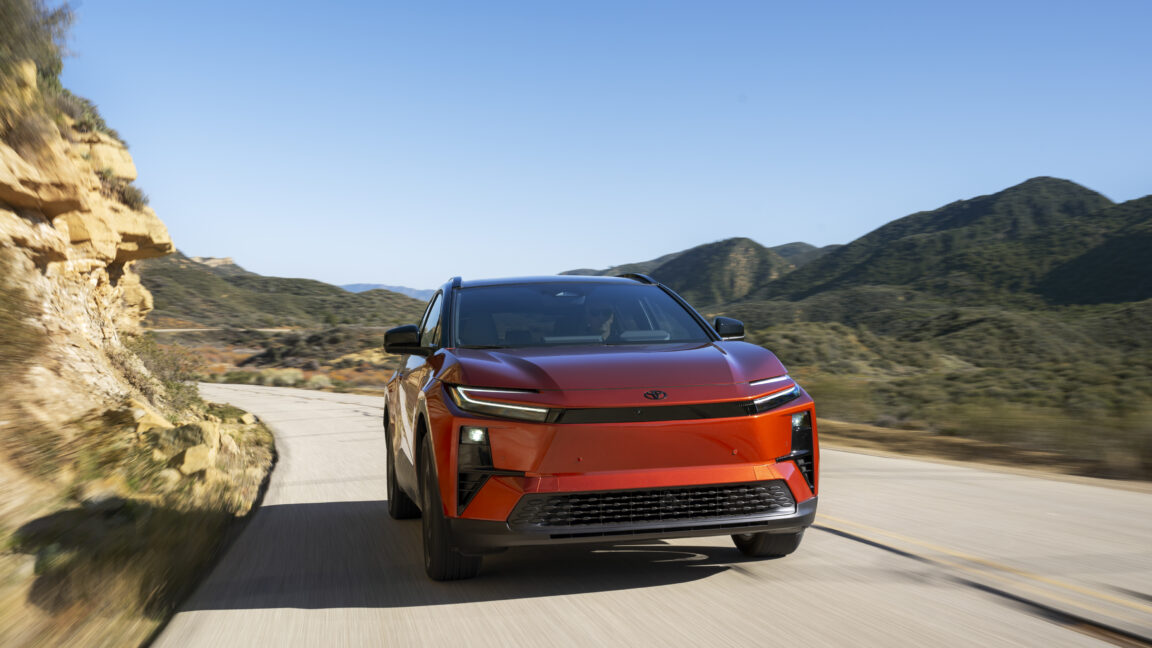
The weather was gross during our week with the C-HR, and I didn't get good photos, so please enjoy these images courtesy of Toyota.
Credit:
Toyota
The weather was gross during our week with the C-HR, and I didn't get good photos, so please enjoy these images courtesy of Toyota.
Credit:
Toyota
After a slower start than its major rivals, Toyota has been making up for it with a flurry of new electric vehicles for the North American market. Its first attempt, the bZ4x, was an also-ran, but a new battery pack, more efficient motors, and a NACS charging port transformed the face-lifted bZ into an EV I happily recommend. Then, earlier this year, it followed up with some bZ-related variants. For those who miss the vibe of a station wagon, there is the bZ Woodland, and an all-electric Highlander is nearing the showroom, too. But today’s focus is the C-HR, and I’m still not entirely sure what to make of it.
It’s the smallest of the bunch, some 6.7 inches (170 mm) shorter than the bZ. But it’s still as wide and only a little more than an inch shorter. So if you’re put off by the bZ’s size, and are looking for something diminutive—and based on reader feedback, there are many of you out there—this small SUV will probably still fail to pass muster.
It’s not any cheaper than the bZ until you consider that the C-HR is only available with one choice of powertrain: a twin-motor AWD setup with a combined 338 hp (252 kW) powered by a 74.7 kWh battery pack. That same arrangement, with a 223 hp (167 kW), 198 lb-ft (268 Nm) front motor and 118 hp (88 kW), 125 lb-ft (169 Nm) rear unit, costs almost $3,000 more in a bZ than the $37,000 starting price of the C-HR.
No, the C-HR is one of those frivolous vehicles, one that puts bold styling and a sporty character ahead of simple utility. After all, the bZ already exists if you want stolid.
From the driver’s seat, it might look like a bZ. There’s the same multifunction steering wheel, the same small main instrument display, the same infotainment system, and a pleasing array of actual plastic buttons, each with just one discrete function. Toyota’s 14-inch touchscreen infotainment system isn’t particularly flashy, but the screen is responsive, and Apple CarPlay runs wirelessly.
Take it off the back
You notice the 3.9 inches (200 mm) that’s missing from the wheelbase if you sit in the back. It’s not especially cramped compared to the back seat of the old gas-powered C-HR, but it’s hardly palatial. As you sit level with the C pillar back there, it can feel a little dark even with the optional panoramic glass roof, which robs a little over an inch of headroom as a trade-off for letting more light into the cabin. There’s only one USB-C port in the back, and it’s only 15 W, unlike the two 60 W ports up front, but if you opt for the C-HR XSE, you can get heated rear seats to go with the standard heated fronts.
The C-HR certainly feels frenetic on the street. Even with the car set to Eco mode, it’s plenty peppy; in normal mode, I found the initial throttle response to be a bit too eager. Despite that, Toyota quotes the same 4.9-second 0–60 mph (97 km/h) time for the C-HR as the other AWD EVs it builds. Perhaps driving them back-to-back would reveal no appreciable difference, but if the point was to imbue the C-HR with an eager quality, Toyota’s engineers succeeded at the task. It’s not the last word in driving thrills, though, with front-biased power delivery thanks to that AWD setup and not particularly communicative steering.
The C-HR interior is basically copied from the bZ.
Toyota
Over a week of mostly city driving, the C-HR reported an average of 3.8 miles/kWh (16.4 kWh/100 km), but also only estimated 149 miles of range with 72 percent state of charge in the battery, which might be down to the extremely hot and humid weather in DC but makes it hard to extrapolate out to a number that matches the official EPA range, which is 273 miles (439 km) when fitted with 20-inch wheels. (The 18-inch wheels on the C-HR SE add 14 miles/23 km in range.)
If you’re out and about and need a charge, the native NACS port, which tops out at 150 kW, means all of Tesla’s compatible Superchargers are among the tens of thousands of fast chargers you can use, although the position of the charge port behind the front wheel arch can make it a challenge to get close enough for the older Tesla cables to reach. A DC fast charge from 10–80 percent takes around 30 minutes, or 7.5 hours with an 11 kW AC charger, Toyota says.
The heat and humidity during our test week brought me to my other bugbear with the C-HR. I’ve made peace with the fact that no Toyota remembers to turn the auto hold function back on if I used it last time I drove the car. But the C-HR added another level of amnesia by never remembering that the AC should be on. Perhaps it’s an eco strategy to save a few Wh on startup, but if it’s hot enough to melt gallium in the shade, I want my car to remember to make it cold when I turn it on.
Jonathan is the Automotive Editor at Ars Technica. He has a BSc and PhD in Pharmacology. In 2014 he decided to indulge his lifelong passion for the car by leaving the National Human Genome Research Institute and launching Ars Technica's automotive coverage. He lives in Washington, DC.
3 Comments
View original source — Ars Technica ↗
Related stories

The Verge
TechnologyJun 23, 2026 · 1 min
Xteink’s tiny e-readers are 20 percent off for Prime Day
The Verge

TechRadar
TechnologyJun 23, 2026 · 1 min
Cracks in the crypto world? This top data center provider is spending $500 million to turn former cryptomining sites…
TechRadar

ZDNet
TechnologyJun 23, 2026 · 1 min
Looking for a good deal on a new ThinkPad? I found one that's $830 off
ZDNet
BBC
TechnologyJun 23, 2026 · 1 min
We're at one of Europe's biggest tech events
BBC