The Guardian
England’s grizzly Ghana draw exposes limitations of Madueke and Gordon | Barney Ronay
After the high: the comedown. You could probably have seen this coming. If only that rush after half-time in Dallas, where England surged with such alluring creative energy, hadn’t been quite so much of a buzz.
It turns out, however, that this is still an England tournament team. Nothing comes easily. The world will not bend to you. We can’t have nice things. Or only some nice things sometimes. By the end watching England struggle in Boston against a gristly and indigestible Ghana was like having your will, hope, sense of fun slowly sucked out of your body through a surgical drainage catheter.
The moment that might have been the moment came right at the death. With 86 minutes gone England finally found a strange green substance opening up between the yellow shirts that had jounced and jostled and suffocated them to that point.
This, it turns out, was open grass, space, air to breathe. They did something useful with it, Reece James picking out Nico O’Reilly with a fine right-footed cross. His header twanged the bar. The rebound fell to Harry Kane, at a decent height, with space to shoot, the target yawning in front of him. And for a moment the game seemed to stop, the day stretching out.
As a kid Kane will have dreamed of place-kicking in this stadium, home of the Patriots, and one of the open, homely old cathedrals of the NFL. He took his chance here, punting the ball between the posts, miles over the bar, and off down the open concrete space behind the goal, bouncing off up the highway towards Salem.
A 0-0 draw is hardly a fatal blow to England’s hopes. Ghana were a horrible prospect for much of the time, set up in a triple headlock defensive line overseen by the master of doom, Carlos Queiroz, who has not yet been asked to do a turn as one of the promotional faces of this product-shifting World Cup, but could perhaps do a good turn for concrete fencing, non-drying paint, or some deep product of the inner bowel, the ultra blocker.
Either way Queiroz and Ghana did a number on England, understood what those tactics would or could do to them. For a while at the start England were bright, or semi-bright, then steady, cautious, then they just seemed to lose their creative will completely. Does this matter?
The game here had almost no bearing on what a knockout game might look like, or a meeting with the kind of team that comes wanting to play, to have the ball, rather than putting you in a 90-minute sleeper hold.
But there were things that will concern and frustrate Tuchel, not to mention those who have already questioned his slightly rigid round-headed selection. And really, it is the moment to talk about England’s starting wingers. Anthony Gordon and Noni Madueke, who were exposed here as rigidly functioning parts, following the same series of movements every time, outside to in, unable to find a new pattern even when they kept running down the same dead end street.
For all the talk of a great golden hand of talent, England’s two starting wingers here have six goals in 48 England games between them, with no sense that this is an oversight, or an unfair reflection or that there are other gears to come. And no doubt there will be much talk of players who aren’t here, Cole Palmer and Phil Foden perhaps. But the fact is neither deserved it. Neither made a case for selection. Foden, at least, has never really had a good game for England.
Creativity is a multi-headed thing in any case. It relies on movement, on team play, rather than individual inspiration. But England can and must be better than this, can have more craft, more devil, more sense of playing outside the system occasionally too, rather than following the same paths and blind alleyways. Teams that win tournaments will eventually surprise you.
Here Boston was chilly, damp, misty and green with a feeling of a kind of oversized Shire, Middle Earth with clapboard houses and enormous cars. The England fans gathered in shorts and plastic ponchos in the far flung eaves, draping their banners and flags with the names of old England. Sunderland, Salford Wolverhampton.
The Boston Stadium is home of the New England Patriots, a wide, low slung place and open to the sky, like a giant upturned Stetson. The whole complex has a slight showground feel, the kind of place for a rally or a march past, pompoms, homecoming queens, Uncle Sam on a giant tractor. It was a lovely spectacle before kick-off with its turrets and planes and swooping angles.
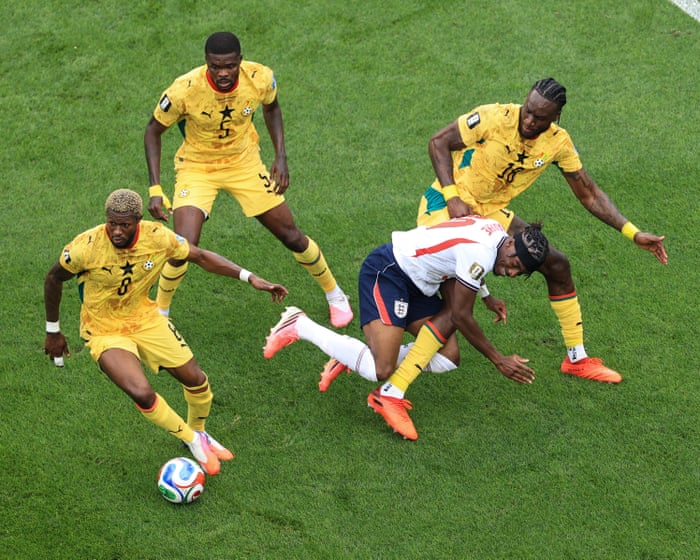
And England looked perky enough at the start, keeping the ball for a full three minutes, before finally working an overload on the right for Madueke. At which point, the pattern began to set itself. Madueke doesn’t like to use his right foot. Instead he spurned the pocket of space, went backwards, was surrounded by three players instantly. It’s an odd one. You’re a brilliantly talented footballer on the right for England at a World Cup. Why not just experiment with putting a cross in?
With 14 minutes gone England had taken 86% of possession and made 138 passes to Ghana’s 13. Ghana were like a thick, gloopy footballing custard, yellow shirts melding together, swamping you, sticking to your feet. England had one obvious problem. Against a low block the use of two inverted wingers, or at least two wingers this inverted, can become a structural issue. The space you’re always coming into is the space where everyone else is.
The first half, Hydration Break x2, was frustratingly barren. This was total passivity from Ghana, possum-ball, play dead, effect a state of rigor mortis in the hope your opponent wanders off or falls asleep.
But England had no surge this time, had no adrenal shift of gears. So the game simply slid past.
With 65 minutes gone Tuchel brought on Bukayo Saka, who would, in his best form, be a clear upgrade on the basic quality of England’s constant cutting inside. England will move on, with a little more knowledge of what they need to do in the US to make any impression, but without any real sense of moving closer towards it.
View original source — The Guardian ↗
Related stories

ESPN
SportsJun 24, 2026 · 1 min
Ghana: 'VAR went for coffee' to aid 'lucky' Englan...
ESPN

ESPN
SportsJun 24, 2026 · 1 min
Johnson reunites with May, goes No. 9 to Mavs
ESPN
ESPN
SportsJun 24, 2026 · 1 min
'The City is Ready': Trae Young welcomes AJ Dybant...
ESPN

ESPN
SportsJun 24, 2026 · 1 min
Devers apologized to Vitello: 'A misunderstanding'...
ESPN