Indian Express
Indian Express··4 min read
‘Tamper-proof’ IDs, real-time traffic monitoring: Security for this year’s Amarnath Yatra goes high-tech
3 min readSrinagarJun 24, 2026 05:40 AM IST
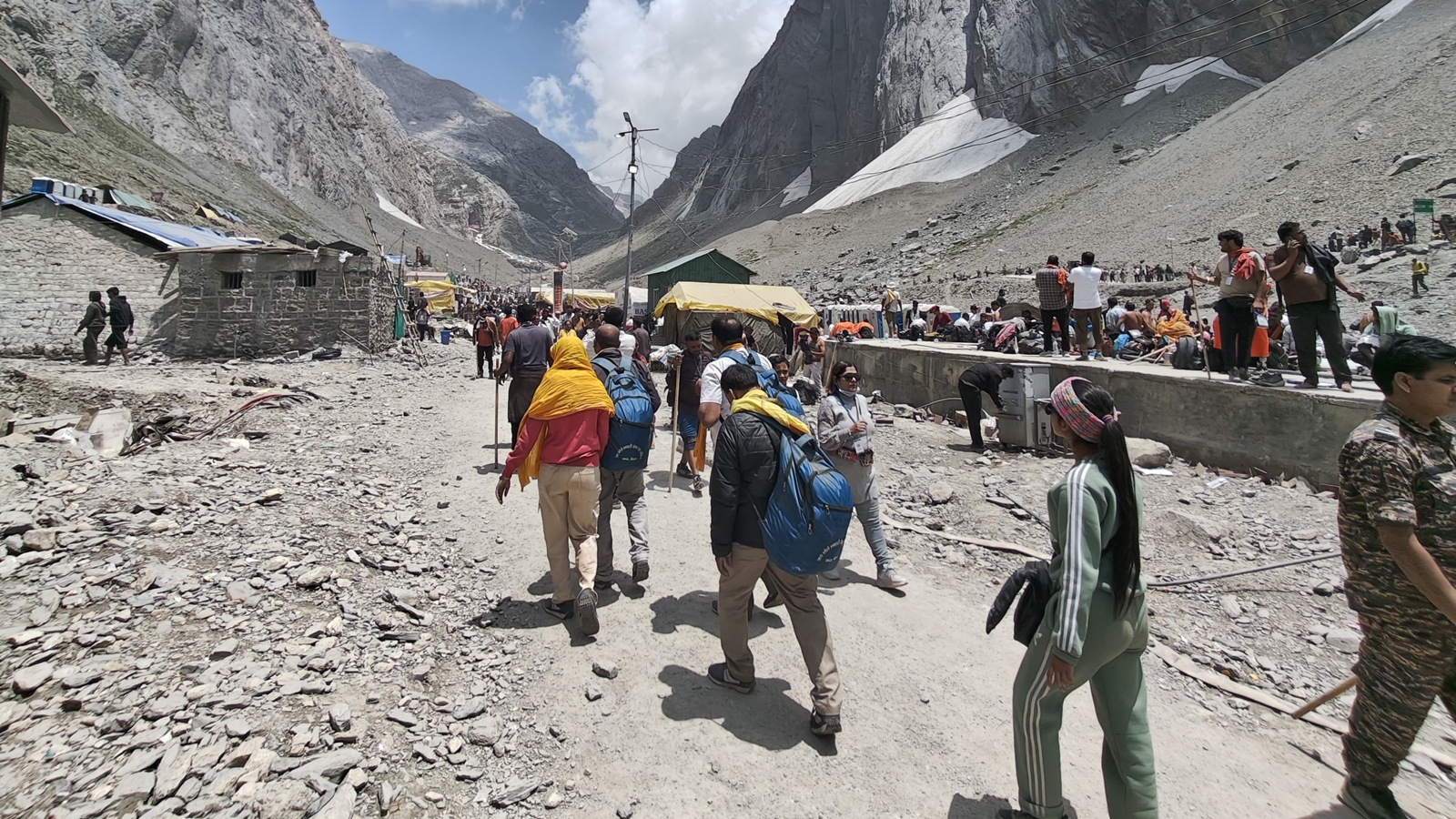
Pilgrims trek to the Amarnath shrine. (Express photo by Anand Mohan J/File)
A multi-layered security apparatus, no-fly zones along the twin yatra routes, watch towers to keep vigil and real-time monitoring of vehicular movement — as the annual Amarnath Yatra is set to start next week, an unprecedented security grid has been put in place.
And for the first time, the Jammu and Kashmir Police issued “tamper-proof” QR-code-based identity cards to service providers, including pony riders, to ensure the safety of pilgrims.
While security agencies say there are no specific intelligence inputs about threats to pilgrims, a multi-layered security setup has been put in place as a precaution.
The government has declared the Amarnath Yatra route, from Jammu to the Himalayan shrine, from both the Pahalgam and Baltal routes, a no-fly zone. This means that pilgrims, for the second straight year, won’t be able to avail of the helicopter services to reach the shrine.
Security officials said electronic surveillance, coupled with multi-tier security deployment, was necessitated after last year’s terror attack on tourists at the Baisaran valley in Pahalgam.
Security agencies will be monitoring, in real time, the movement of pilgrim convoys through a network of CCTV cameras set up across the twin routes. The government has also issued RFID tags for vehicles, pilgrims and service providers.
New ID cards
To prevent the militants from disguising themselves as service providers, police have added another layer of security by issuing QR-code-based identity cards to them. “The cards, when scanned, will provide complete information about the service provider,” said a police officer, adding, “This is essential to stop terrorists from disguising themselves as pony riders or other service providers.”
Story continues below this ad
Police have also set up high-rise watch towers and observation posts known as ‘Machan Morchas’ to keep a vigil at strategic locations along the route.
Over the last week, the J&K Police and other security agencies have been conducting mock drills and surveillance exercises to prepare personnel for emergency response in the case of an untoward incident.
Traffic restrictions
Police have also issued a travel plan on key routes. While pilgrims have been asked to strictly follow the route and timings, restrictions have also been put in place on civilian movement along the Srinagar-Jammu national highway.
The government has said that no civilian traffic would be allowed to leave for the Valley from Jammu before 11.30 am. Strict restrictions have also been put in place on civilian traffic coming from Jammu towards Srinagar, with no vehicle set to be allowed to cross the Banihal-Qazigund tunnel after 3 pm. Similar restrictions have been put in place on key routes in the Valley, too.
Story continues below this ad
Every year, lakhs of Amarnath pilgrims from across the country take the arduous journey to the Himalayan cave shrine during the summer. This year, the yatra will begin on July 3 and end on August 28.
The security of the yatra is considered one of the biggest security exercises in the Valley. With multi-agency involvement in the security of the yatra, DGP Nalin Prabhat has called for strengthening coordination and intelligence sharing among the different agencies to ensure safe and smooth conduct of the pilgrimage.
Bashaarat Masood is a Special Correspondent with The Indian Express. He has been covering Jammu and Kashmir, especially the conflict-ridden Kashmir valley, for two decades. Bashaarat joined The Indian Express after completing his Masters in Mass Communication and Journalism from the University in Kashmir. He has been writing on politics, conflict and development. Bashaarat was awarded with the Ramnath Goenka Excellence in Journalism Awards in 2012 for his stories on the Pathribal fake encounter.
Expertise and Experience
Two Decades of Frontline Reporting: Bashaarat has spent 20 years documenting the evolution of Kashmir, from high-intensity conflict and political shifts to socio-economic development.
Award-Winning Investigative Journalism: He is a recipient of the prestigious Ramnath Goenka Excellence in Journalism Award (2012). This honor was bestowed for his reporting on the Pathribal fake encounter, a series of stories that highlighted his ability to handle sensitive human rights and security issues with investigative rigor.
Specialized Beats: His authoritative coverage spans:
Political Transitions: Tracking the shift from statehood to Union Territory, electoral dynamics, and the pulse of local governance.
Security & Conflict: Providing nuanced reporting on counter-insurgency, civil liberties, and the impact of the conflict on the civilian population.
Development: Documenting the infrastructure, healthcare, and educational landscape within the Valley.
Academic Background: He holds a Masters in Mass Communication and Journalism from the University of Kashmir, providing him with a localized academic and professional foundation that is rare in regional reporting. ... Read More
Tags:
amarnath yatra
View original source — Indian Express ↗
Related stories

ESPN
SportsJun 24, 2026 · 1 min
Johnson reunites with May, goes No. 9 to Mavs
ESPN

ESPN
SportsJun 24, 2026 · 1 min
Ghana: 'VAR went for coffee' to aid 'lucky' Englan...
ESPN
ESPN
SportsJun 24, 2026 · 1 min
'The City is Ready': Trae Young welcomes AJ Dybant...
ESPN

ESPN
SportsJun 24, 2026 · 1 min
Devers apologized to Vitello: 'A misunderstanding'...
ESPN