Indian Express
Indian Express··5 min read
‘No show of midriff, thighs, leg’. Why female dancers have to follow these temple fest rules
6 min readNew DelhiUpdated: Jun 24, 2026 12:05 PM IST
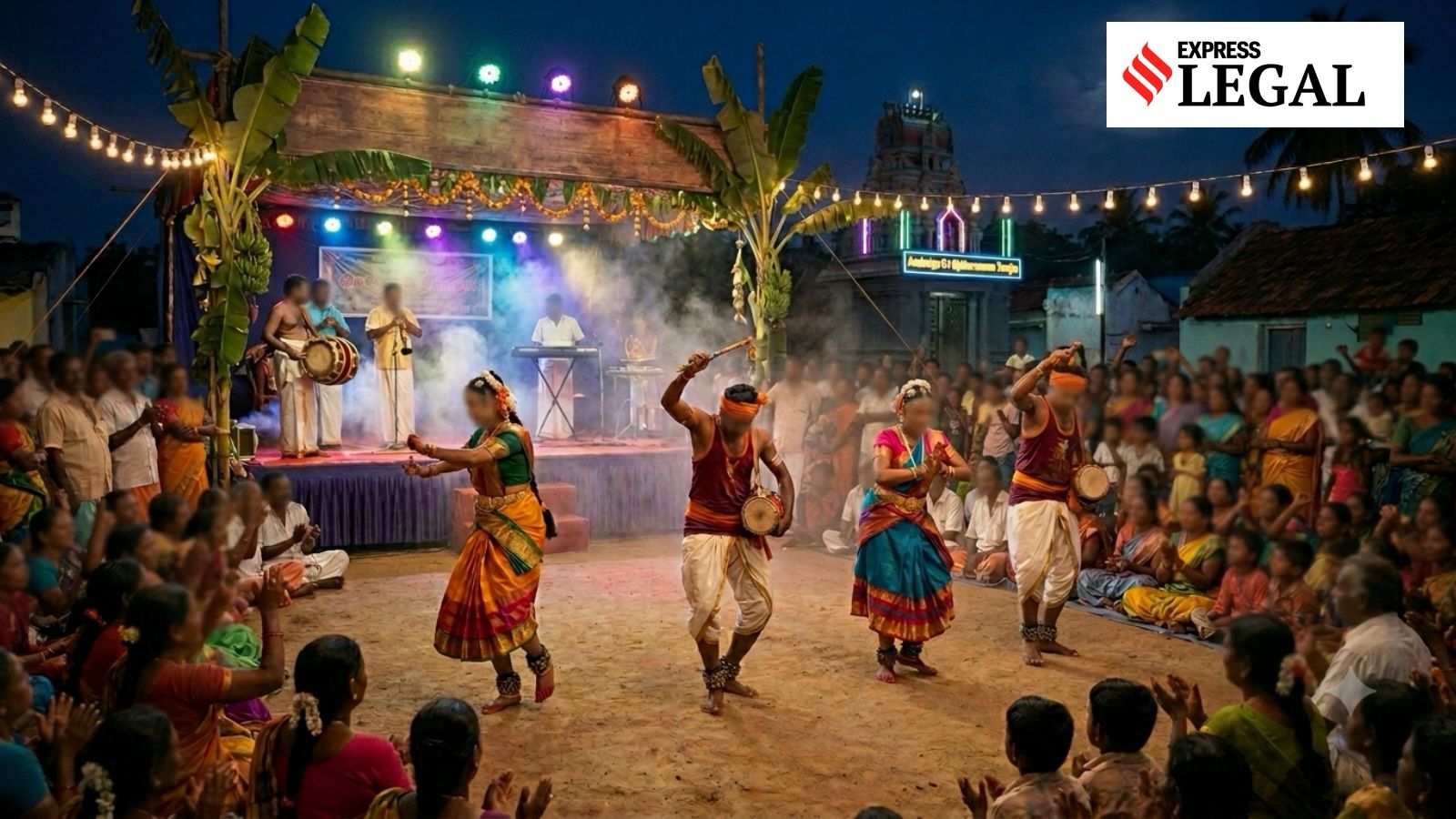
The court further directed that none of the songs or dances performed in the programme should exhibit any political tone, tenor, or colour, or promote any religion, community, or caste. (AI-generated image)
Directing that female performers must not wear attire exposing the midriff, thighs, legs or chest, the Madras High Court recently imposed several conditions for regulating a cultural programme associated with a temple festival in Tamil Nadu’s Thoothukudi district, warning that violations could lead to legal action against the organisers and temple committee members.
Justice L Victoria Gowri observed that the director general of police (DGP), Tamil Nadu, had issued circulars instructing the police across the state on considering applications seeking permission for cultural programmes.
“The attire of the dancers performing in the said programme should be modest and should not involve exposure of the midriff, thighs, legs or chest. Any violation of this condition shall result in legal action, including the arrest of the organisers and all members of the temple committee,” the June 22 order noted. The performance scheduled for the following day.
“The petitioner is permitted to conduct a cultural program on June 23, 2026 from 7 PM to 10 PM, in connection with the temple ‘No show of midriff, thighs, leg’. Why female dancers were told to follow rules for temple festof Sri Aathi Parameshwari Amman Temple, Mukkani Village, Thoothukudi District,” the bench added.
The Madras High Court said that the organisers, responsible members of the festival committee, must ensure that only cultural programmes having some relevance to the temple or the festival in question would be conducted and no obscene display or dance shall be conducted.
Justice L Victoria Gowri also directed that no slogans or speeches supporting or opposing any political party should be promoted at the event.
The court ordered that the programme should not extend beyond 10 pm, and that women participating in the cultural programme would not be depicted or portrayed in an obscene or undignified manner, either in the form of clothing or otherwise.
The court directed that the participants must not perform any obscene dance or vulgar dialogues during the performance, and the music that should be used in accordance with the precincts of the temple and double-meaning songs should not be played to spoil the minds of students and youths, the court said.
Story continues below this ad
‘No political promotion’
In addition, the court directed that there should be no supply of alcohol or any intoxicating material by participants or audience in and around the area where the cultural programme is scheduled to be held, and no donations or prizes should be given in the name of political parties.
It further directed that none of the songs or dances performed in the programme should exhibit any political tone, tenor, or colour, or promote any religion, community, or caste. Additionally, no slogans or speeches supporting or opposing any political party, leader, caste, community nor political symbols or banners supporting political parties or communal leaders should be promoted.
The court also ordered that songs praising communal leaders or having communal overtones should not be played, and organisers should not erect any digital banners/placards or flex boards in support of any political party on either side of the arterial roads, platforms, walkways or any other roads.
The court said that the function should not affect caste, religious or communal harmony and should be conducted without any discrimination. Any violation of the conditions shall result in legal action, including the arrest of the organisers and all members of the temple committee, it added.
Story continues below this ad
Dress code, timing and other rules
It is made clear that the actors/actresses of the adal padal program should wear proper dress – dhoti or pyjamas for men with an upper cloth, sarees or half-sarees or churidhars with upper cloth for women, and fully covered dresses for children.
The entire programme shall be videographed, and the police is empowered to stop it if it exceeds the permitted time.
The organisers shall ensure that no untoward incidents disturb public peace. If any untoward incident takes place, the organisers shall be held responsible.
The organisers shall have to obtain all required permissions from the authorities concerned. They shall also pay bandobast charges.
The high court stated that the police officers concerned are at liberty to take necessary action as per law if there is a violation of the conditions. The performance will be halted in such an event and the matter is to be brought to the notice of the court.
Additionally, the judge said that any other conditions imposed by the authorities as per the ground situations are also to be followed. Violating the same could lead to action under the law and organisers/committee members shall be held responsible for the same.
Earlier court directions
This is not the first time the Madras High Court has issued such directions in connection with cultural programmes held alongside temple festivals. On March 27 this year, while allowing conditional permission for programmes, including Valli Thirumanam dance and drama performance in connection with the Sri Kaliamman Temple Festival in Madurai district, the court had strictly prohibited obscene displays, undignified portrayals of women, and double-meaning songs.
On March 6, while permitting the performance of the Tamil folk dance ‘karagattam‘ during a temple festival in Tiruchirappalli, the Madras High Court expressed concern over the attire used by performers in the traditional dance. It subsequently directed the dancers to adhere to the traditional dress code depicted in the iconic Tamil film Karagattakaran.
© IE Online Media Services Pvt Ltd
Somya Panwar works with the Legal Desk at The Indian Express, where she covers the various High Courts across the country and the Supreme Court of India. Her writing is driven by a deep interest in how law influences society, particularly in areas of gender, feminism, and women’s rights.
She is especially drawn to stories that examine questions of equality, autonomy, and social justice through the lens of the courts. Her work aims to make complex legal developments accessible, contextual, and relevant to everyday readers, with a focus on explaining what court decisions mean beyond legal jargon and how they shape public life.
Alongside reporting, she manages the social media presence for Indian Express Legal, where she designs and curates posts using her understanding of digital trends, audience behaviour, and visual communication. Combining legal insight with strategic content design, she works on building engagement and expanding the desk’s digital reach.
Somya holds a B.A. LL.B and a Master’s degree in Journalism. Before moving fully into media, she gained experience in litigation and briefly worked in corporate, giving her reporting a strong foundation. ... Read More
Tags:
Cultural performances
dance
Madras High Court
View original source — Indian Express ↗
Related stories

The Punch
NewsJun 24, 2026 · 1 min
Meet 38-year-old UNILORIN’s youngest professor
The Punch
The Punch
NewsJun 24, 2026 · 1 min
Oyo gov: No amount of blackmail can stop Adelabu in 2027 – Aide
The Punch
The Punch
NewsJun 24, 2026 · 1 min
VIDEO: Charly Boy opens up on 48-year marriage, admits long unions can get boring
The Punch
The Punch
NewsJun 24, 2026 · 1 min
Abia slashes Okada fine to N20,000, shifts enforcement date
The Punch