Indian Express
Indian Express··5 min read
Meet ‘Ballista’: New Australian spider that flings dangerous ants into air
Written by: Express Intern
5 min readJun 24, 2026 02:30 PM IST
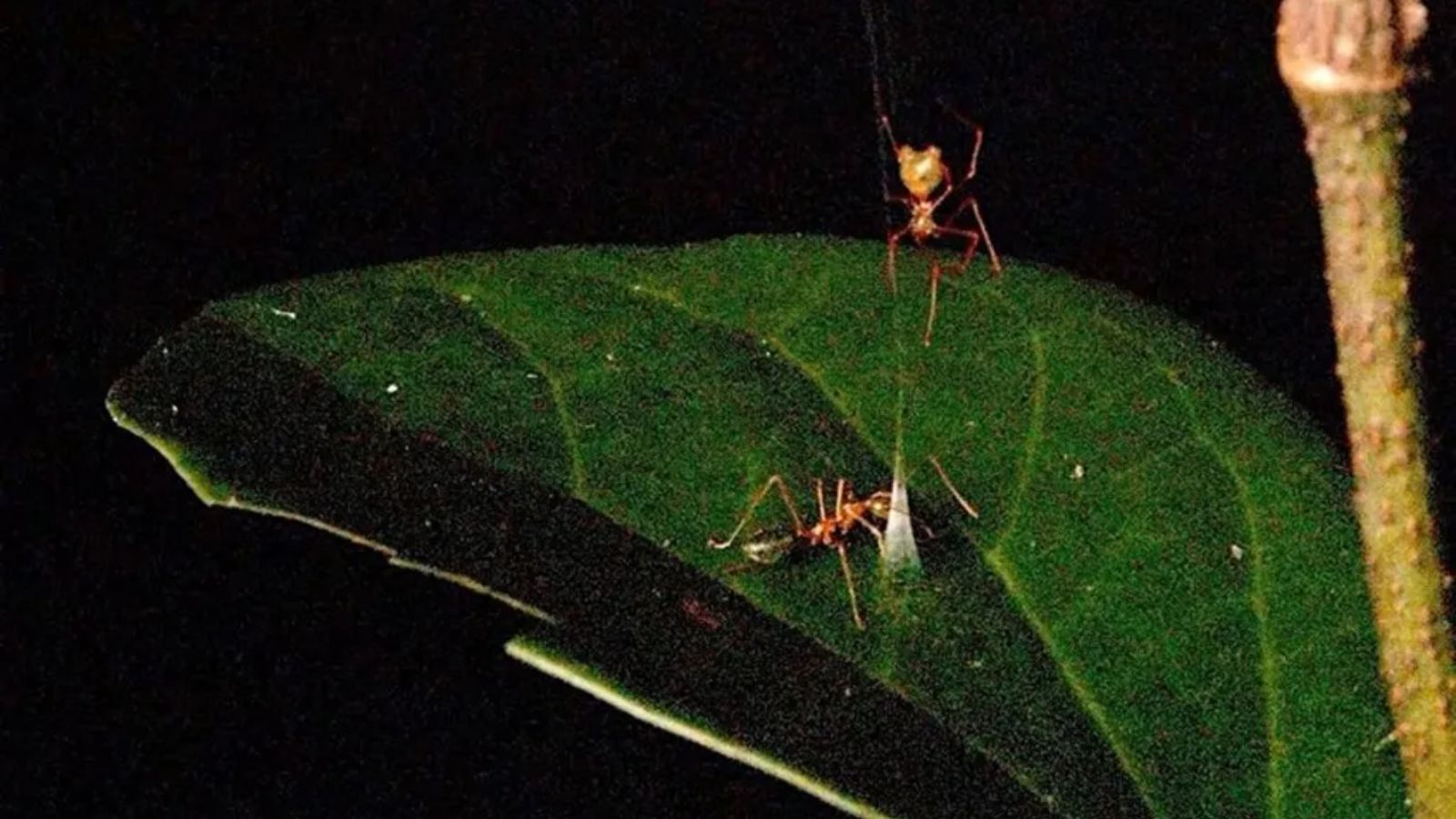
High speed camera capturing the ballista spider in motion catching its prey (Photo: Ajay Narendra, Pranav Joshi, Daniele Liprandi, Gregory J Anderson, Jonas Wolff/Macquarie University)
In Northern Australia, researchers recently observed a newly discovered spider species securing its prey by engineering a cone-shaped silk trap that violently catapults ants upward the moment they bite its tethered base, the BBC reports.
The unique hunting method was developed by the nocturnal predator to hunt for aggressive ants, which are dangerous and an unusual prey for arachnids. The cone-shaped trap can fling an ant at an extremely high force, the magnitude of which is 15 times higher than that experienced by jet pilots, BBC cited Professor and researcher Ajay Narendra as saying.
The species is yet to receive its scientific name; as of now, it is named “Ballista,” a weapon used to throw stones in a battle during ancient times.
Arachnid engineering marvel details
“The snare mechanism seems to have evolved as a highly specialised way of allowing the spider to ‘pick off’ potentially hazardous prey one at a time and transport them a safe distance away from ant trails and nests,” BBC quoted researcher Dr Jonas Wolff as saying.
Ants have developed formidable defenses to fend off predators. Beyond delivering a vicious sting, a single ant can trigger a massive invasion, mobilising an entire army of workers to its aid, Narendra explained.
How was the experiment carried out?
A team from Australia’s Macquarie University spent 10 nights in a tropical rainforest of northern Queensland observing the spider’s behaviour through high-speed and infrared camera equipment.
Current Biology published its findings, explaining the habitat of the balista spider. Hidden in webs beneath the leaves, the species reside among the aggressive and territorial green tree ant Oecophylla smaragdina.
Story continues below this ad
At night, it drops to 50 cm to a leaf, branch, or forest. This becomes the anchor point to start building the trap. The green tree ant is the only species that is attracted to the trap.
The spider invests hours in constructing a cone-shaped scaffold composed of numerous tension lines, then sheathes it in finer silk before retreating. Observations revealed that when green ants bite the structure, the snare instantly triggers, catapulting the prey into the spider’s web with extreme acceleration, BBC reports.
High-tech spider captured in motion building a cone shaped trap for the prey. (Pranav Joshi, Macquarie University)
The spider’s trap deploys so rapidly that researchers initially missed it on high-speed cameras. Later filmed at 5,000 frames per second, the snare accelerates at an astonishing 4,921 kilometers per second—100 times faster than a Formula One car. This highly energetic, finely tuned mechanism even outperforms famous slingshot spiders, CNN reports.
According to CNN reports, the trap turns the ant’s natural aggressiveness into a weakness. Flinging the ant into the air pulls it safely away from the rest of its group. Researchers hypothesise that this rapid extraction prevents the spider from being overwhelmed by a swarm of retaliating workers. However, it remains a mystery why green tree ants are the only species observed aggressively attacking the snare. They suspect the spider coats the silk with a special scent that only triggers green tree ants to attack.
Story continues below this ad
“This is a remarkable discovery because it combines two aspects that are rarely seen together: extreme biomechanical performance and a high degree of ecological specialization,” Leonardo Delgado-Santa, a professor of biology at the University of Quindío in Colombia and a researcher with the Ecdysis Research Group, not involved in the research, explained in an email to CNN.
The spider exclusively catches green ants, completely ignoring other nocturnal species nearby. Scientists suspect the trap is laced with specific pheromones designed to lure and provoke only the green ants.
“This seems to be the only case where a spider’s web is designed to catch a single prey species, and where the mechanism is triggered by the prey rather than by the predator,” BBC quoted Narendra as saying.
Researchers are eager to understand the ballista’s family tree and to uncover the mysterious ability of the species.
Story continues below this ad
“Other species of Propostira are found in Asia, and we are keen to determine their hunting strategies,” said Narendra.
(The article is curated by Salonee Kulkarni, who is an intern with The Indian Express)
© IE Online Media Services Pvt Ltd
The Express Global Desk at indianexpress.com which delivers authoritative, verified, and context-driven coverage of key international developments shaping global politics, policy, and migration trends. The desk focuses on stories with direct relevance for Indian and global audiences, combining breaking news with in-depth explainers and analysis.
A major focus area of the desk is US immigration and visa policy, including developments related to student visas, work permits, permanent residency pathways, executive actions, and court rulings. The Global Desk also closely tracks Canada’s immigration, visa, and study policies, covering changes to study permits, post-study work options, permanent residence programmes, and regulatory updates affecting migrants and international students.
All reporting from the Global Desk adheres to The Indian Express’ editorial standards, relying on official data, government notifications, court documents, and on-record sources. The desk prioritises clarity, accuracy, and accountability, ensuring readers can navigate complex global systems with confidence.
Core Team
The Express Global Desk is led by a team of experienced journalists and editors with deep expertise in international affairs and migration policy:
Aniruddha Dhar – Senior Assistant Editor with extensive experience in global affairs, international politics, and editorial leadership.
Nischai Vats – Deputy Copy Editor specialising in US politics, US visa and immigration policy, and policy-driven international coverage.
Mashkoora Khan – Sub-editor focusing on global developments, with a strong emphasis on Canada visa, immigration, and study-related policy coverage. ... Read More
Stay updated with the latest - Click here to follow us on Instagram
Tags:
animal
Animal Planet
Australian researchers
discovery
spider
View original source — Indian Express ↗
Related stories

The Punch
NewsJun 24, 2026 · 1 min
Ebonyi communities endorse PDP gov candidate
The Punch
The Punch
NewsJun 24, 2026 · 1 min
Court fixes June 30 for ruling on Sowore’s bail application
The Punch
The Punch
NewsJun 24, 2026 · 1 min
Police kill two kidnappers, recover N2.2m ransom proceeds in Ogun
The Punch
The Punch
NewsJun 24, 2026 · 1 min
NYSC announces passing-out date for 2025 Batch ‘B’ Stream I corps members
The Punch