Indian Express
Rakhigarhi remains sent for scientific study: What ancient human remains can tell us
5 min readNew DelhiJun 24, 2026 05:25 PM IST
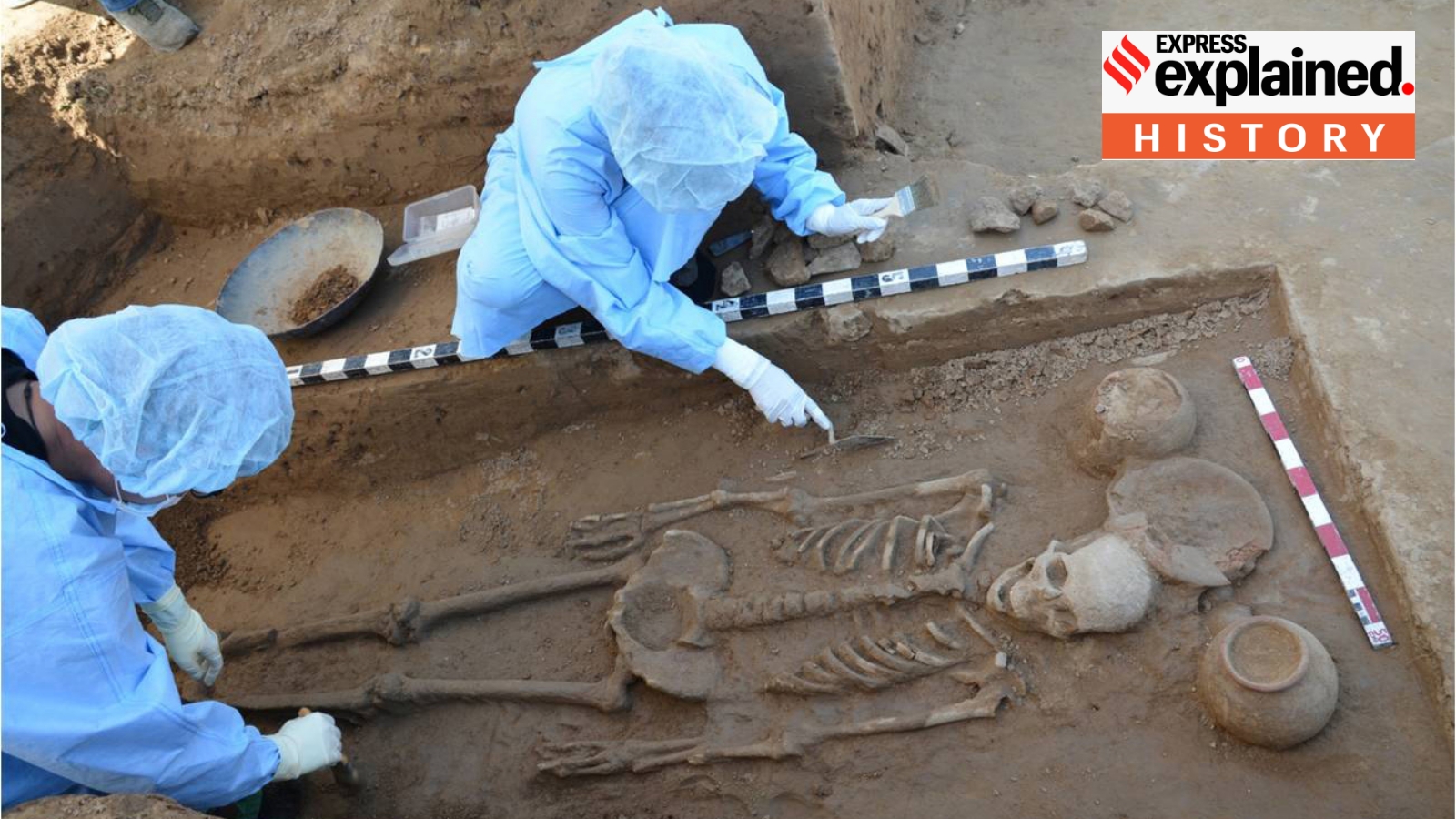
DNA experts examine a human skeleton excavated at Rakhigarhi in Hisar district of Haryana. Photo: Express archive
Written by Shatakshi Saklani
Human skeletal remains excavated from the Harappan site of Rakhigarhi in Haryana have been formally handed over by the Archaeological Survey of India (ASI) to the Anthropological Survey of India (AnSI), a national research institute under the Union Ministry of Culture, for scientific investigation.
In a Press Information Bureau (PIB) release Monday (June 22), the Ministry said that archaeologists uncovered eight burials at the site’s Mound No. 7 during excavations conducted by ASI in the 2025-26 field season. Field season refers to the primary period during the year when archaeologists conduct active fieldwork, such as excavations and surveys.
Three complete human skeletons, along with skeletal fragments recovered from other burials, have now been transferred to AnSI’s ancient human skeletal repository and laboratory in Kolkata, the PIB note said. The remaining skeletal materials obtained at these sites are also expected to be transferred in the coming days.
Professor B V Sharma, director of AnSI, said that the transfer, carried out under a recently signed Memorandum of Understanding between the two institutions, is expected to significantly advance multidisciplinary research into one of the most important urban centres of the “Indus-Saraswati Civilization”.
According to AnSI, the research will be conducted in collaboration with leading scientific institutions, including the Birbal Sahni Institute of Palaeosciences (BSIP), University College London (UCL), and a team of scholars from Banaras Hindu University (BHU) specialising in ancient DNA research. Here’s what to know.
What can ancient human remains tell us?
Material remains are a crucial source in reconstructing information about the Harappan Civilisation, since its script remains undeciphered.
Story continues below this ad
Human skeletal remains discovered from across Harappan sites have been the focus of several interdisciplinary studies. In A History of Ancient and Early Medieval India (2024), historian Upinder Singh wrote: “Archaeologists increasingly rely on various scientific techniques in order to obtain precise information about the lives of past communities.”
Human remains have been increasingly studied using approaches from palaeoanthropological research (interdisciplinary study of human evolution), molecular biology, and DNA studies. These techniques have enabled researchers to investigate what ancient people may have looked like and to trace patterns of ancestry and migration.
Palaeopathological investigations — which study ancient diseases and medical conditions using physical human and animal remains — can help shed light on the diseases that the inhabitants of the Indus Valley Civilisation may have suffered and their overall health status. Additionally, study of the teeth and mandibles (lower jawbone) of the Harappan people can help reconstruct their dietary practices. Singh wrote: “The dental structure of humans is connected to subsistence patterns and methods of food preparation.”
Since patterns of food consumption and nutrition are related to social standing, assessing the nutritional inputs in the skeletal remains of men and women can provide insight into disparities in status between various social groups. Differences in burials and the study of grave goods can further be used to make interpretations about social status and cultural practices of the Indus Valley inhabitants.
Why is Rakhigarhi important?
Story continues below this ad
Located in Haryana’s Hisar district, Rakhigarhi is widely recognised as one of the largest Harappan sites in India, spread across approximately 550 hectares. The site was occupied from the Early Harappan phase (circa 3300-2600 BCE) to the Mature Harappan phase (circa 2600-1900 BCE).
Archaeological excavations at the site have revealed evidence of a planned urban settlement including mud-brick fortifications, streets and drains. The site also boasts a well-developed craft tradition with the discovery of pottery, terracotta figurines, and uninscribed seals. A lapidary workshop was identified, providing evidence of beadmaking. There is also evidence of bone and ivory working.
Rakhigarhi is also significant as one of the Harappan sites where cemeteries and human burials have been discovered.
Why does the transfer matter?
The transfer of the Rakhigarhi skeletal remains marks more than a simple administrative exercise — it underscores the adoption of an increasingly interdisciplinary approach towards the reconstruction of Harappan past, bringing together archaeology with insights from anthropology, genetics and environmental sciences to develop a more holistic understanding.
Story continues below this ad
By applying modern scientific methods to the study of skeletal remains, researchers hope to gain valuable insights into the origins, health, mobility, and biological history of South Asia’s earliest urban civilisation.
The author is an intern with The Indian Express.
View original source — Indian Express ↗
Related stories

ZDNet
TechnologyJun 24, 2026 · 1 min
LastPass hit by new data breach - 4 steps you should take now
ZDNet

The Guardian
TechnologyJun 24, 2026 · 1 min
Every Apple Watch is at the lowest price we’ve ever seen thanks to Prime Day
The Guardian

ZDNet
TechnologyJun 24, 2026 · 1 min
Google Home Speaker review: The smart speaker that elevates the Gemini for Home experience
ZDNet

Wired
TechnologyJun 24, 2026 · 1 min
The Samsung 990 Pro SSD Is on Sale for the Lowest Price You’re Likely to See This Year.
Wired