The Next Web
Main Capital raised the Netherlands’ biggest-ever fund on boring software
While public markets panic that AI will gut enterprise software, a quiet Dutch firm just raised €5.25bn on the opposite bet. Main Capital’s pitch: boring, essential software is exactly where the next decade of value sits.
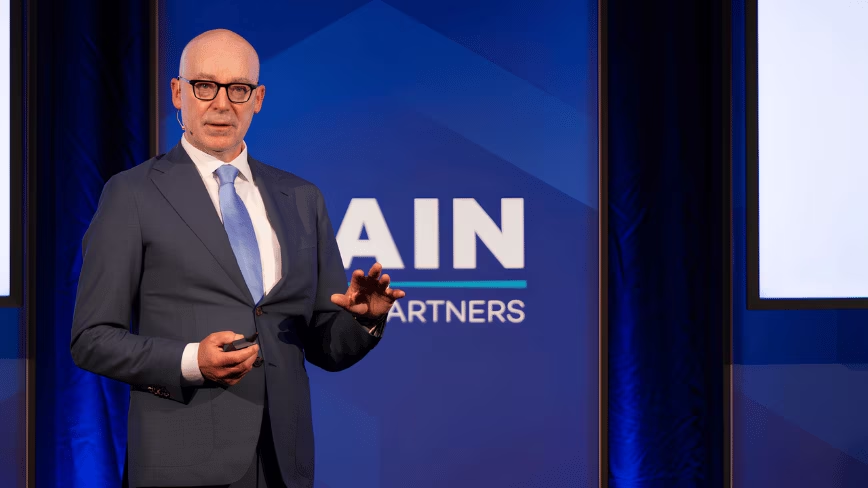
Charly Zwemstra has spent 23 years buying software that almost nobody finds exciting. Think hospital appointment systems, municipal tax records, accounting workflows. The kind of software an organisation never thinks about until it breaks. This week, investors handed his firm €5.25bn to keep doing exactly that.
Main Capital Partners, the Hague-based enterprise software investor, closed two new funds at their hard caps in under six months. Main Capital IX reached €4bn, more than double its predecessor. Main Foundation III reached €1.25bn, also more than double the fund before it. Both were oversubscribed.
Together they push Main’s assets under management past €12bn, and the firm says the raise is the largest private equity buyout fundraise ever completed in the Netherlands.
The size is notable. The timing is the real story.
The 💜 of EU tech
The latest rumblings from the EU tech scene, a story from our wise ol' founder Boris, and some questionable AI art. It's free, every week, in your inbox. Sign up now!
Raising against the panic
Main closed this money into a market that has turned on software. The iShares software ETF has fallen about 30% from its September 2025 peak, according to Tech Funding News. Salesforce, Workday and Atlassian have all shed serious value since February. The fear is simple: that AI automation will hollow out enterprise software from the inside.
That fear has rattled the buyout world too. Firms such as Thoma Bravo and Vista Equity Partners spent recent months reassuring their investors through letters and webinars. Main’s investors asked for no such comfort.
The reason sits in one number. Over 23 years, Main has recorded a loss rate well below 0.5%. In private equity, where write-offs are routine, that is close to unheard of. Add 38 exits at a weighted average gross return of 4.7x, and the track record did the persuading. Existing backers re-upped at more than 120%, meaning they committed more than they had before.
Hamilton Lane raised its cheque. New money arrived too. It came from sovereign wealth funds, public pension funds and insurers across the US, Asia and the Middle East. Among them were the State Teachers’ Retirement System of Ohio and the Korean Teachers’ Credit Union. Main ran the whole process without a placement agent.
The unglamorous machine
Main’s model is simple to describe and hard to copy. It buys profitable software companies in narrow niches, then bolts on related businesses to build cross-border market leaders. The firm writes equity cheques from €5m to €150m. It has now completed more than 300 acquisitions, roughly 100 platform deals and over 200 build-ups.
The portfolio runs to more than 55 companies and over 15,000 employees across Europe and North America. None of it is glamorous. All of it is sticky.
A municipality does not casually switch tax software, and a hospital does not rip out its scheduling system on a whim. That switching cost is the whole point. It is why the cash flows hold up when fashionable SaaS names wobble.
The model runs constantly in the background. In recent weeks alone, Main has taken a majority stake in Ferranti, a Belgian maker of mission-critical software for utilities, and merged its HR platform BCS with Timegrip to build a pan-European payroll group. Neither deal made headlines. Both are the strategy in miniature.
Zwemstra founded Main in 2003 after leaving AlpInvest Partners, and was an early mover in European software buyouts. Two decades on, the approach looks less like a niche and more like a moat.
Betting that AI helps, not hurts
Main’s read on AI is the inverse of the market’s. Where others see a threat to enterprise software, the firm sees an acquisition opportunity. “We stand at an inflection point,” Zwemstra said. “AI is unlocking a new wave of growth and value creation opportunities.”
The firm backs that claim with its own data. Main runs proprietary market-intelligence tools across its portfolio to track where AI is creating durable value and where it is squeezing the prices incumbents can charge.
The logic is that consolidation and AI now point the same way. A fragmented market of small, essential software vendors is easier to roll up when buyers want fewer suppliers and more capable products. Main thinks it can supply both.
Those product-markets span healthtech, govtech, infrastructure and proptech. Each is full of small vendors sitting on troves of regulated, hard-to-replace data. That data is exactly what makes an AI feature useful, and exactly what a new entrant cannot easily copy. Main is betting the incumbents it already owns start the AI race a step ahead.
The wider market may be turning back its way. Enterprise software deal flow in the first half of 2026 is at its highest since 2021, as financing reopens and mid-cap software still trades below its peaks.
For a firm built to buy important software at careful prices, cheaper targets are a gift, not a threat.
A European champion heads to the UK
The new funds also pay for expansion. For the first time in its history, Main will actively chase platform investments in the United Kingdom, which it calls one of Europe’s most mature software markets. The UK becomes a sixth core market alongside Benelux, DACH, the Nordics, France and North America.
Main opened a Boston office in 2023 and a Paris office in 2025, and now runs roughly 100 staff across six locations.
For European tech, the shape of this matters. A Dutch firm has quietly built a €12bn software investor without leaving the continent’s unfashionable middle market, and global pension money is now chasing it. That is a rarer outcome in Europe than the funding headlines usually suggest.
The open question is whether discipline can outlast the cycle. Main’s entire case rests on essential software staying essential, and on AI lifting those businesses rather than eventually eroding them. The firm has 23 years and a sub-0.5% loss rate arguing it is right. The next few years, and €5.25bn, will test whether the boring bet still holds when AI reaches the boring software too.
View original source — The Next Web ↗
Related stories

TechRadar
TechnologyJun 24, 2026 · 1 min
My Apple Watch’s daily charging habit put me off smartwatches — this Prime Day Garmin deal has pulled me back in
TechRadar

The Verge
TechnologyJun 24, 2026 · 1 min
Figma now has AI motion graphics and shader tools
The Verge

TechCrunch
TechnologyJun 24, 2026 · 1 min
Figma adds code layers, support for animations, more AI features in new update
TechCrunch
ZDNet
TechnologyJun 24, 2026 · 1 min
10 of the best Prime Day Lenovo laptop deals, vetted by hands-on reviews
ZDNet