Indian Express
UPSC Key: Kharif Crops, Non-governmental Organizations and Lipulekh pass
Rainfall 43% deficit so far, kharif crops likely to be hit: Govt
Syllabus:
Preliminary Examination: Current events of national and international importance
Main Examination: General Studies II: Indian Economy and issues relating to planning, mobilization, of resources, growth, development and employment and Major crops-cropping patterns in various parts of the country
What’s the ongoing story: With India staring at a fairly weak monsoon season this year and kharif crops likely to be impacted, the Agriculture Ministry has formulated contingency plans for districts likely to be most affected due to low rainfall, and identified 111 districts with irrigation coverage of 25 per cent or less as ‘high priority’ needing intervention, Agriculture Minister Shivraj Singh Chouhan said on Tuesday.
Key Points to Ponder:
• Monsoon mechanism in India-Know in detail
• What is the arrival and departure of monsoon?
• What is the all India monthly and seasonal rainfall?
• What do we mean by long period average (LPA) of rainfall?
• What is large excess, excess, normal, deficient, large deficient rainfall?
• How has the monsoon progress been so far?
• Why has the monsoon slowed?
• Which is the main rabi growing states in India?
• Kharif and Rabi Crops-Compare and Contrast
• How monsoon impacts Kharif Crops?
• Is monsoon the backbone of Indian economy?
• How Monsoon impacts on sowing?
• Why is the Southwest Monsoon critical for Kharif agriculture in India?
Key Takeaways:
• After chairing a review meeting, held over video conference, with state agriculture ministers, senior officials and district collectors, Chouhan said that 315 districts across the country were likely to be affected due to low monsoon rainfall.
• “Of these (315 districts), 111 districts are of high priority, where the irrigation coverage is less than 25 per cent; 76 districts are of medium priority, where 25-50 per cent irrigation is available; 128 districts are of low priority, where relatively better irrigation is available through dams and other means. The bulk of these districts are in 12 states — Madhya Pradesh, Maharashtra, Gujarat, Uttar Pradesh, Rajasthan, Karnataka, Bihar, Jharkhand, Telangana, Andhra Pradesh, Odisha and Tamil Nadu,” Chouhan said, addressing a press conference after the meeting.
• He said a detailed discussion was held with the state agriculture ministers and district collectors, and they were urged to intensify preparations at the local level.
Do You Know:
• The India Meteorological Department (IMD) has said that the country as a whole was expected to receive rains that were only 90 per cent of the long period average during the monsoon season. If that turns out to be the case, it would be the driest monsoon season in India in over a decade. As of now, the situation is looking even more grim.
• For June, IMD had predicted 92 per cent rainfall. But with just one week remaining in the month, the shortfall in rainfall over the country as a whole is more than 42 per cent. Of the 36 States and Union Territories, as many as 26 have a deficiency of 20 per cent or more, as on Tuesday. Nine of these have a deficiency of more than 60 per cent.
• June was predicted to be one of the better months in this monsoon season, with the latter months expected to be more impacted by the El Nino phenomenon. But the progress of the monsoon remained stalled for a week after June 15.
Other Important Articles Covering the same topic:
📍Delayed monsoon forces rethink on kharif sowing: Farmers advised to use more seeds, cut acreage
Previous year UPSC Prelims Question Covering similar theme:
1) Consider the following statements: (UPSC CSE, 2012)
1. The duration of the monsoon decreases from southern India to northern India.
2. The amount of annual rainfall in the northern plains of India decreases from east to west.
Which of the statements given above is/are correct?
(a) 1 only
(b) 2 only
(c) Both 1 and 2
(d) Neither 1 nor 2
2) Which of the following activities constitute real sector in the economy? (UPSC, CSE, 2022)
1. Farmers harvesting their crops
2. Textile mills converting raw cotton into fabrics
3. A commercial bank lending money to a trading company.
4. A corporate body issuing Rupee Denominated Bonds overseas.
Select the correct answer using the code given below:
(a) 1 and 2 only
(b) 2, 3 and 4 only
(c) 1, 3 and 4 only
(d) 1, 2, 3 and 4
Previous year UPSC Main Question Covering similar theme:
📍Why is the South-West Monsoon called ‘Purvaiya’ (easterly) in Bhojpur Region? How has this directional seasonal wind system influenced the cultured ethos of the region? (UPSC, 2023)
POLITICS
Govt tightens FCRA norms for NGOs getting foreign funds, revises penalties
Syllabus:
Preliminary Examination: Current events of national and international importance.
Main Examination: General Studies II: Development processes and the development industry —the role of NGOs, SHGs, various groups and associations, donors, charities, institutional and other stakeholders.
What’s the ongoing story: The Union Home Ministry has tightened the foreign funding framework for NGOs and associations under the Foreign Contribution Regulation Act (FCRA). It has issued two notifications that sharply revise penalties and specify purpose-based, geography-linked registration while explicitly keeping foreign money out of proselytising activities.
Key Points to Ponder:
• What amendment is made in the Foreign Contribution (Regulation) Rules, 2011?
• What is proselytization?
• In what context the term ‘proselytization’ is used in Foreign Contribution (Regulation) Act (FCRA)?
• Foreign Contribution (Regulation) Act (FCRA)-What and When it was enacted?
• Rationality behind the enactment of Foreign Contribution (Regulation) Act (FCRA)?
• NGOs and FCRA-why most of the NGOs are brought under FCRA?
• What is foreign contribution defined in Section 2(1)(h) of FCRA, 2010?
• What is a foreign source?
• Can NGOs use the foreign contributions for investment in Mutual Funds and other speculative investments?
• Who can receive foreign contribution?
• Who cannot receive foreign contribution?
• Are there any banned organisations from whom foreign contribution should not be accepted?
• What is ‘pressure group’?
• What is Non-governmental Organizations?
• What are the legislations which regulates the finances of NGOs in India?
• A large number of Non-governmental Organizations (NGOs )exist in India-Can you recall some of those?
• Relationship between Government and Non-governmental Organizations -Analyse
• What is difference between charity and Non-Governmental Organization (NGO)?
• Know the terms and differences between them- Non-Governmental Organization, Non-Profit Organization Charity Organization, Pressure Group and Social Enterprise
Key Takeaways:
• The first notification amends the Foreign Contribution (Regulation) Rules, 2011, requiring every FCRA registration to specify both the purposes for which foreign funds can be used and the States or Union Territories where such activities can be undertaken. Organisations must now select their activities from a government-prescribed Schedule of 105 permissible purposes.
• Existing FCRA-registered associations have been given one year to indicate the purposes and geographical areas they wish to retain in their registration. Any subsequent expansion in scope will require fresh approval.
• The notification also broadens the definition of “key functionary”, restricts organisations with foreign nationals in key management positions from ordinarily receiving registration or prior permission, introduces a minimum utilisation requirement for renewal and cancellation decisions, tightens conditions for release of subsequent instalments of foreign funds, and mandates more extensive disclosures in annual returns, including activity reports, social media account details and information on ultimate donors.
• The second notification revises compounding penalties for violations such as excess administrative spending, speculative investments, diversion of foreign funds and use of foreign contributions outside approved purposes or areas.
• The changes mark a shift from a relatively broad, programme-based framework to a far more prescriptive regulatory regime.
• Under the 2011 Rules, organisations broadly identified themselves as undertaking religious, cultural, educational, economic or social activities and described their programmes. The new rules require them to choose from a government-notified list of approved activities, with registrations tied to those specific purposes.
• A second major change is geographical restriction. While organisations earlier disclosed their areas of operation, registration itself was not linked to specific states or Union Territories. The new framework makes geography part of the licence.
• The 2011 rules referred mostly to “Members of the Executive Committee or Governing Council” and “Chief Functionary”, without defining “key functionary” which have now been specified as directors of companies, partners in firms, trustees of trusts, the Karta of a Hindu Undivided Family, office bearers and members of governing bodies, and “any other officer or person… who has control over, or responsibility for the management or affairs” of the association.
• The rules also explicitly exclude “proselytisation” from permitted religious activities, define “key functionary” more broadly, place new restrictions on organisations with foreign nationals in leadership positions, introduce a minimum utilisation threshold for foreign funds, and tighten scrutiny of organisations receiving funds through prior permission. Taken together, the changes significantly increase government oversight over how, where and for what purposes foreign contributions can be used.
Do You Know:
• One of the most notable features of the new Schedule is the repeated use of the phrase “excluding proselytisation” in relation to religious activities.
• While the 2011 rules recognised a range of religious activities, they did not expressly refer to proselytisation. The new framework allows faith-based activities such as religious education, theological study, preservation of religious traditions and religious gatherings, but explicitly excludes conversion-oriented work.
• The Constitutional backdrop is significant. Article 25 guarantees the right to profess, practise and propagate religion, but the Supreme Court in Rev Stainislaus vs State of Madhya Pradesh (1977) held that the right to propagate religion does not include a right to convert another person.
• By expressly excluding proselytisation, the Centre is signalling that foreign contributions can support religious and faith-based activities, but not conversion-oriented work.
• Since coming to power, the Narendra Modi government has faced allegations of targeting Christian organisations under the FCRA regime over suspicions of conversion. Several Christian institutions, including Missionaries of Charity, Compassion International, World Vision India, Evangelical Fellowship of India and Church of North India-linked entities, have faced FCRA action.
• The government’s stated rationale is to strengthen oversight of foreign funding, plug compliance gaps and improve monitoring of how foreign contributions are used.
Other Important Articles Covering the same topic:
📍FCRA Amendment Bill introduced in Lok Sabha, Opposition calls it ‘draconian’, ‘dangerous’
Previous year UPSC Main Question Covering similar theme:
📍Examine critically the recent changes in the rules governing foreign funding of NGOs under the Foreign Contribution (Regulation) Act (FCRA), 1976. (UPSC, 2015)
The Big Picture
Via Lipulekh
Syllabus:
Preliminary Examination: Current events of national and international importance.
Mains Examination: General Studies II: India and its neighbourhood- relations.
What’s the ongoing story: With the Lipulekh Pass now set to reopen for trade after seven years, The Indian Express takes you on a cross-border route marked by geography and geopolitics.
Key Points to Ponder:
• Map Work-Lipulekh pass, Nathula Pass, Lake Manasarovar, Mahakali River, Mount Kailash, Limpiadhura, Kalapani, Indian states bordering Nepal, China-Nepal border.
• What is the importance of Kailash-Mansarovar Yatra?
• Know the cultural, economic, and strategic implications of Kailash Mansarovar Yatra
• Treaty of Sugauli, 1816-what you know about the same?
• How much land did Nepal lose in the Sugauli Treaty?
• Why is the Treaty of Sugauli important?
• Lipulekh pass-Why dispute exists?
• India-Nepal Bilateral relations-know the historical background
• What is the India-Nepal Treaty of Peace and Friendship of 1950?
• India-Nepal Bilateral relations-What is the present situation?
• India-Nepal Border Dispute-Know in details
• India and Nepal have border disputes over what areas?
• Why has this border dispute become so politically charged in Nepal?
• China, India and Nepal-Connect the dots
• Is China’s political influence in Nepal harming Indian interests?
• Why is Nepal so important?
• India-Nepal Bilateral Relations and Shared Heritage-Know in detail
• What is India’s Neighbourhood First Policy?
• India’s Neighbourhood First Policy and Nepal-Connect the dots
Key Takeaways:
• The Pass is set to reopen after seven years, opening the door to a cross-border trade that is buffeted by the vagaries of geography and geopolitics. The Pass has stayed shut since 2019, first due to the pandemic and later as India-China border skirmishes led to a chill in bilateral relations.
The road to Lipulekh from Dharchula.
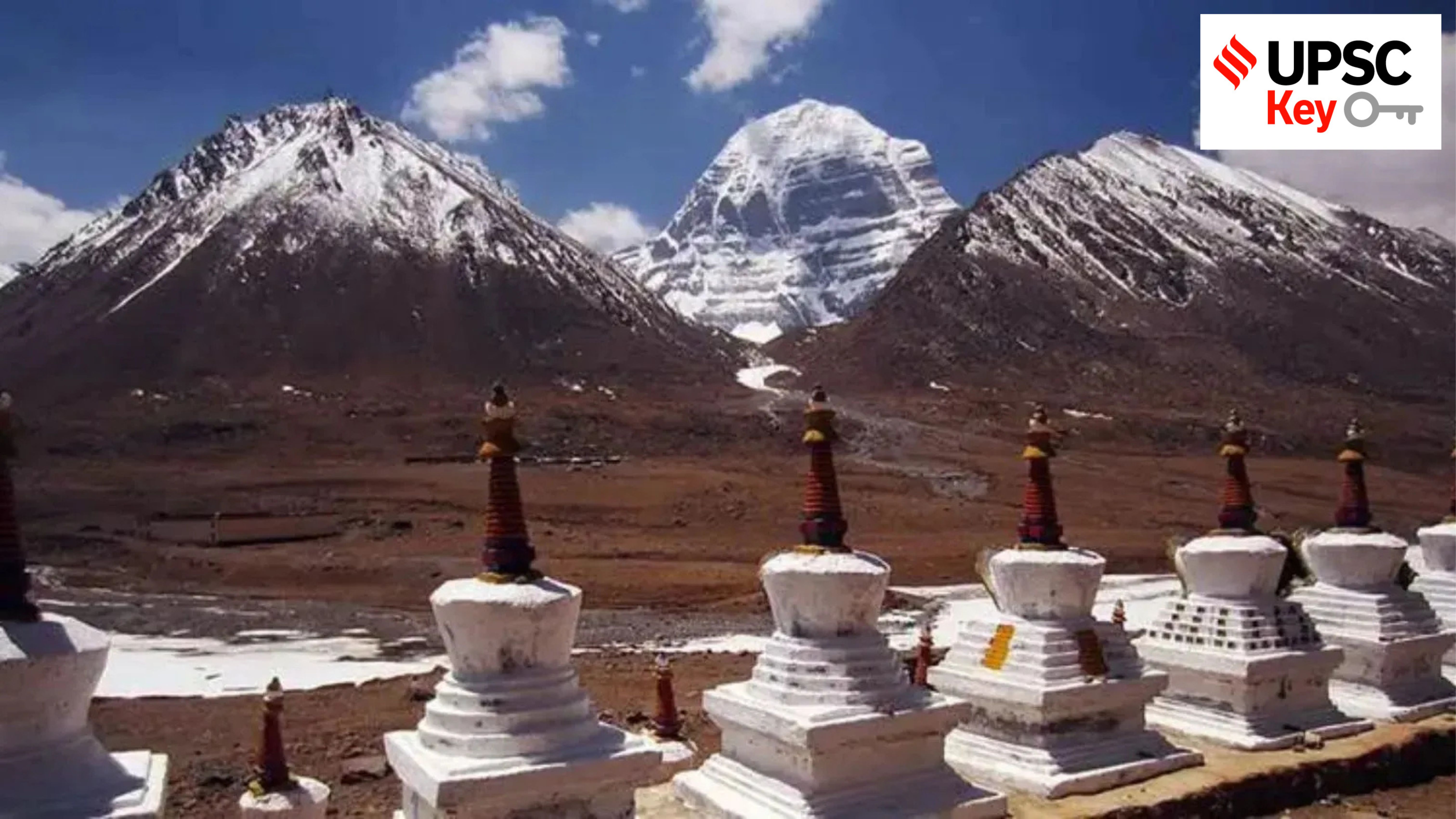
• At the trijunction of India, Nepal, and China’s Tibet Autonomous Region, the Lipulekh Pass loops its way through the snow-covered Himalayan ranges, reaching 17,000 feet at its highest point. The Pass has for centuries served as the gateway for pilgrims headed to Mount Kailash as part of the Mansarovar Yatra and Lake Manasarovar in Tibet. It’s also a historical transit point for trade between India and the Taklakot market in Tibet.
• The region is contested, with Nepal claiming Lipulekh and the larger region, including Kalapani and Limpiyadhura, based on the 1816 Treaty of Sugauli.Which is why the Pass, and the announcement earlier this year to reopen it for business, holds immense strategic value despite the low trade volumes.
• Trade between the two regions was first suspended during the 1962 war with China, and reopened only in 1992. Since then, every diplomatic chill would be accompanied by uncertainty and fears that it would impact trade. But as India and China worked to mend their relationship, in 2025, the government opened the route for the Mansarovar Yatra and earlier this year, announced the reopening of the Lipulekh Pass for trade.
Do You Know:
• On April 30, India announced that the Kailash Mansarovar Yatra is set to take place from June to August this year. Nepal’s objection to Lipulekh pass being used for the yatra and India challenging Kathmandu’s premise sets a road¬block that needs to be removed before the pilgrims begin their journey.
• The Nepalese Foreign Ministry was referring to India and China resuming trade through the Lipulekh pass in August 2025, before the GenZ protests toppled the government in September 2025.
• Lipulekh pass became a point of discord between India and Nepal in 2020, when the Oli government had objected to India building infrastructure and a road there. This had led to Nepal publishing its own map, claiming Lipulekh. India rejected such claims in May 2020, as well as in August 2025 when Kathmandu objected to Delhi’s plans to start trade with China through the pass.
• Treaty of Sugauli, 1816— Signed on March 4, 1816, to end the Anglo-Nepalese War (1814–1816), the Treaty of Sugauli established the western boundary of Nepal along the Kali River (Mahakali/Sarada). It forced Nepal to surrender territories like Garhwal, Kumaon, and the Tarai to the British East India Company. The treaty remains the basis for ongoing Kalapani border disputes.
Other Important Articles Covering the same topic:
📍Mapping the history of Kalapani dispute between India and Nepal
Previous year UPSC Prelims Question Covering similar theme:
3) Consider the following statements in respect of BIMSTEC: (UPSC, 2025)
I. It is a regional organization consisting of seven member States till January 2025.
II. It came into existence with the signing of the Dhaka Declaration, 1999.
III. Bangladesh, India, Sri Lanka, Thailand and Nepal are founding member States of BIMSTEC.
IV. In BIMSTEC, the subsector of ‘tourism’ is being led by India.
Which of the statements given above is/are correct?
(a) I and II
(b) II and III
(c) I and IV
(d) I only
Previous year UPSC Main Question Covering similar theme:
📍‘China is using its economic relations and positive trade surplus as tools to develop potential military power status in Asia’. In the light of this statement, discuss its impact on India as her neighbour. (UPSC, 2017)
EXPLAINED
Before tariff reset, will US and India strike balance?
Syllabus:
Preliminary Examination: Current events of national and international importance.
Main Examination: General Studies II: Bilateral, regional and global groupings and agreements involving India and/or affecting India’s interests.
What’s the ongoing story: As US Trade Representative (USTR) Jamieson Greer leads his first trade delegation to India after over a year of negotiations, the two countries appear to be closer than ever to finally completing their trade deal.
Key Points to Ponder:
• What is Section 301 of the of the U.S. Trade Act of 1974 ?
• The International Emergency Economic Powers Act (IEEPA) tariffs-know its key highlights.
• Why US Supreme Court declared the International Emergency Economic Powers Act (IEEPA) tariffs illegal
• How the Supreme Court judgment on IEEPA tariffs impacted India-US trade deal?
• What is the difference between Section 301 and 232 tariffs?
• The United States has implemented final punitive tariffs on India under Section 301-True or False?
• What is meant by import duty?
• What is the role of import duties in managing trade relations?
• India–US economic and trade relations-know in detail
• Know the significance of the United States as a trade and investment partner for India.
• What are the key areas of convergence and divergence in India–US trade negotiations?
Key Takeaways:
• Greer, in an op-ed last year, wrote that US President Donald Trump uniquely recognises that the privilege of selling into the world’s most lucrative consumer market is a “mighty carrot” and a tariff is a “formidable stick”. America’s approach to trade deals across the globe and the timing of USTR’s visit to India encapsulates this carrot-and-stick approach.
• The US had imposed sweeping reciprocal tariffs on several countries last year under a rarely-used legislation called the International Emergency Economic Powers Act (IEEPA). In February, however, the US Supreme Court struck down these reciprocal tariffs, prompting the administration to use alternative legislation to resurrect its tariff policy.
• One of these pieces of legislation was under Section 122, which gives the US authority to impose 10% tariffs for 150 days. These are now set to lapse on July 24 — when Washington is expected to introduce a new, steeper tariff architecture under Section 301 of the US Trade Act of 1974.
• The final stretch of the India-US talks come right before this. The US has already proposed 12.5% tariffs on India and is expected to release the findings of its second Section 301 investigation on India and 15 other countries well before July 24.
• India is among the handful of countries with whom the US is yet to formally sign a trade deal. It has already sealed deals with nearly a dozen trade partners, including the EU, Japan, South Korea and several ASEAN countries.
Do You Know:
• Under IEEPA, the US President has the power “to deal with any unusual and extraordinary threat, which has its source in whole or substantial part outside the United States, to the national security, foreign policy, or economy of the United States, if the President declares a national emergency with respect to such threat.”
• Before Trump, the Act was used to impose sanctions on other nations, with Carter declaring a national emergency in the wake of the 1979 Iran hostage crisis to freeze all Iranian government assets in the US. This emergency has been renewed annually by eight successive presidents over 40 years, leaving the US in a virtual state of emergency ever since. George W Bush did something similar in 2001 following the September 11 attacks. As of September 1, 2025, 77 national emergencies have been declared under IEEPA, of which 46 are ongoing, according to a Congressional Research Service report.
• However, no US President before Trump had interpreted IEEPA to impose tariffs. The executive order announcing the
sweeping ‘Liberation Day’ tariffs of April 2, 2025, said the US is facing a “national emergency” due to the “foreign trade and economic practices” and the
“absence of reciprocity” in trade relationships.
• India was one of the worst hit by tariffs that resulted in a flight of foreign investment and resulted in steep depreciation of the domestic currency. The rupee has fallen almost 12% in the last one year. A formal trade deal remained aloof for months as the US demanded that India wind down imports of Russian oil and accept genetically-modified American agricultural products.
• The India-US joint statement of February said India will eliminate or reduce tariffs on all US industrial goods and a wide range of US food and agricultural products, including dried distillers’ grains (DDGs), red sorghum for animal feed, tree nuts, fresh and processed fruit, soybean oil, wine and spirits, and additional products.
Other Important Articles Covering the same topic:
📍UPSC Issue at a Glance | India-US Interim Trade Deal: Backdrop, key highlights, gains, and concerns
Previous year UPSC Main Question Covering similar theme:
4) Consider the following statements: (UPSC CSE, 2023)
Statements-I: Recently, the United States of America (USA) and the European Union (EU) have launched the ‘Trade and Technology Council’.
Statement-II: The USA and the EU claim that through this they are trying to bring technological progress and physical productivity under their control.
Which one of the following is correct in respect of the above statements?
(a) Both Statement-I and Statement-II are correct and Statement-II is the correct explanation for Statement-I
(b) Both Statement-I and Statement-II are correct and Statement-II is not the correct explanation for Statement-I
(c) Statement-I is correct but Statement-II is incorrect
(d) Statement-I is incorrect but Statement-II is correct
Previous year UPSC Mains Question Covering similar theme:
📍‘What introduces friction into the ties between India and the United States is that Washington is still unable to find for India a position in its global strategy, which would satisfy India’s National self-esteem and ambitions’. Explain with suitable examples. (UPSC, 2019)
Intellectual disabilities & the question of choice in giving birth
Syllabus:
Preliminary Examination: Current events of national and international importance.
Mains Examination: General Studies II: Issues relating to development and management of Social Sector/Services relating to Health, Education, Human Resources.
What’s the ongoing story: The Karnataka High Court permitted the parents of a 23-year-old woman with severe intellectual and developmental disabilities a total abdominal hysterectomy, or the surgical removal of the uterus, last week.
Key Points to Ponder:
• What is reproductive autonomy of a woman?
• What Medical Termination of Pregnancy Act says about abortion?
• Is medical termination of pregnancy allowed?
• ‘Reproductive autonomy is central to the right to life and personal liberty under Article 21’—Discuss in light of recent Supreme Court’s order.
• What is hysterectomy?
• Why is there a need to perform hysterectomy?
• Hysterectomy has several positive and negative effects on women’s physical and psychosocial health-what are they?
Key Takeaways:
• Her parents had approached the court stating that their daughter’s cognitive impairments made her incapable of understanding or managing menstrual hygiene, which had led to recurring infections and prolonged medical complications. After a multidisciplinary medical board confirmed that the woman lacked the capacity to give informed
consent and recommended the surgery for her well-being, the court allowed the procedure.
• The judgment was the latest instance of courts’ intervention in the reproductive autonomy of women with intellectual disabilities — decisions that often involve the complex intersection of law, medicine, and human rights.
• Historically, women with intellectual disabilities have been highly vulnerable to forced sterilisations and non-consensual medical procedures, often justified by caregivers as a matter of convenience or under the guise of protecting them from the consequences of sexual abuse.
• To prevent this, Indian law places strict safeguards on procedures that permanently alter a person’s reproductive capacity. Section 10 of the Rights of Persons with Disabilities Act, 2016, prevents persons with disability from being subjected to any medical procedure leading to infertility without their free and informed consent.
• A legal dilemma, however, arises when a woman’s intellectual disability is so severe that she lacks the cognitive capacity to understand the nature, risks, and consequences of a procedure, rendering her unable to give “informed consent”.
• In such scenarios, caregivers and doctors cannot unilaterally make the decision and must approach a court. The courts invoke what is known as “parens patriae” — a legal doctrine wherein the court steps into the shoes of a guardian for individuals unable to care for themselves. The court does not simply substitute its own judgment for the individual’s; it conducts an inquiry to determine what course of action lies in the “best interests” of the person — that prioritises their health, dignity, and bodily integrity.
• The issue of consent and medical necessity in hysterectomies was addressed by the Supreme Court in the 2023 case of Dr Narendra Gupta v. Union of India, a public interest litigation that highlighted that “unnecessary hysterectomies” were being carried out on women, particularly from marginalised communities, under government health insurance schemes. These procedures were often allegedly performed in private hospitals without informing the women about the side-effects or obtaining their informed consent.
• Recognising this as a serious violation of the fundamental right to health under Article 21 of the Constitution, the Supreme Court directed all states and Union Territories (UTs) to strictly implement the Union Health Ministry’s 2022 Guidelines to Prevent Unnecessary Hysterectomies. The court mandated the formation of hysterectomy monitoring committees at the national, state and district levels to audit such surgeries and directed the blacklisting of hospitals found performing the procedure without medical necessity or informed consent.
Do You Know:
• While the Karnataka case dealt with a hysterectomy, most of the jurisprudence regarding the reproductive rights of intellectually disabled women in India revolves around pregnancies, often resulting from sexual assault. Here, the Medical Termination of Pregnancy Act, 1971, comes into play. Under the Act, if a pregnant woman has a mental illness, a pregnancy can be terminated with the written consent of her guardian. The law, however, does not extend this guardian-consent provision to women with intellectual disabilities. For them, their own consent remains an absolute legal requirement for an abortion.
• This distinction came to the fore in Suchita Srivastava v. Chandigarh Administration, a landmark 2009 Supreme Court judgment. In this case, a woman with mild intellectual disability residing in a state-run welfare home in Chandigarh was raped and became pregnant. The UT’s administration approached the judiciary seeking to terminate the pregnancy, assuming she was unfit for motherhood. The woman, however, expressed a desire to keep the child.
Other Important Articles Covering the same topic:
📍SC asks states, UTs to implement Centre’s guidelines on ‘unnecessary’ hysterectomies
Previous year UPSC Main Question Covering similar theme:
📍What are the continued challenges for Women in India against time and space? (UPSC, 2019)
The straightforward constitutional process to replace the UK PM
Syllabus:
Preliminary Examination: Current events of national and international importance
Mains Examination: General Studies II: Effect of policies and politics of developed and developing countries on India’s interests and Comparison of the Indian constitutional scheme with that of other countries.
What’s the ongoing story: UK Prime Minister Keir Starmer formally announced his resignation on Monday (June 22) after weeks of speculation, with the resignation extending to the leadership of the Labour Party as well.
Key Points to Ponder:
• Why did British Prime Minister Keir Starmer resign?
• How the UK chooses its PM?
• When might a new leader be selected?
• Does this mean a coronation?
• Will there be a general election?
• Is post-Brexit Britain too difficult to govern?
• What is the difference between the British Parliament and the Indian Parliament?
Key Takeaways:
• Starmer had previously declared his intention to fight to protect his leadership less than a week ago. “If there is a challenge, I intend to fight in any challenge to my leadership”, he said during the G7 meeting. It was preceded by former Health Minister Wes Streeting’s statement that he was prepared to trigger a Labour leadership contest and throw his hat into the ring.
• But this followed another change of position, with Streeting urging Starmer to reconsider over the weekend. A few hours after Starmer’s resignation, Streeting threw his support behind Andy Burnham, the newly elected Member of Parliament (MP) for the Makerfield constituency.
• Starmer’s resignation and impending replacement mean that the UK will officially have had seven Prime Ministers over the course of a decade. Despite a Prime Minister’s fixed term of service being five years, not a single UK PM has come close to completing their term since 2016. Boris Johnson came the closest, having served as the PM from 2019 to 2022.
Do You Know:
• The UK Parliament consists of two Houses, the House of Lords and the House of Commons. The political party which holds the majority of the 650 seats in the House of Commons chooses the Prime Minister, who is usually the leader of the ruling party.
• A common misconception is that the PM is elected to serve a fixed term of five years. In reality, the limit applies to the parliamentary term for the party in power and not the individual that becomes the PM. Thus, even though the government and the party may enjoy popular support, the top leadership can continue to witness upheaval.
• The selection of the PM begins with the general elections, where citizens vote to choose their MP. This elected MP represents the local constituency in the House of Commons. The leader of the political party that secures the majority of the seats in the House of Commons is then invited by the Monarch (currently, the King) to form the new government.
• The loss of this internal confidence can trigger a leadership election within the party, which, if successful, leads to the replacement of the sitting PM. This provision is based on the fact that the British system treats the PM as the first among equals or the primus inter pares.
• In Starmer’s case, the former Labour Party leader had been the subject of intense scrutiny owing to poor results in the May local elections and the controversy over the appointment of Peter Mandelsor as the Ambassador to the US, despite his connection to the convicted child sex offendor Jeffrey Epstein.
Other Important Articles Covering the same topic:
📍Keir Starmer steps down as British PM, leader of Labour Party: What went wrong
Previous year UPSC Main Question Covering similar theme:
📍Compare and contrast the British and Indian approaches to Parliamentary sovereignty. (UPSC, 2023)
ECONOMY
Banks can extend loans against FCNR(B) deposits, says RBI
Syllabus:
Preliminary Examination: Current events of national and international importance.
Main Examination: General Studies III: Indian Economy and issues relating to planning, mobilization, of resources, growth, development and employment.
What’s the ongoing story: The Reserve Bank of India (RBI) on Tuesday said Indian banks, including their overseas branches, are permitted to extend loans to non-resident account holders or even issue Standby Letters of Credit (SBLC) in favour of overseas lenders against FCNR(B) deposits mobilised under the new swap facility.
Key Points to Ponder:
• What is Foreign Currency Non-Resident (Bank), or FCNR(B)?
• Why FCNR(B) deposits are significant in India’s external sector management?
• What is the role of NRIs in strengthening India’s foreign exchange position?
• What is the current account deficit?
• What is the interest rates and capital inflows?
• How can FCNR(B) deposits contribute to exchange rate stability?
Key Takeaways:
• The regulator has said that this permission is in addition to existing provisions that already allow banks to extend secured or unsecured credit and issue guarantees under normal banking norms.
• The RBI, in its clarification issued as frequently asked questions (FAQ), said banks are permitted to extend loans to the FCNR (B) account holders and mark lien on such deposits. Lien is a legal claim or right over someone else’s property until a debt or obligation is paid.
• On June 5, the RBI announced the special dispensation that allows banks to mobilise fresh three- to five-year FCNR(B) deposits until September 2026. It also permitted them to swap these deposits with the RBI at a concessional rate, effectively covering the entire hedging cost.
• By absorbing the hedging burden, the RBI has made FCNR(B) deposits a more attractive source of overseas funding for lenders. Experts believe the steps announced may attract an additional $50 billion in foreign capital into Indian markets as banks have offered higher interest rates after considering the hedging sops.
• The RBI will be providing a forex swap for the deposit received. The facility is a plain buy/sell foreign exchange swap from the RBI side covering only the principal amount of the deposits and not the interest component. “The bank will be allowed to undertake swaps for tenors of less than three years provided they have mobilised fresh eligible FCNR (B) deposits for minimum original tenor of three years as per the scheme,” it said.
• Interest rates on deposits, including where differential rates of interest are offered, will be subject to compliance with paragraph 32(2) of the Reserve Bank (Commercial Banks – Interest Rate on Deposits) Directions, 2025.
• Banks will continue to offer regular FCNR (B) deposits, without availing swap facility, for customer deposits with a tenor of 3 years and above up to 5 years, without the requirement of a minimum lock-in period of one year. However, records shall be maintained separately, it said.
• ECBs can be raised for any period, as permitted in terms of Foreign Exchange Management (Borrowing and Lending) (First Amendment) Regulations, 2026. However, the ECBs of average maturity of three years and above are eligible for this facility. Further, the tenor of the swap will be co-terminus with the repayment schedule or maturity of the ECB, subject to a maximum period of five years, the central bank said.
Do You Know:
• FCNR(B) deposits are fixed-term bank deposits that can be opened in India by NRIs, Overseas Citizens of India (OCIs), and Persons of Indian Origin (PIOs). These deposits allow overseas Indians to maintain their savings in designated foreign currencies such as the US dollar, pound sterling, euro, Japanese yen, Australian dollar, and Canadian dollar, rather than converting their funds into Indian rupees.
• Interest earned on FCNR(B) deposits is exempt from income tax in India as long as the depositor qualifies as a non-resident under Indian tax laws. Under the current framework, banks can offer rates linked to internationally accepted benchmark rates.
Other Important Articles Covering the same topic:
📍Knowledge Nugget: What are FCNR (B) deposits and swap scheme?
Previous year UPSC Prelims Question Covering similar theme:
5) Consider the following: (UPSC CSE, 2021)
1. Foreign currency convertible bonds
2. Foreign institutional investment with certain conditions
3. Global depository receipts
4. Non-resident external deposits
Which of the above can be included in Foreign Direct Investments?
(a) 1, 2 and 3 only
(b) 3 only
(c) 2 and 4 only
(d) 1 and 4 only
PRELIMS ANSWER KEY
1.(c) 2.(a) 3.(d) 4.(c) 5.(a)
For any queries and feedback, contact [email protected]
Subscribe to our UPSC newsletter. Stay updated with the latest UPSC articles by joining our Telegram channel – IndianExpress UPSC Hub, and follow us on Instagram and X.
View original source — Indian Express ↗
Related stories

TechRadar
TechnologyJun 24, 2026 · 1 min
We know GTA 6's price now, so prepare for its launch with these Logitech and Razer headset and controller Prime Day…
TechRadar

The Verge
TechnologyJun 24, 2026 · 1 min
The solar-powered Birdbuddy Pro is on sale for $168, the lowest price yet
The Verge

TechRadar
TechnologyJun 24, 2026 · 1 min
How to watch Switzerland vs Canada
TechRadar

TechRadar
TechnologyJun 24, 2026 · 1 min
Geekom's Prime Day mini PC deals just dropped — here's our verdict based on our benchmark tests
TechRadar