The Guardian
Pauline Hanson wants a ‘monocultural’ society. But this version of Australia has never existed | Alan Atkinson
Pauline Hanson says Australia cannot be multicultural and must exist as a “monocultural society”. And yet Australia has never been monocultural, except as an unrealised dream.
Multiculturalism means having several cultures, or ethnicities, within a single nation-state. Of course, multiculturalism is only a halfway house. You can also have various language and legal traditions under one government, which it is fair to call pluralism. The United Kingdom, for instance, including England, Scotland, Wales and Northern Ireland, is a pluralist state.
So is Canada. So is Belgium. So is Spain. You could say that pluralism, or certainly multiculturalism, is deeply embedded within Judeo-Christian ways of life. Even Jesus hints at its virtues in the parable of the Good Samaritan!
The British empire was a pluralist arrangement from the 1760s until its demise. There were different languages and legal systems in Quebec (French), in southern Africa (Dutch), and so on. The authorities in England sometimes made a real effort in that way, even amid coercion and violence.
Pluralist arrangements in a more limited sense were tried with some Indigenous peoples, Mohawk and Inuit in Canada, for instance, and Māori in New Zealand.
Australians today are deeply suspicious of pluralism. There seems to be an idea that the nation is too fragile to manage such diversity. The no vote in the Indigenous voice referendum of 2023 is evidence of that. But multiculturalism, at least, has always been here. Like it or not, it is part of the way we are.
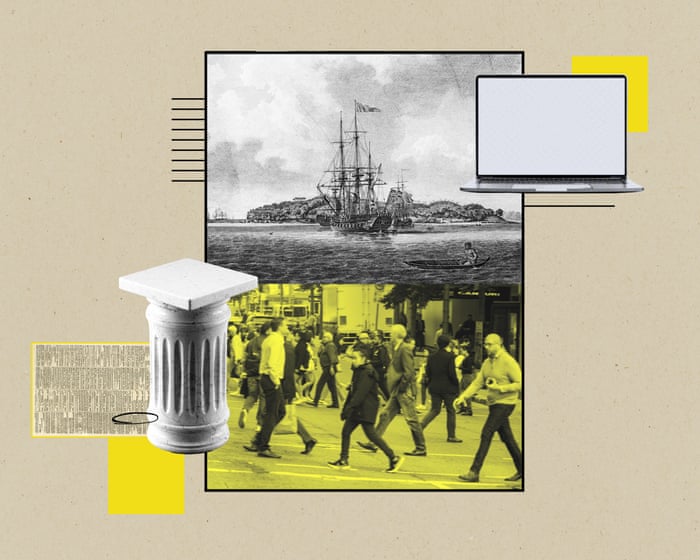
Mixed ethnicity would have been the order of the day in the early New South Wales settlement if the British government had had its way. Women convicts were greatly outnumbered by men on the first fleet in 1788 and the first governor, Arthur Phillip, was instructed to find Pacific Islander women who might be willing to set up with the men as the founders of a new population. The governor thought that was a bad idea, but only because he thought the women would “pine away in misery”.
The first fleet itself was enormously diverse. The English and Irish were separate nationalities and much more at odds than they are today, especially given that a large number of Irish still spoke Gaelic – as did Highland Scots. The first fleeters also included 11 Africans and about 40 men and women from continental Europe – France, Germany, the Netherlands, Portugal, Norway and Sweden.
All the colonial capitals started as seaports. The men who worked on British merchant ships were picked up in ports all over the world, and the same was more or less true of the British navy. For that and other reasons the authorities learned to value all sorts.
Bustling seaports were necessarily multicultural. For that reason alone it was well understood that diversity of population proved acuteness and prosperity. What we call multiculturalism was a core part of new ideas about free enterprise, because it meant diversity of skill and outlook, deeper experimentation and a more useful contest of ideas. Leading colonists understood the connection very well. The Macarthurs at Elizabeth Farm employed a Chinese carpenter and Greek vinedressers, specifically for their distinctive skills.
In the later 1800s this enthusiasm was diluted somewhat. In Queensland, working men objected to eating pub food prepared by Chinese cooks with vegetables from Chinese market gardens. And in northern NSW, white storekeepers were angry about competition from Chinese storekeepers, although their anger only proves that townspeople liked buying from Chinese-run shops.
In the 1900s, the White Australia policy was introduced, until we again woke up to the virtues of diversity.
View original source — The Guardian ↗
Related stories

The Punch
PoliticsJun 24, 2026 · 1 min
How we’ll prevent governors from abusing state police — Senate
The Punch
The Punch
PoliticsJun 24, 2026 · 1 min
BREAKING: Senate passes state police bill, empowers govs to appoint commissioners
The Punch
The Punch
PoliticsJun 24, 2026 · 1 min
Jeffrey Epstein planned to blackmail me over affairs, Bill Gates tells congress
The Punch

Al Jazeera
PoliticsJun 24, 2026 · 1 min
ABC ‘fighting back’, urging US public to defend stations amid FCC scrutiny
Al Jazeera