Indian Express
300 mm rainfall in 24 hours: First monsoon showers drown Mumbai
4 min readMumbaiJun 24, 2026 08:43 PM IST
The IMD, which issued a yellow alert and predicted heavy rain, issued a red nowcast warning for Mumbai and Palghar districts at 4 am on Wednesday. (Express photo by Akash Patil)
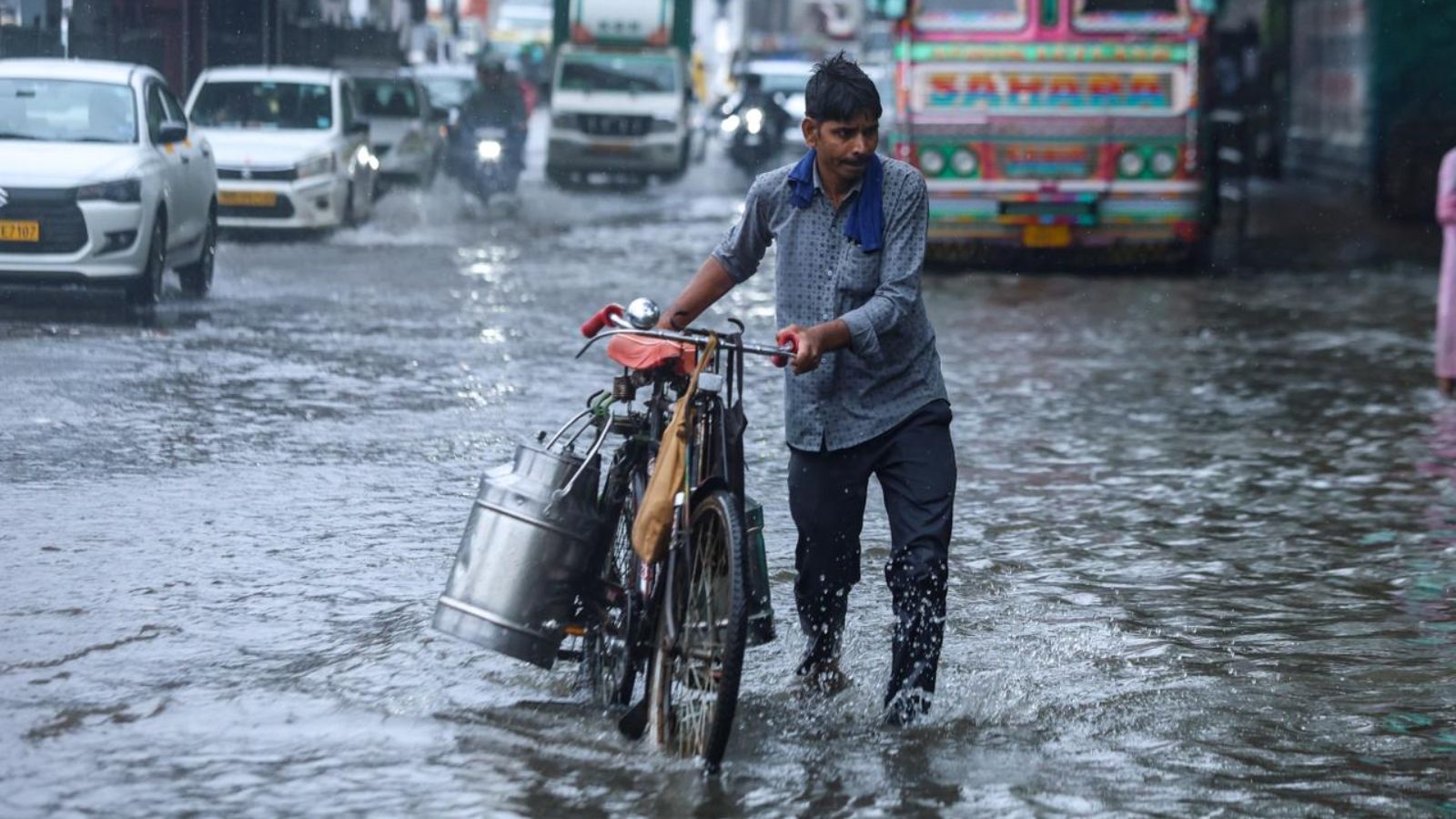
Mumbai woke up to flooded roads and severe traffic snarls Wednesday after the skies opened up and dumped more than 300 mm of rainfall across the city, after the India Meteorological Department (IMD) officially announced the arrival of the southwest monsoon on Tuesday. With 248 mm rain in 24 hours, South Mumbai recorded its wettest June day in over a decade on Wednesday morning.
The IMD, which issued a yellow alert and predicted heavy rain, issued a red nowcast warning for Mumbai and Palghar districts at 4 am on Wednesday, amid the possibility of intense spells, thunderstorms, and gusty winds. The weather bureau downgraded the nowcast to an orange alert at 7 am. It also sounded a yellow alert for Mumbai until Friday morning.
On Tuesday, as the IMD declared the onset of monsoon, light rain swept parts of Mumbai throughout the day, with the suburban station recording 8.9 mm and the Colaba coastal observatory recording 36 mm between 8.30 am and 5.30 pm.
After that, the showers gathered pace with intense spells lashing Mumbai’s southern and suburban divisions.
Records from the Brihanmumbai Municipal Corporation’s automatic weather stations showed that from 10 pm, a downpour battered the city with many pockets receiving over 300 mm rain in 24 hours.
A car was damaged near Dadar railway station after a tree fell on it amid heavy rainfall in Mumbai, on Wednesday. (Express photo by Akash Patil)
Between 8 am Tuesday and 7 am Wednesday, F/South ward office in island city received 322 mm rain while Malwani in the western suburbs recorded 334 mm rain. Meawhile, followed by 296 mm in Powai, 289 mm rain was recorded in Malad, 281 mm in Charkop, 277 mm in Dadar, 265 mm in Kandivali, as well as 255 mm rain in Byculla.
Between 8.30 am on Tuesday and Wednesday, the Santacruz observatory received 225 mm rain in 24 hours, while the Colaba observatory received 248 mm rainfall. IMD data showed that this was South Mumbai’s wettest June day in over a decade. Historically, the heaviest 24-hour rainfall ever recorded at Colaba station was in 1991 when over 478 mm rain lashed the region on June 10.
Story continues below this ad
The city, which had been reeling under a rain deficit of over 300 per cent until Tuesday morning, received nearly 43 per cent of the average June rain quota of 526 mm in a single day.
While the Santacruz observatory received only 46 mm rain between June 1 and June 23 morning, the station logged 225 mm rainfall till Wednesday morning.
Traffic snarls
Amid intense showers, low-lying areas such as Andheri subway, Hindmata junction, Dadar, Gandhi Market, and Malad subway were flooded, bringing traffic to a standstill. Waterlogging was also reported in the King Circle junction, forcing pedestrians and vehicles to wade through accumulated water.
To facilitate traffic movement, the civic administration deployed dewatering pumps in indundated areas. Andheri subway was dewatered and opened for traffic by 5.30 am. “The disaster management cell is constantly monitoring the low-lying areas, railway stations, important roads, bridges and coastal areas,” said the BMC after the waterlogging woes drew flak from citizens and political quarters.
Story continues below this ad
The heavy showers disrupted railway services on the Trans-harbour line for nearly hour, leaving hundreds of commuters stranded during peak travel time. Train services were affected between 5.50 am and 7.35 am due to cave-in beneath the tracks between Turbhe and Koparkhairane.
Rain receded significantly later but light drizzle continued through the day. The Santacruz observatory clocked in only 7.5 mm rain between 8.30 am and 5.30 pm while the Colaba station recorded 14.8 mm rain.
© The Indian Express Pvt Ltd
Nayonika Bose is a Senior Correspondent with The Indian Express’ Mumbai bureau. While in the early stages of her career, her focused reporting on local governance and community welfare already demonstrates clear Expertise and Trustworthiness in covering essential civic issues impacting Mumbai's residents.
Expertise & Authority (E-E-A-T)
Specialized Focus: Nayonika's reporting is dedicated to civic and community issues, providing readers with highly relevant, ground-level information about the functionality and administration of India's largest metropolitan area.
Core Coverage Areas: Her articles highlight a strong focus on the fundamental quality of life and public safety in Mumbai, including:
Civic Infrastructure: Reports on critical failures and initiatives related to public works, such as the recurring problem of unauthorized building collapses in Navi Mumbai, the construction of new infrastructure projects (like the Dahisar-Bhayandar Link Road and the Mahalaxmi cable-stayed bridge), and the maintenance of essential city services (e.g., manhole cover theft).
Urban Governance & Crisis Management: Provides detailed coverage of the Brihanmumbai Municipal Corporation's (BMC) response to major crises, particularly during the monsoon (e.g., heavy rainfall, water cuts, and public health concerns like dengue and malaria) and large-scale public safety incidents (e.g., the hoarding collapse fallout).
Community Welfare & Rights: Reports on key social issues, including the financial aid scheme for persons with disabilities, the struggles of Mumbai's hawkers protesting eviction drives, and the dangers faced by workers due to the continuation of manual scavenging in water tanks.
Cultural & Heritage Reporting: Covers significant community stories, including the restoration of British-era fountains and the history of institutions like the 126-year-old Chinchpokli cemetery, showing a breadth of interest beyond pure administration.
Tweets @nayonikakb ... Read More
Stay updated with the latest - Click here to follow us on Instagram
Tags:
monsoon
Mumbai
View original source — Indian Express ↗
Related stories

TechRadar
TechnologyJun 24, 2026 · 1 min
Stuart Fails to Save the Universe
TechRadar

The Verge
TechnologyJun 24, 2026 · 1 min
Riot now lets you enable its anti-cheat when you want to
The Verge

TechRadar
TechnologyJun 24, 2026 · 1 min
Digital Grand Theft Auto 6 pre-orders come with this bonus that you can instantly use to play free GTA games
TechRadar

TechRadar
TechnologyJun 24, 2026 · 1 min
Finally ready to try Dungeons and Dragons? These are the book, dice, and accessory deals I’d pick from Amazon’s Prime…
TechRadar