TechRadar
Broadcom and OpenAI debut Jalapeño Intelligence Processor, plot an Apple-like move to 'build the full stack'
Broadcom and OpenAI reveal custom AI chip called Jalapeño
It is the first of a family of processors designed from ground up for inference and agentic AI
Global rollout is expected in 2027
Broadcom and OpenAI have finally announced their first custom chip, dubbed Jalapeño, designed from ground up by OpenAI for ChatGPT, Codex and 'future agentic products'.
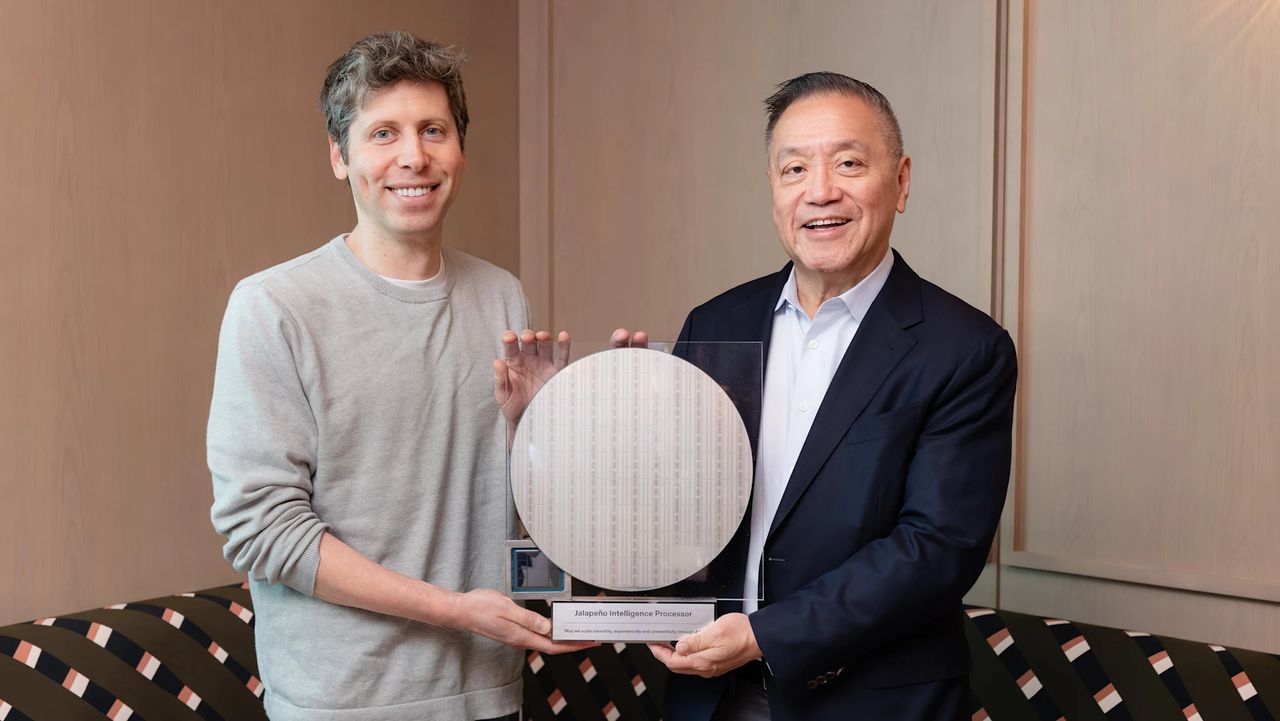
JIP, for Jalapeño Intelligence Processor, is inference-native and little is known about the hardware. A closer look at the packaged chip (lower left of the picture below) leads me to believe that the ASIC silicon is surrounded by eight HBM stacks to reduce latency to a minimum.
OpenAI disclosed that it only took nine months for the chips to be designed and delivered, something that usually takes years, especially with an entirely new architecture. Company President Greg Brockman highlighted the role of ChatGPT as a virtual chip architect, which 'accelerated the tape-out', which he described as surprising.
Jalapeño Intelligence Processor
The 300mm wafer that both CEOs are holding will generate about 50 to 60 ASICs.
Engineering samples of Jalapeño have been running ML workloads including GPT-5.3-Codex-Spark, OpenAI’s first model designed for real-time coding and designed to be used with Cerebras’s huge WSE (Wafer Scale Engine).
OpenAI is following the footsteps of Apple, AWS, Google and many others that want to control the hardware, the software and the infrastructure - the so-called “full stack”. Elon Musk’s SpaceX wants to go a step beyond by being the only one that also builds the actual chips.
While the focus is on Jalapeño, OpenAI will also partner with Celestica and Broadcom to build the rack systems and the network infrastructure that surrounds the intelligence processor.
Sign up to the TechRadar Pro newsletter to get all the top news, opinion, features and guidance your business needs to succeed!
This should lead to much lower prices, more feature differentiation (against objective rivals - and Broadcom customers) and faster time to market.
AGI (and Team Green) in sight?
The small print of the photo showing OpenAI CEO Sam Altman and Broadcom CEO Hock Tan spelt out a surprising motto. "May we scale smoothly, exponentially and uneventfully through AGI".
Jalapeño and its successors may well be instrumental to 'reaching' Artificial General Intelligence. The press release mentions a 'multi-generation' compute platform and I wouldn't be surprised if the future iterations notch up the heat with chilli names like Serrano, Cayenne, Habanero and Moruga.
Tan told CNBC there will be a small prototype development by the end of 2026, adding, "We will start seeing it really ramp up in ’27 and really going full tilt in first half ’28". Whispers of the collaboration were first heard in July 2024 with an official announcement made at GITEX in October 2025.
OpenAI has signed a flurry of strategic agreements with the likes of AMD, AWS and Cerebras to secure enough AI chips and reduce its dependency on Nvidia. Likewise, Broadcom has positioned itself as a key provider for anyone with deep enough pockets to yearn for their own hardware.
Other than OpenAI, Google, Meta, and ByteDance are also likely customers with Anthropic, Apple and Fujitsu craving for Broadcom's expertise in ASIC and its custom AI accelerator portfolio.
Becoming the kingmaker will help Broadcom close the gap between itself and Team Green, the nickname given to Nvidia.
In a veiled dig towards the world’s most valuable company, OpenAI said that its new platform was “not a general-purpose accelerator adapted from earlier AI workloads”, a clear allusion to Nvidia GPUs that were used for training.
The next big iteration of ChatGPT, GPT-5.6 is expected to be released this week.
Follow TechRadar on Google News and add us as a preferred source to get our expert news, reviews, and opinion in your feeds. Make sure to click the Follow button!
And of course you can also follow TechRadar on TikTok for news, reviews, unboxings in video form, and get regular updates from us on WhatsApp too.
Désiré has been musing and writing about technology during a career spanning four decades. He dabbled in website builders and web hosting when DHTML and frames were in vogue and started narrating about the impact of technology on society just before the start of the Y2K hysteria at the turn of the last millennium.
View original source — TechRadar ↗
Related stories

ZDNet
TechnologyJun 24, 2026 · 1 min
These essential smart home devices are highly useful - and all under $25
ZDNet

The Verge
TechnologyJun 24, 2026 · 1 min
Google’s new rules for the app store will allow alternative billing next week
The Verge

Ars Technica
TechnologyJun 24, 2026 · 1 min
Formula E reveals first calendar for GEN4 with lots of real race tracks
Ars Technica

Wired
TechnologyJun 24, 2026 · 1 min
The Best Breville Espresso Machine Is 30 Percent off Right Now (2026)
Wired