BBC
BBC··5 min read
'From excitement to emptiness': Families affected by largest NHS maternity scandal tell their stories
'From excitement to emptiness': Families affected by largest NHS maternity scandal tell their stories
ByGreig Watson and Chris WaringEast Midlands
The findings of an inquiry into the largest maternity scandal in NHS history have finally been made public.
The numbers are as striking as they are horrific - about 2,500 families involved and the stark figure of 155 babies who may have survived with better care, in addition to 105 who suffered serious injury due to failings.
A total of 520 cases of mothers and babies were graded as two or three for harm, with grade two representing "significant concerns" and grade three "major concerns" over care.
Grade two represents sub-optimal care in which different management might have made a difference to the outcome, while grade three is where different management would reasonably be expected to have made a difference.
Nottingham University Hospitals (NUH) NHS Trust has apologised to all those affected and said it was committed to making improvements.
But behind the statistics are the faces and stories of the families who have been changed forever.
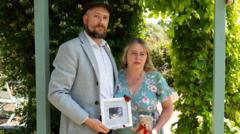
Sarah and Jack Hawkins
Gary and Sarah Andrews
Gary and Sarah Andrews's daughter Wynter died 23 minutes after she was delivered by Caesarean section on 15 September 2019 after repeated warning signs of her being in distress had been missed.
Gary said: "One clinician sat down and said they'd looked over all the notes and they couldn't see anything wrong and if they listened to every mother's concerns the hospital would be overrun."
Wynter was delivered "in poor condition" with the umbilical cord "wrapped tightly around her leg and neck". Efforts to resuscitate her were abandoned 23 minutes later.
An inquest in October 2020 found Wynter may have survived if "multiple missed opportunities" had been spotted by staff.
Trust failed in care of baby who died after 23 minutes
NHS trust fined £800k over baby's neglect death
Natalie Needham
Natalie's Needham's baby son Kouper died of respiratory complications in July 2019 in a Moses basket in the family living room, when he was just 24 hours old.
He had been discharged from Nottingham City Hospital about 14 hours after he was born, but Natalie had concerns that she believes were dismissed because she had four older children.
"We are fighting so much to make sure things are put into place to make it right," she said.
Carly Wesson and Carl Everson
Carly Wesson and Carl Everson terminated their pregnancy in 2019 after being advised their daughter had a rare genetic condition called Patau's Syndrome, which often results in miscarriage, stillbirth or the baby dying shortly after birth.
But they were told about six weeks later that the test result had been a false positive and their results had changed.
When the couple asked if their daughter, who they had nicknamed Ladybird, would have survived, a doctor told them: "Well, you could have miscarried anyway."
The couple have called for a statutory public inquiry into maternity services, saying: "We hope the Ockenden review leads to clear actionable change, both in Nottingham and nationally."
Felicity Benyon
Felicity Benyon faced lifelong injuries after she gave birth to her second child.
Doctors suspected she had a potentially fatal pregnancy complication called placenta percreta, where the placenta attaches itself and grows through the uterus.
It was confirmed Felicity needed an emergency hysterectomy during a planned Caesarean section, but when doctors removed her womb, they also - mistakenly - took out her bladder and she had to be fitted with a stoma.
Felicity said: "I want promises that Donna's recommendations will be implemented - not just 'thank you for doing this Donna, it's great'."
Hayley Coates
Hayley Coates experienced a normal pregnancy with her son Kaylan, but that all changed during a long and difficult labour.
When Kaylan Coates was eventually delivered with forceps at the Queen's Medical Centre in 2018, he had a fractured skull, he was starved of oxygen and he suffered major brain injuries. He died in hospital from an infection a week later.
Hayley said: "The amount of families and babies and mothers injured which could have and should have been avoided is something more than shocking.
"In no means will this review change any of the past outcomes, but I hope this review now means no more babies loose their lives due to negligence."
Kim Errington
Edward Errington-Rozkalns, known as Teddy, died in November 2020 after "undoubted failings" led to midwives failing to monitor his blood sugar levels before sending him home.
He was a day old when he died.
Kim Errington said: "A public inquiry is massively important because without it, nobody is held to account and no change is going to happen without that.
"It's unbelievable what families have had to put themselves through - or actually what the state and the system has put us through."
Michelle Welsh
Michelle Welsh, now MP for Sherwood Forest, had booked a Caesarean section in 2020 due to issues in pregnancy, but this was repeatedly delayed.
Although she left hospital with her baby, Welsh - who was appointed as the government's first maternity adviser in May - was unhappy with her experience and did not feel listened to.
She said: "We need to give the Donna Ockenden report the respect that it deserves. We need to look at it thoroughly and we need to take action."
Sarah and Ryan Sissons
Sarah Sissons's son Ryan suffered brain damage as a result of poor care and delays in treatment when he was born in 2008.
Sarah told the BBC she had to plead with doctors at City Hospital for her son to be seen by senior doctors after he began having seizures and became jaundiced.
She said: "I hope this review highlights the hundreds of children who have been damaged by NUH. It worries me what their futures will look like.
"I hope the government will now take steps to help them get all the help they need."
Additional reporting by Laura Hammond
If you have been affected by any of the issues raised in this article, help and support is available via the BBC Action Line
Get in touch
Tell us which stories we should cover in Nottingham
Related stories

The Punch
PoliticsJun 24, 2026 · 1 min
Imo CP assures INEC of maximum security ahead of elections
The Punch
The Punch
NewsJun 24, 2026 · 1 min
Over 150 baby deaths linked to UK maternity scandal – Probe
The Punch
The Punch
NewsJun 24, 2026 · 1 min
FRSC alerts motorists on traffic diversion on Lagos-Ibadan Expressway
The Punch
The Punch
NewsJun 24, 2026 · 1 min
Police parade five suspects over arms stockpiling in Oyo
The Punch