Indian Express
Indian Express··3 min read
10 lakh kg waste processed in 8 years: Lessons from a zero-waste residential colony in Delhi
In February 2017, shortly after moving into Navjeevan Vihar, Dr Ruby Makhija’s car was stolen. She approached the colony’s Residents’ Welfare Association (RWA) seeking better security measures. Impressed by her ideas, the RWA appointed her secretary.
Around the same time, the Municipal Corporation of Delhi (MCD) had begun pushing for the implementation of Solid Waste Management rules and calling RWAs for consultations.
For Makhija, the timing felt consequential. “We are privileged. We see the contrast between cleanliness abroad and in India. I wanted to change that,” she said.
What began as discussions around governance gradually evolved into a larger question: “Could a residential colony manage its own waste instead of contributing to Delhi’s overflowing landfills?” she recalls.
That question led Navjeevan Vihar’s 280 households to attempt something rare in Delhi — becoming a zero-waste colony where residents segregate and process most of their waste within the community itself. Eight years later, the colony claims to have diverted more than 10 lakh kilograms of waste from landfills. Following Lieutenant Governor Taranjit Singh Sandhu’s visit this week, the model is now being discussed as one that could extend beyond affluent neighbourhoods into other parts of the city.
How they started implementation
Makhija says institutional support from MCD helped early on.
“The Deputy Commissioner at MCD helped us a lot. He said he’d go the extra mile if our RWA took up the initiative. That gave us the boost we needed,” said Makhija.
Story continues below this ad
The team then spent months studying waste management models in India and abroad, paying particular attention to why many failed. “The project formally began in 2019,” she said. Makhija said funding largely came from the RWA’s maintenance pool.
“We collect Rs 1,200 from each household as maintenance, and 95% of residents pay upfront for the entire year, so it’s easy for us to budget,” she said.
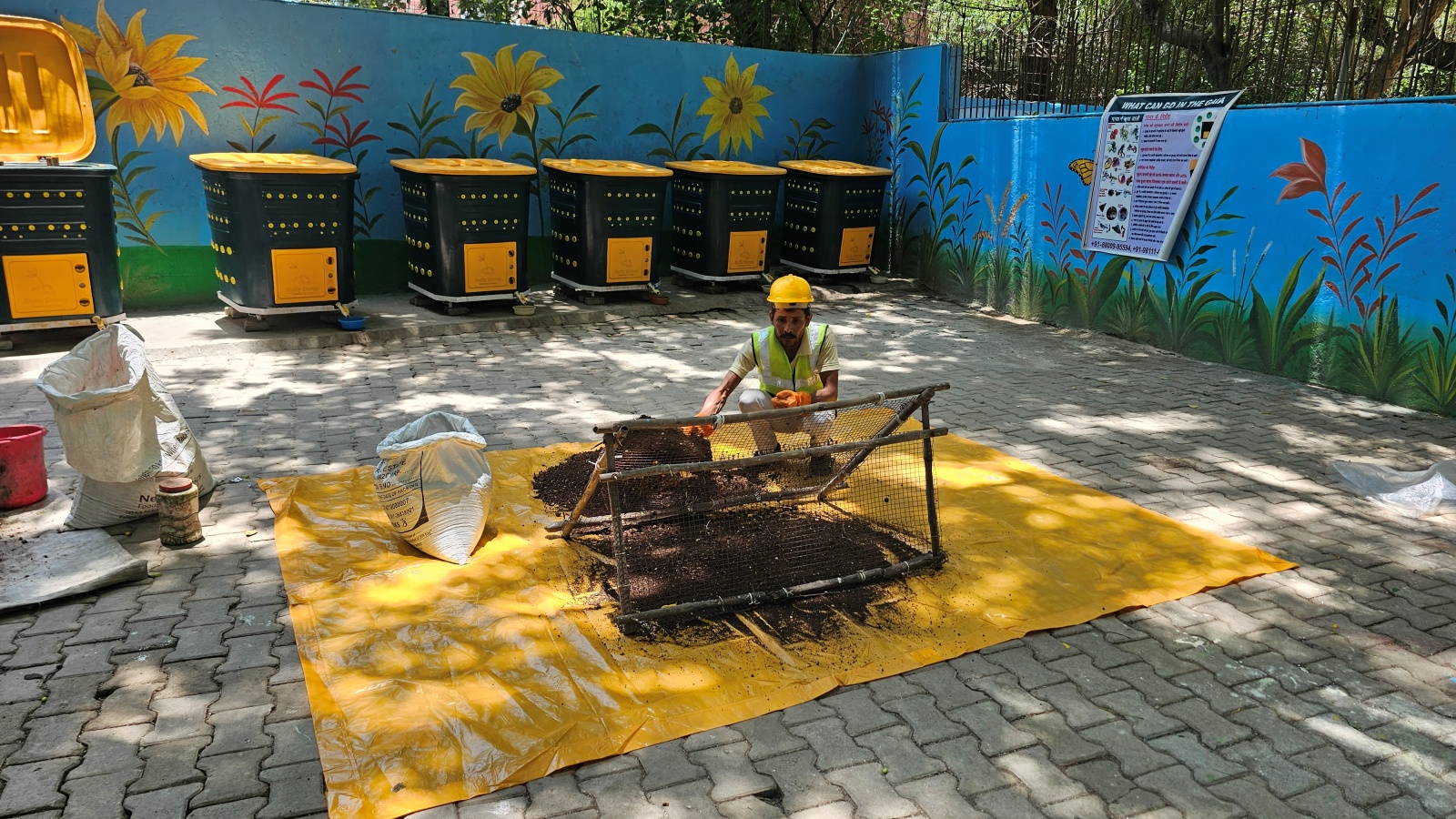
Residents were asked to segregate waste at source using separate bins for wet, dry, and hazardous waste. “Wet waste was composted within the colony. Dry waste was stored at an RRR (Reduce-Reuse-Recycle) centre before being sent for recycling. Compost generated through the process was reused in the colony’s green spaces,” she explains.
Now, according to residents, the colony generates around 250–275 kg of waste every day. Dry waste accounts for around 105–110 kg, while wet waste amounts to 120–125 kg. The rest is sanitary and hazardous waste.
Story continues below this ad
“The compost bins we bought four years ago cost Rs 6 lakh, including one year of consumables. These days, they cost much less,” said Makhija.
The challenges
The biggest obstacle was not infrastructure but behaviour.
“Daily segregation remained inconsistent despite broad support,” she said.
Makhija said her core team responded with a mix of accountability and community pressure. “Residents who repeatedly failed to segregate were identified in colony groups. Children became ambassadors – learning about waste management in schools and through door-to-door campaigns, then encouraging parents to comply,” she said.There was another hurdle: domestic workers initially resisted, viewing segregation as additional labour.
“The RWA introduced incentives, including monthly distribution of biodegradable sanitary napkins for workers and their daughters,” she said.
Story continues below this ad
Garbage collectors, too, became stakeholders once they were allowed to retain earnings from recyclable dry waste, she says.“Infrastructure required adjustments as well. Early compost pits created odour complaints from nearby homes, prompting the colony to shift to enclosed composting units,” Makhija said.
Over time, Makhija says the project became less about waste and more about participation. “The lesson is that waste systems succeed only when communities feel ownership,” she said.
The RWA’s framework, she says, now focuses on three variables: space, funding, and local leadership.“The habits need to be fixed, not the waste,” she said.
How they are helping others
The experiment has since expanded beyond one colony.
Story continues below this ad
Makhija founded the NGO Why Waste Wednesdays, which now audits residential colonies, DDA flats, and cantonment areas across Delhi, helping communities design local waste systems.Replication, she says, has limits. “Smaller colonies and lower-income neighbourhoods often lack funds and infrastructure, though MCD support can fill some gaps through shared composting facilities,” she said.
However, she now believes that Lieutenant Governor’s endorsement has opened a new possibility. “We have had awareness sessions in some colonies. But not an end-to-end waste management project. They barely produce any waste compared to the upscaled colonies since they reuse most of their products. I haven’t received any structure or plan from the MCD or concerned authorities, but I’m sure there will be
discussions soon about the project,” she said.
View original source — Indian Express ↗
Related stories

The Punch
NewsJun 25, 2026 · 1 min
Lagos sets up independent electricity system operator
The Punch
The Punch
NewsJun 25, 2026 · 1 min
W’Bank, AfDB connect 50 million Africans to electricity
The Punch
The Punch
NewsJun 25, 2026 · 1 min
African countries study Nigeria’s local content model – NCDMB
The Punch
The Punch
PoliticsJun 25, 2026 · 1 min
Stop exporting the future, Tinubu demands end to African resource exploitation
The Punch