CNA
CNA··5 min read
Bang & Olufsen’s newly refurbished Singapore flagship is rethinking how luxury audio is sold
Obsessions
At its largest Culture Store in Asia Pacific, the century-old Danish brand is betting that experience, craftsmanship and longevity matter more than technical specifications.
New: You can now listen to articles.
This audio is generated by an AI tool.
25 Jun 2026 06:06AM
(Updated: 25 Jun 2026 06:15AM)
There is a pair of S$640,000 (US$495,500) loudspeakers at the centre of Bang & Olufsen’s new Singapore flagship that is not, strictly speaking, for sale.
The Beolab 90 Titan Edition exists in the same conversational register as a Patek Philippe or a Steinway – objects whose value derives from craft, scarcity and the emotional weight accumulated over time.
Designed for the most discerning listeners, the Beolab 90 delivers precise, powerful sound in virtually any space. Each speaker produces 8,200 watts through 18 premium drivers, 14 channels of ICEpower (Bang & Olufsen’s audio partner) 300-watt amplification, and four 1,000-watt Class D Heliox amplifier channels, making it a masterclass in acoustic engineering.
Each piece is commissioned individually, with production beginning only after an order is placed. Ownership, in this context, feels closer to stewardship.
An unusual thing to encounter in a shopping mall – which is perhaps precisely the point.
Most luxury announces itself. A watch catches the light from across a room. A supercar precedes its owner by three streets. Even a rare handbag is designed to be recognised from a distance.
Sound behaves differently. The finest audio reveals itself in increments: in the grain of a voice, the sustain of a piano note, the way a room suddenly seems to breathe. Its luxury is atmospheric. Which makes it, almost uniquely among luxury categories, genuinely difficult to sell.
This is the problem Bang & Olufsen has spent a century making look effortless. In a city of high-rise apartments, where ideal listening conditions are rarely available, technologies such as Room Compensation help adapt performance to the realities of domestic life. Using a built-in microphone, the system maps the acoustics of a room and adjusts playback according to speaker placement, helping deliver a more consistent listening experience even in compact spaces.
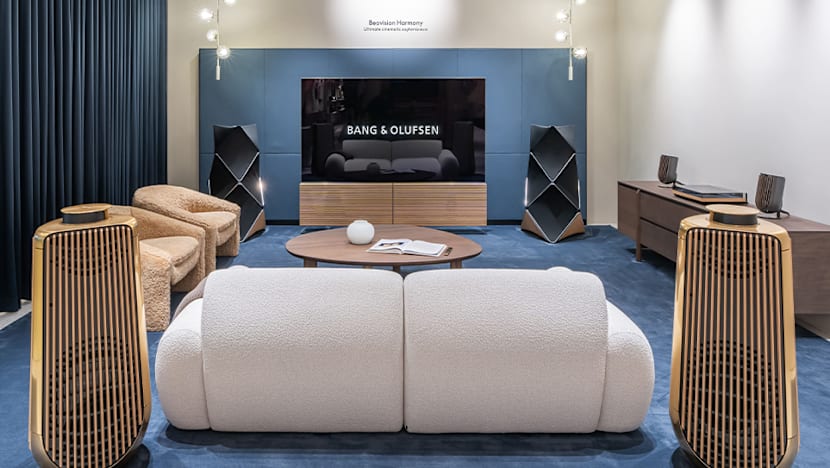
The Danish company’s newly refurbished Southeast Asian flagship at Scotts Square occupies 2,853 sq ft on a prominent corner with the quiet assurance of a brand that has little left to prove. It is the largest Culture Store in Asia Pacific and the first of its kind in Southeast Asia. As Bang & Olufsen marks its centenary, the space functions less as a retrospective than a declaration of intent.
The most striking quality is what the space refuses to do. No product walls. No competing rows of headphones. No specification sheets pinned alongside objects straining for attention. Visitors move through a sequence of carefully considered domestic environments, with oak floors, aluminium details and materials chosen for how they age, where speakers emerge like kinetic sculpture and screens float against composed interiors with improbable lightness. The experience is closer to visiting the home of someone with exceptional taste than entering a consumer electronics showroom.
Chief executive Nikolaj Wendelboe, who took the role in January 2026 after seven years as the company’s CFO, grew up with the brand in the way many Danes do – not as a product category but as domestic furniture. The stereo in the living room. The television that seemed to arrive from another decade. Objects that outlasted trends, renovations and the slow churn of everything else.
“Many Danes have a personal relationship with Bang & Olufsen,” he said. “They remember seeing it in their parents' homes, and often those products are still there decades later.”
Few consumer electronics companies inspire that kind of recollection. Fewer still have sustained it across a century. The challenge Wendelboe inherits is not preservation but translation: convincing a generation conditioned by annual upgrade cycles that permanence remains a value worth paying for.
The technology industry is structurally opposed to longevity. Products are often designed around replacement cycles, with obsolescence built into the economics of the industry. Bang & Olufsen’s counter-argument is structural rather than rhetorical: The Recreated Classics programme restores and reissues landmark products from the archive, while Cradle to Cradle certification and modularity built into new designs extend the life of objects already in homes.
The objective is continuity – the possibility that a product evolves alongside its owner rather than being discarded by them. A philosophy more naturally associated with mechanical watchmaking or handcrafted furniture than consumer electronics, and one Bang & Olufsen has spent recent years making a credible case for.
The Culture Store concept, then, is the retail expression of that argument. Products are situated within living environments that show how sound interacts with architecture, material and habit. Visitors move from intimate listening rooms to more expansive, cinematic settings. Sound cannot be sold on paper; frequency ranges and acoustic measurements reassure enthusiasts but rarely inspire desire. Rooms do.
The distance between a sofa and a speaker. The height of a ceiling. The warmth of timber. The way a recording you know intimately fills an unfamiliar space.
The products here occupy rooms with the composure of serious furniture. Bang & Olufsen has spent a century refining how technology coexists with beauty, and the Scotts Square flagship makes that conviction tangible at every scale, from the grain of the materials to the Beolab 90 Titan Edition. Part of the wider Atelier collection, it stands with the authority of an object designed to outlast everything around it, asking visitors to consider what a loudspeaker can be when longevity, rather than specification, becomes the brief.
“Our heritage shows our innovation through the years, built on longevity,” stated Wendelboe. “Our clients trust us to preserve their favourite products with reparability over the years.”
The most sophisticated luxury brands have understood for some time that what they are selling is an ongoing relationship: A sequence of experiences, consultations and refinements that unfolds over years. A customer begins with headphones, progresses to a standalone speaker, eventually builds an integrated domestic system around a life that has changed. The flagship supports that journey at every stage.
Bang & Olufsen enters its second century in possession of something many luxury houses spend decades attempting to construct: Genuine heritage, a coherent visual language and real emotional inheritance. The question is whether it will remain necessary.
In Singapore, the answer takes the shape of a space where technology softens into design, and listening becomes, once again, an act of attention. The finest luxury is rarely the object itself. It is the atmosphere it leaves behind.
Source: CNA/bt
Related stories

The Punch
NewsJun 25, 2026 · 1 min
Lagos court jails 14 for attacking sanitation officers
The Punch
The Punch
NewsJun 25, 2026 · 1 min
Mexican, four others held after NDLEA smashes Oyo meth lab
The Punch
The Punch
NewsJun 25, 2026 · 1 min
LASWA partners NSIB to boost waterways safety
The Punch
The Punch
NewsJun 25, 2026 · 1 min
CGC tenure extension crucial for reform consolidation — Group
The Punch