VnExpress
Vietnam plans $9B ring road encircling region that generates a third of its GDP
Vietnam's Ministry of Construction has proposed a 321-kilometer ring road looping the greater Hanoi region, a six-lane expressway with a preliminary cost of VND235.74 trillion (US$8.95 billion).
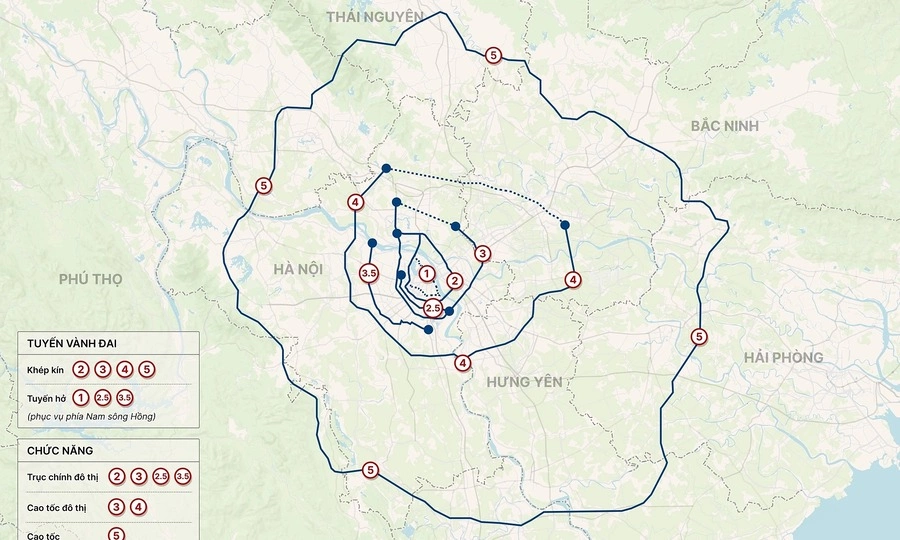
At 321 km, the planned Ring Road 5 would stretch nearly three times the length of Ring Road 4, the belt now under construction around Hanoi and due in 2027, and cost more than three times as much.
The route would begin and end at Yen Bai Commune on Hanoi's western edge, passing through seven provinces and cities: Hanoi, Ninh Binh, Hung Yen, Hai Phong, Bac Ninh, Thai Nguyen and Phu Tho.
The regionis home to about 31 million people, roughly 27% of Vietnam's population, and generates close to a third of national GDP, according to the project's submission.
The ministry sent the pre-feasibility study to the prime minister after nearly a year of survey work. Its estimate comes in about VND26 trillion ($990 million) below an earlier version.
The road would carry six lanes for most of its length, narrowing to four through Thai Nguyen. Localities would reserve a corridor at least 120 meters wide, enough for about 10 lanes, for service roads, greenery and sidewalks.
Almost the entire route, about 317.9 km, would sit at ground level.
Only a 3.1-km elevated stretch is planned, in Ninh Binh, between the National Highway 1 interchange and the Cau Gie-Ninh Binh expressway.
Consultants rejected wider use of viaducts as too expensive. The elevated Ninh Binh section alone would run about VND8 trillion ($300 million) more than an at-grade design, with little payoff across land that is mostly farms.
Hanoi's ring road network. Graphic by Tam Thao
The ministry recommended public investment over a public-private partnership.
The state budget would cover land clearance, parallel roads, greenery and sidewalks, which struggle to draw private money. The expressway itself would also be state-funded and tolled at about VND1,300 per car per kilometer, roughly five U.S. cents.
Public investment lets the whole route open at once and keeps tolls low, the ministry said, easing congestion on inner-city and local roads.
By its math, tolling would bring in about VND25.71 trillion in the first decade and around VND103.17 trillion ($3.9 billion) over 20 years.
The belt is designed to tie together six radial expressways running out of Hanoi: Hanoi-Lao Cai, Hanoi-Thai Nguyen, Hanoi-Hai Phong, Hanoi-Lang Son, Phap Van-Cau Gie-Ninh Binh and Hanoi-Hoa Binh.
It would also link national highways, seaports, airports and logistics hubs across northern Vietnam, and is intended to serve as a new growth axis for the region.
The ministry wants the project substantially finished in 2030 and open from 2031.
As a project of national importance, it requires an investment-policy decision from the National Assembly.
Permanent Deputy Prime Minister Pham Gia Tuc signed a decision on June 16 setting up a state appraisal council, chaired by the construction minister, to review the report before the government forwards it to the legislature, the government portal said.
View original source — VnExpress ↗
Related stories
CNA
BusinessJun 25, 2026 · 1 min
Frasers Property plans to sell stakes in five properties to Thai conglomerate
CNA

Bloomberg
BusinessJun 25, 2026 · 1 min
How Warsh Sank the Debasement Trade
Bloomberg

Financial Times
BusinessJun 25, 2026 · 1 min
South Korea delays plan for new single-stock options amid record volatility
Financial Times

AllAfrica
BusinessJun 25, 2026 · 1 min
Africa: 655 Million People Still Living Without Electricity Underscore Urgent Need to Deliver On Universal Energy…
AllAfrica