VnExpress
VnExpress··2 min read
World's top destination for international students to end rule for indefinite stay
The Trump administration is moving to abolish the decades-old rule that lets international students remain in the U.S. for as long as their studies last, replacing it with a fixed admission period capped at four years.
The Department of Homeland Security has sent its final regulation to the White House Office of Management and Budget, the last step before the rule can be published and take effect, according to Bloomberg Law and the international education association NAFSA.
For more than three decades, students on F visas have been admitted for "duration of status," where their stay tied to the length of their academic program rather than a fixed end date. As long as they keep studying and follow visa conditions, the clock never runs out.
The new rule ends that. Students would instead be admitted for a set period tied to the end date on their enrollment forms, capped at four years. Anyone still studying past that point would have to apply to U.S. Citizenship and Immigration Services for an extension.
The cap would also force students in shorter programs to leave when their course ends unless they secure an extension first, ICEF Monitor reported.
The proposal would cut the grace period after graduation from 60 days to 30, and bar undergraduates from switching schools or majors during their first year, according to immigration-law analyses.
It would apply to F visa students, J exchange visitors, I visa for foreign media representatives and their dependents. DHS estimates it would affect more than two million visa holders a year.
The agency has framed the rule as a way to tighten oversight and close what it calls compliance gaps, arguing that fixed end dates make it easier to track who is in the country and for how long.
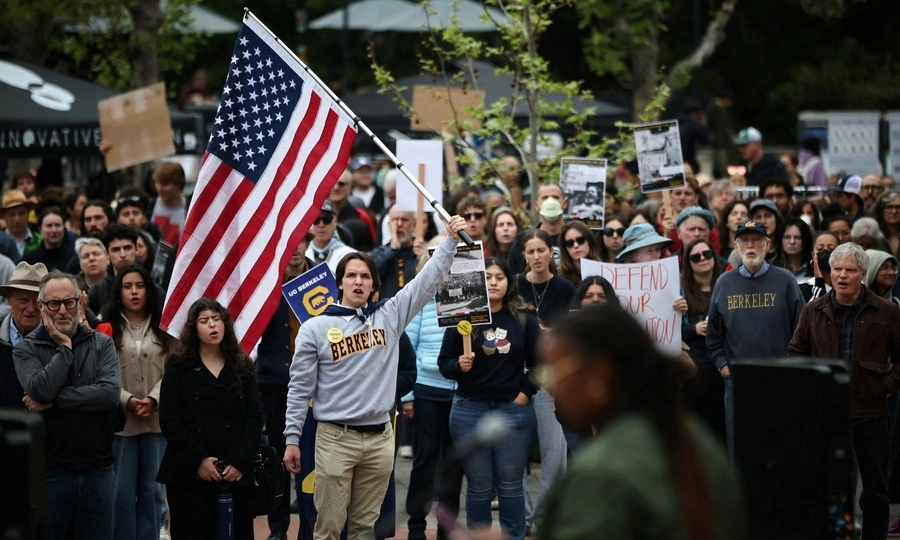
Demonstrators holding a "Stand Up for Internationals" rally on the campus of Berkeley University in Berkeley, California, U.S., April 17, 2025. Photo by Reuters
The U.S. remains the world's top destination for international students, hosting a record 1.18 million in the 2024/2025 academic year, according to the Institute of International Education's Open Doors report.
But new enrollments fell 17% in fall 2025, with nearly all institutions surveyed pointing to visa concerns.
International students contributed close to $55 billion to the U.S. economy in 2024.
A four-year ceiling poses the sharpest problem for doctoral and research students, whose programs routinely run longer. They would face repeat extension filings, biometrics appointments and processing delays at an already backlogged USCIS.
DHS first floated the idea during President Trump's first term, publishing a version in 2020 and withdrawing it in 2021 before reviving it in 2025.
Immigration attorneys expect court challenges once the rule is published, most likely arguing it is "arbitrary and capricious" under federal law. Still, several firms are telling clients to plan for the rule to take effect with the fall 2026 intake.
View original source — VnExpress ↗
Related stories

CNA
NewsJun 25, 2026 · 1 min
The new frontier in the US-China AI race: Talent
CNA

The Punch
PoliticsJun 25, 2026 · 1 min
Earthquake: Venezuela’s Rodriguez confirms phone call with US Rubio
The Punch

ESPN
SportsJun 25, 2026 · 1 min
Transfer rumors, news: Man United want Scotland 'k...
ESPN
The Punch
NewsJun 25, 2026 · 1 min
Japan denies China’s aircraft carrier harassment claim
The Punch