CNA
CNA··3 min read
Europe accelerates defence push amid security threats and uncertain US commitment
World
Pressure has come from Washington, which has launched a six-month review to assess whether European allies are taking primary responsibility for the continent's security.
New: You can now listen to articles.
This audio is generated by an AI tool.
25 Jun 2026 06:24PM
SISSONE, France: European leaders are ramping up efforts to strengthen the continent's defence capabilities as traditional security alliances face growing strain.
With the war in Ukraine continuing on Europe's doorstep and uncertainty mounting over the United States' long-term commitment to the continent's security, the European Union is accelerating plans to boost military readiness.
Under its Readiness 2030 plan, the bloc aims to mobilise up to €800 billion (US$910 billion) in defence investment by the end of the decade to modernise its armed forces.
“Such a tectonic shift in European defence demands a fundamental paradigm change in how Europe approaches its security,” said European Commissioner for Defence and Space Andrius Kubilius.
“We’re moving from reactive coordination to proactive readiness.”
TRAINING FOR MODERN WARFARE
Across Europe, that shift is already taking shape.
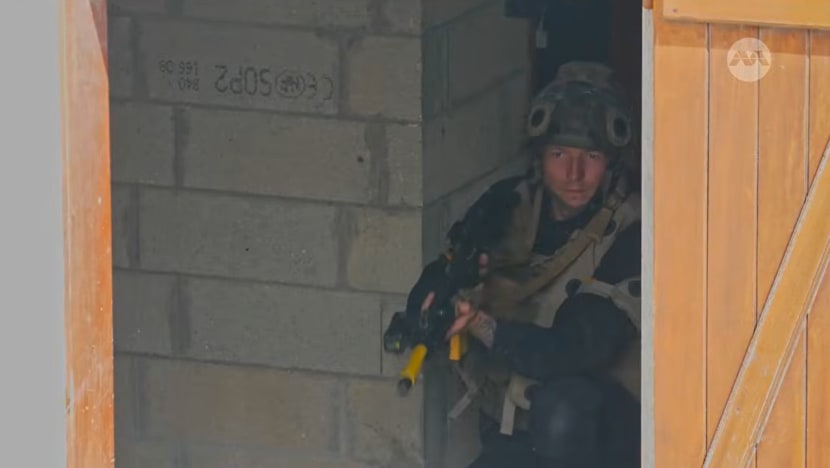
At the CENZUB urban combat training centre in northern France, for instance, soldiers are honing their skills in a mock city built to recreate the chaos of urban warfare.
Every shot fired, target hit and tactical manoeuvre is tracked and analysed.
The training is designed to prepare troops for the realities of modern conflict.
“It’s very important to train in a realistic environment and our goal is to give a first-hand experience very close to reality,” said Colonel Frederic Chamaud, commanding officer in the French Army’s CENZUB-94th Infantry Regiment.
“For young leaders, it’s very important to train like this before joining their units.”
CENZUB has been training French forces and international partners for two decades.
Now, defence and technology company Thales has provided the training centre with a major analytics upgrade.
Sensors attached to soldiers, vehicles, equipment and the terrain collect data throughout each exercise, helping commanders turn battlefield performance into tactical lessons.
Thales product line manager Gregoire Hubsch said: “With this tool, different customers can improve their understanding of the real battlefield.”
He added that military training must evolve to reflect changing battlefield realities, particularly the growing use of drones, making it vital for troops to train in conditions that closely resemble modern combat.
As threats continue to evolve, the North Atlantic Treaty Organization (NATO) is also incorporating new technologies, including unmanned ground robots, into military exercises to help soldiers adapt to the changing nature of warfare.
BEYOND BIGGER BUDGETS
The investment is part of a broader effort across Europe to rebuild the continent's military capabilities.
European defence spending rose 14 per cent in 2025 compared with the previous year, as governments responded to heightened security concerns and calls for greater strategic autonomy.
Pressure has also come from Washington, which has launched a six-month review to assess whether European allies are taking primary responsibility for the continent's security.
But defence experts warn that increasing spending alone will not guarantee greater security.
Security expert Sven Biscop said European countries must do more to pool resources rather than simply expanding their national militaries.
The director of the Europe in the World programme at Brussels-based think tank Egmont Institute said: “The risk is that in five to 10 years’ time, every European country will have larger national forces but each individually will still be as dependent on the US as they are today and that would really be a wasted opportunity.”
Source: CNA/ca(dn)
Related stories

CNA
NewsJun 25, 2026 · 1 min
The new frontier in the US-China AI race: Talent
CNA

The Punch
NewsJun 25, 2026 · 1 min
ICPC arraigns El-Rufai, ex-aide over N8.6bn CCTV contract fraud
The Punch
The Punch
NewsJun 25, 2026 · 1 min
We’ll recover all trapped in Rivers collapsed building —NEMA
The Punch

ESPN
SportsJun 25, 2026 · 1 min
Marshawn Lynch, Alex Morgan top celebrities at 202...
ESPN