Indian Express
If passport not a proof of citizenship, what is? What India’s various laws say
The Ministry of External Affairs (MEA) on Wednesday clarified that an Indian passport is primarily a travel document and should not be construed as a standalone proof of citizenship. The statement, made on Passport Seva Divas, triggered widespread confusion. For most Indians, the passport is the most authoritative document issued by the state — carrying the Republic’s name, accepted across the world, and issued only after verification by government authorities.
The MEA’s clarification, however, reflects a longstanding legal position: a passport is issued because the government is satisfied that a person is an Indian citizen, but the passport itself does not create citizenship, nor is it conclusive proof of citizenship if that status is challenged in law.
The controversy has revived a deeper question that India has grappled with for decades: if a passport is not proof of citizenship, then what is?
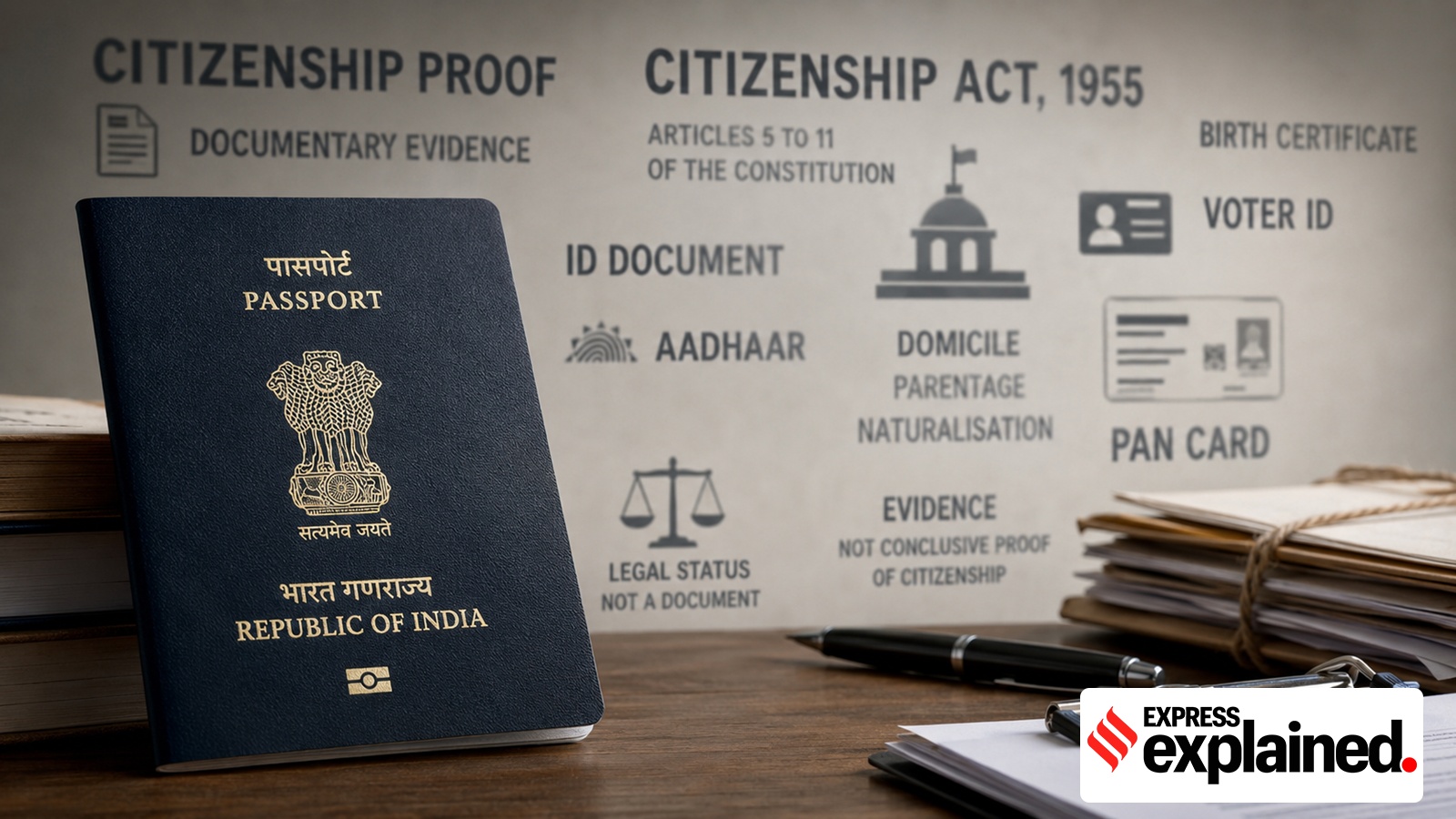
Citizenship is a legal status, not a document
The answer lies in the architecture of Indian law. Articles 5 to 11 of the Constitution and the Citizenship Act, 1955 define who is an Indian citizen. Significantly, neither identifies any single document as proof of citizenship.
Instead, citizenship is treated as a legal status arising from facts such as birth, parentage, domicile or naturalisation. Documents serve as evidence of those facts. For a person born in India, citizenship depends on when they were born and, in certain cases, the citizenship status of their parents. For someone naturalised, it depends on compliance with statutory conditions.
This distinction is reflected in a little-noticed answer given by the Ministry of Home Affairs in Parliament in February 2020. Asked whether Aadhaar, passport, voter ID, PAN card or birth certificate constitute valid proof of citizenship, the government said: “Acquisition of Indian Citizenship is governed by The Citizenship Act, 1955 and rules made thereunder. Citizenship of India can be acquired by birth or descent or registration or naturalisation or incorporation of territory. The eligibility criteria for acquisition and determination of citizenship is as per the provisions of the Citizenship Act, 1955.”
Notably, it did not identify any of the mentioned documents as citizenship documents. Yet, under the Citizenship Rules, 2003, those seeking Indian citizenship under certain provisions are required to produce a copy of their parents’ passports to prove they are Indian citizens.
Story continues below this ad
Why a passport is important — but not conclusive for citizenship
Given that a passport is issued only to Indian citizens and is accepted abroad, in practice, it is among the strongest pieces of evidence that a person is an Indian citizen.
However, legally, its status as a citizenship document is complicated by the Passports Act itself. Section 20 of the Act empowers the Central government to issue a passport or travel document even to a person who is not an Indian citizen if it considers such issuance necessary in the public interest.
MEA sources said the provision is used to issue passports in special cases. “Largely, say an Indian origin person becomes stateless due to certain geo-political developments, or someone is in India and has become stateless but must travel abroad,” an official said.
Historically, Tibetan refugees and Sri Lankan Tamils in India have been issued special travel documents by Indian authorities when visiting foreign countries, sources said. In 2023, the madras High Court asked the government to grant a passport to a Sri Lankan Tamil Refugee under Section 20 of the Passport Act.
Story continues below this ad
The principle is common across democracies. In the UK and US, too, passports are issued because the state has already determined that a person is a citizen; they do not themselves create citizenship. The difference is that both countries have more robust civil registration systems and, for naturalised citizens, formal citizenship certificates that serve as primary legal proof.
Former foreign secretary Nirupama Menon Rao said the controversy arose because legal precision and public understanding often diverge.
“A passport does not create citizenship, nor is it the legal instrument that can determine citizenship if that status is challenged before a court,” Rao wrote on social media. “Like many democracies, India distinguishes between citizenship law and passport law.”
What have the courts said?
Judicial pronouncements offer no simple answer.
During hearings on the Special Intensive Revision (SIR) of electoral rolls in Bihar last year, a Supreme Court bench of Justice Surya Kant and Justice Joymalya Bagchi observed: “We would like you to clarify…we have repeatedly passed order that the list illustratively indicates 11 documents…if you see those 11, apart from passport and birth certificates, none are conclusive proof of citizenship.”
Story continues below this ad
The observation appeared to place passports and birth certificates in a higher evidentiary category than other documents accepted by the Election Commission for voter verification.
Yet, in cases dealing directly with citizenship disputes, courts have often looked beyond passports.
In 2013, the Bombay High Court refused relief to four persons accused of being illegal immigrants despite their producing passports (which were later terminated), Aadhaar cards and birth certificates.
“The birth certificate of one of the applicants will not (suffice) as under the law it is imperative for such applicant to establish that his parents were Indian national. There is no such proof adduced,” Justice K U Chandiwal observed.
Story continues below this ad
In the 2005 Sarbananda Sonowal v Union of India judgment, the Supreme Court underscored that the burden of proving citizenship rests on the person claiming it. “There is good and sound reason for placing the burden of proof upon the person concerned who asserts to be a citizen of a particular country,” the court said.
Even earlier, in State of Andhra Pradesh v Abdul Khader (1962), the Supreme Court treated a passport as evidence of nationality but examined constitutional criteria such as birth, domicile and migration history before determining citizenship.
The bigger problem: India has no universal citizenship document
The current debate exposes a peculiarity of the Indian system. Unlike many countries, India does not issue a universal citizenship certificate to all citizens.
Certificates of citizenship do exist, but only for a limited category of people — those who acquire citizenship through registration or naturalisation under Sections 5 and 6 of the Citizenship Act. Such individuals receive formal certificates recording their acquisition of citizenship.
Story continues below this ad
But the overwhelming majority of Indians are citizens by birth. They receive no equivalent citizenship certificate.
As a result, India has citizens but no single citizenship credential.
This gap is partly a product of history. India’s civil registration system evolved unevenly over decades, and universal birth registration is a relatively recent phenomenon. For millions of older Indians, citizenship has traditionally been inferred from a combination of records — electoral rolls, school certificates, land records, birth certificates, passports and other government documents — rather than established through a single definitive credential.
NRC: The search for a citizenship document
The closest India came to creating such a document was through the National Register of Citizens (NRC).
Story continues below this ad
The legal architecture was put in place during the Vajpayee government through the Citizenship Rules, 2003. The rules envisaged a National Register of Indian Citizens, along with local and state-level registers, and contemplated the issuance of identity cards linked to citizenship.
The idea resurfaced during the UPA years in a tussle between the Home Ministry and the UIDAI over whether identity verification should precede citizenship verification.
In a conversation with The Indian Express, former Union Home Secretary R K Singh recalled that senior Home Ministry officials repeatedly argued that Aadhaar could not serve as proof of citizenship.
“At that time we had said it will enable large number of infiltrators to get documents. PM held a meeting on this. Nandan Nilekani was there. We put our point. I was very clear it cannot be a proof of citizenship. Nilekani agreed that his verification was peripheral,” Singh said.
Story continues below this ad
“As far as passport is concerned, its verification levels are stronger. But passport was not designed to be a document of citizenship. It was always imagined as a travel document. The idea of NRC was tied to providing a proof of citizenship,” he added.
However, the NRC was never rolled out nationwide. The exercise became politically contentious and was eventually overtaken by the controversy surrounding the Citizenship (Amendment) Act and fears of a nationwide citizenship verification exercise.
The only large-scale implementation occurred in Assam between 2015 and 2019, where applicants had to establish links to legacy records predating March 24, 1971. Nearly 19 lakh people were left out of the final list, many because of documentary inconsistencies, spelling variations, missing records and difficulties in proving family linkages.
Former foreign secretary Rao argued that the larger lesson was the need for “stronger and more comprehensive civil registration, universal birth registration and reliable archival records so that citizenship can never become hostage to missing or inconsistent paperwork”.
That may ultimately be the central paradox revealed by the passport controversy: India has a detailed citizenship law, but for most of its citizens, no single document that conclusively proves they belong.
View original source — Indian Express ↗
Related stories

Straits Times
TechnologyJun 25, 2026 · 1 min
Apple raises prices of MacBooks, iPads as memory costs skyrocket
Straits Times

The Verge
TechnologyJun 25, 2026 · 1 min
Samsung’s new budget phone costs $50 more despite downgrades
The Verge

BBC
TechnologyJun 25, 2026 · 1 min
In pictures: Britain braves record breaking June temperatures
BBC

TechRadar
TechnologyJun 25, 2026 · 1 min
I saved 50% on an iced coffee maker this Prime Day, and it just arrived
TechRadar