VnExpress
US professors' salaries fall behind inflation amid growing job insecurity
Although nominal wages have increased, the real income of U.S. university professors has declined due to inflation. This financial strain is occurring alongside a wave of formal job cuts that has left many educators in precarious employment.
A recent report by the American Association of University Professors (AAUP) shows that while average pay for full-time faculty rose 2.3% in the recent academic year, the Consumer Price Index for All Urban Consumers (CPI-U) rose 2.7% over the same period, leaving average full-time faculty salaries down roughly 0.4% in real, inflation-adjusted terms.
The report used data from survey concluded in March, drawing from approximately 370,000 full-time faculty, up to 125,000 part-time instructors, and senior administrators at roughly 800 U.S. colleges and universities.
The figures show real average full-time faculty salaries currently remain about 9.5% below their fall 2019 levels, and 5.8% below their fall 2008 levels.
Even when institutions increased pay, it rarely covered the rising cost of living. Among the institutions with comparable full-time salary data over the last two years, nearly 82% reported a nominal salary increase, yet only 40.6% posted salary growth that actually exceeded inflation.
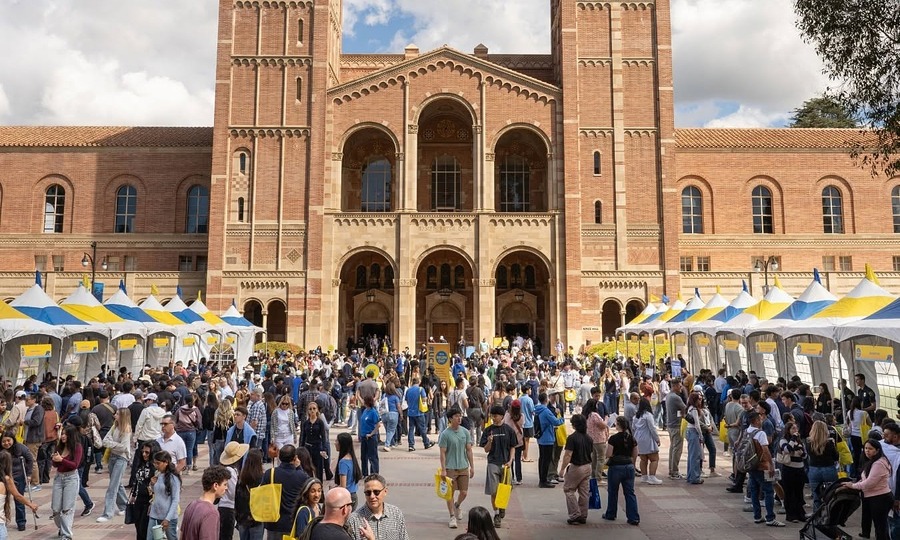
An event at the University of California, Los Angeles (UCLA), April 2026. Photo from the university's Facebook page
The widening gap: adjuncts vs. administrators
Adjunct faculty, who do not hold tenure, face even greater challenges. The report describes their earnings as "low, fragmented, and insecure." About 70% of surveyed institutions set a pay floor of just US$4,000 or less per 3-credit course.
Benefits for these part-time instructors remain remarkably thin. Just 32.7% of institutions contribute toward retirement for part-time faculty, and only 30.6% contribute toward medical insurance premiums.
Administrator compensation, by contrast, tells a different story. Median presidential salaries ranged from $275,000 at public associate's institutions to $850,000 at private-independent doctoral universities. Depending on the institution, presidential compensation ranges from three to more than five times the average salary of a full professor.
The AAUP notes this ratio is one of the clearest illustrations of the widening gap between executive compensation and faculty pay.
Beyond wages, the long shift away from tenure remains the defining structural fact of the academic profession.
According to the AAUP's data, only 31.8% of faculty members held full-time tenured or tenure-track appointments in fall 2023. This is a sharp decline from 1987, when 53.1% of faculty held these secure roles.
Conversely, nearly 70% of today's faculty hold contingent appointments, with almost half of all educators working strictly part-time.
The AAUP warns that this decline reflects a reduced capacity for faculty to pursue research and innovation independently, without pressure from corporate or political influences. It argues faculty compensation is a core governance issue, and how an institution pays its educators reflects whether it is protecting its academic staff and sustaining institutional stability, or increasingly operating in a state of crisis management driven by external pressures.
The U.S. higher education sector is navigating multiple disruptions, from inflation and unstable research funding to political interference and an uneven post-pandemic enrollment recovery.
View original source — VnExpress ↗
Related stories

TASS
BusinessJun 25, 2026 · 1 min
Market participants to discuss stablecoin regulation in Russia
TASS

Bloomberg
BusinessJun 25, 2026 · 1 min
Getting to the World Cup Final Without Losing Your Mind
Bloomberg

MarketWatch
BusinessJun 25, 2026 · 1 min
A $600,000 Ferrari? How healthcare scam artists are laughing at the rest of us.
MarketWatch

Indian Express
BusinessJun 25, 2026 · 1 min
Commercial cooking gas curbs removed as West Asia crisis eases
Indian Express