Indian Express
UPSC Key: Cabinet Secretary, Passport as citizenship proof and Omega Block
Cab Secy’s poser: Do we want 30-yr service experience or just one repeated 30 times?
Syllabus:
Preliminary Examination: Indian Polity and Governance
Main Examination: General Studies II: Role of civil services in a democracy.
What’s the ongoing story: In a two-page note sent to all Secretaries to the Government of India, accompanied by a 10-page guide on how to conduct meetings, Cabinet Secretary T V Somanathan has said that if they just follow “a beaten track”, the question they may face at the end of their service is: did they get “30 years’ experience or one year’s experience repeated 30 times”.
Key Points to Ponder:
• Who is a Cabinet Secretary?
• What is the role of Cabinet Secretary?
• Who is Chief Secretary?
• Is the Chief Secretary the same as the Cabinet Secretary?
• What is the National Centre for Good Governance?
• What are the pillars of good governance?
• The Indian Administrative Service (IAS) hierarchy-know in brief
• Know About All India Service and All India Service Act 1951
• Know the Basics-Federalism, Cooperative Federalism and Competitive federalism
Key Takeaways:
• The note, sent on June 12, underlined the need to improve each year, to get the “small things” right, and to “pause and revisit” matters which may seem “routine”.
• Somanathan also asked the Secretaries to circulate the guide on holding effective meetings, drawn up by the National Centre for Good Governance (NCGG), to all civil servants. He said the Cabinet Secretariat, along with the NCGG, would circulate similar guides on various topics. The conduct of meetings was chosen as the first topic as meetings take up a lot of time in an officer’s day, he wrote.
• The Cabinet Secretary wrote that several middle-ranking officers had told him that they were happy with the subject-matter training being imparted to them, but needed more practical advice on “so-called routine matters”. “’Routine’, though it may seem boring, is often extremely important and, thus, during our long careers in the civil service, we may need to pause and revisit it,” he wrote.
• The 10-page guide on holding meetings starts with the basics, including being clear about why a meeting is being called, who is to be called and the timing. It advises that if the purpose can be achieved through email, phone or text messages, then a meeting should be avoided.
Do You Know:
• The Cabinet Secretariat is responsible for the administration of the Government of India (Transaction of Business) Rules, 1961 and the Government of India (Allocation of Business) Rules 1961, facilitating smooth transaction of business in Ministries/ Departments of the Government.
—This Secretariat provides Secretarial assistance to the Cabinet and its Committees, and also assists in decision-making in Government by ensuring Inter-Ministerial coordination , ironing out differences amongst Ministries/ Departments and evolving consensus through the instrumentality of the standing/ adhoc Committees of Secretaries. Through this mechanism new policy initiatives are also promoted.
—Management of major crisis situations in the country and coordinating activities of various Ministries in such a situation is also one of the functions of the Cabinet Secretariat.
• A Chief Secretary is the highest-ranking civil servant and administrative head of a state government or Union Territory in India. Appointed by the Chief Minister, they serve as the principal advisor on all administrative matters, head the state civil services, and act as the secretary to the state cabinet.
Other Important Articles Covering the same topic:
📍Knowledge Nugget | ‘Administrative scorecards’ to Secretaries: What are the must-know initiatives for civil services efficiency
Previous year UPSC Prelims Question Covering similar theme:
1) Consider the following statements: (UPSC CSE, 2016)
1. The Chief Secretary in a State is appointed by the Governor of that State.
2. The Chief Secretary in a State has a fixed tenure.
Which of the statements given above is / are correct?
(a) 1 only
(b) 2 only
(c) Both 1 and 2
(d) Neither 1 nor 2
2) Which of the following is/are the function/functions of the Cabinet Secretariat? (UPSC CSE, 2014)
1. Preparation of agenda for Cabinet Meetings
2. Secretarial assistance to Cabinet Committees
3. Allocation of financial resources to the Ministries
Select the correct answer using the code given below.
(a) 1 only
(b) 2 and 3 only
(c) 1 and 2 only
(d) 1, 2 and 3
Politics
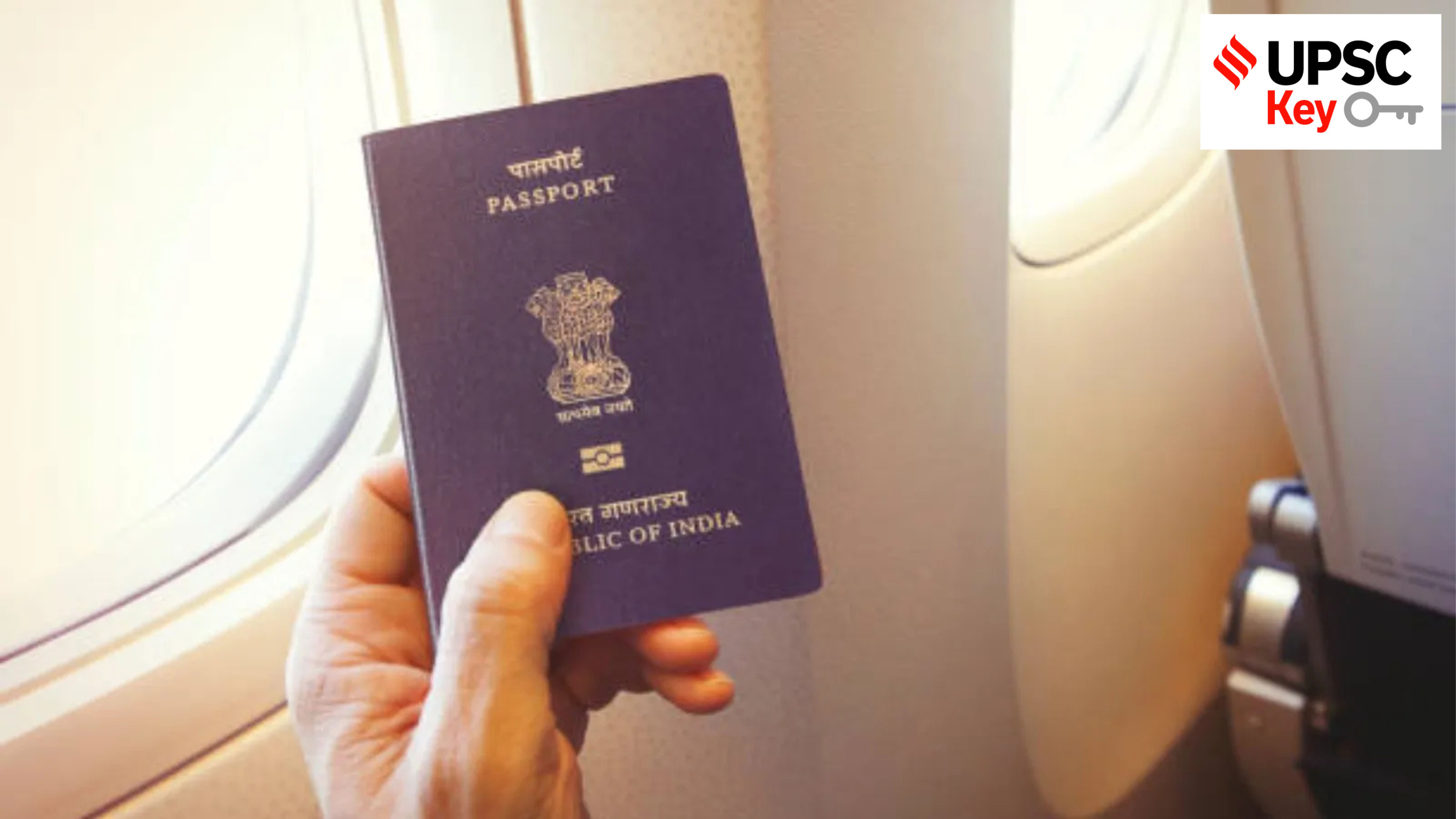
Passport a travel document, not proof of citizenship: MEA
Syllabus:
Preliminary Examination: Indian Polity and Governance-Constitution, Political System, Panchayati Raj, Public Policy, Rights Issues, etc.
Main Examination: General Studies II: Indian Constitution—historical underpinnings, evolution, features, amendments, significant provisions and basic structure.
What’s the ongoing story: Passport is a travel document, not a proof of citizenship, the Ministry of External Affairs has said. Even though it is issued only to Indian citizens, it is not a document that establishes citizenship, officials clarified on Wednesday.
Key Points to Ponder:
• What is passport?
• What exactly MEA said about Passport?
• Why did the MEA say a passport is not a citizenship document?
• Which documents are proof of citizenship in India?
• Why is passport is not a proof of citizenship?
• How does the Maneka Gandhi v. Union of India (1978) indirectly impacted passport issuance and citizenship proof?
• Who are ‘Citizens’?
• Who is a citizen in India’s constitutional scheme? What are various principles/kinds of citizenship?
• Citizens and Aliens-compare and contrast in terms of civil and political rights
• What are those rights and privileges that the Constitution of India confers on the citizens of India and denies the same to aliens?
• The Citizenship Act of 1955 prescribes five ways of acquiring citizenship-Know them in detail
• The Citizenship Act, 1955, prescribes three ways of losing citizenship-What are they?
Key Takeaways:
• Earlier this year, during the hearing on the Special Intensive Revision (SIR) of voter rolls, the Supreme Court had said that Aadhaar was not conclusive proof of citizenship, just a document of identity.
• The MEA also underlined measures incorporated into new chip-based e-passports, such as biometric data, to boost global acceptance and reduce the risk of fraud. India has rolled out chip-enabled e-Passports, which meet international standards for security and authentication.
• Officials said that the government continues to expand the ease of services with over 500 Passport Kendras and a delivery of 1.5 crore passports and related services in 2025. With six working days for passports, excluding police verification, the time spent at passport seva kendras spans less than 45 minutes, officials added.
• The MEA official said that for Indians, countries with visa-free entry stand at 27, an increase from 16 in 2019. “Forty seven countries have a visa on arrival for Indians and 66 countries offer electronic visa for Indians,” the official added, also highlighting a slew of mobility agreements signed with European countries in the recent past.
• The ministry will soon organise a two-day Human Resource Mobility Forum to highlight legal pathways for migration and facilitate networking between foreign employers and Indian nationals seeking jobs abroad.
• Earlier in the day, to mark the 14th Passport Seva Divas, External Affairs Minister S Jaishankar spoke about citizen-centric passport services. In a message shared on X, Jaishankar noted that the event marks the anniversary of the Passports Act of 1967 and serves as a reflection on the modernisation of India’s passport infrastructure.
Do You Know:
• The Ministry of External Affairs (MEA) clarified that a passport is not a conclusive proof of citizenship because it is legally classified only as a travel and identity document. While it is issued to citizens, Indian law dictates that citizenship is determined separately under the Citizenship Act, 1955.
• The landmark The Maneka Gandhi v. Union of India (1978) decision primarily transformed constitutional law regarding Article 21 (Right to Life and Personal Liberty) and administrative fairness, rather than establishing citizenship per se. However, it directly impacted passport law by declaring that the right to travel abroad is an intrinsic part of personal liberty. It mandated that the government cannot arbitrarily impound a passport without a procedure that is just, fair, and reasonable, and without giving the individual an opportunity to be heard
Other Important Articles Covering the same topic:
📍How citizenship was decided by makers of Indian Constitution
Previous year UPSC Prelims Question Covering similar theme:
3) With reference to India, consider the following statements: (UPSC CSE, 2021)
1. There is only one citizenship and one domicile.
2. A citizen by birth only can become the Head of State.
3. A foreigner once granted the citizenship cannot be deprived of it under any circumstances.
Which of the statements given above is/are correct?
(a) 1 only
(b) 2 only
(c) 1 and 3
(d) 2 and 3
Previous year UPSC Main Question Covering similar theme:
📍”Right of movement and residence throughout the territory of India are freely available to the Indian citizens, but these rights are not absolute.” Comment. (UPSC, 2022)
Explained
In dry monsoon, a test of resilience
Syllabus:
Preliminary Examination: Indian and World Geography
Mains Examination: General Studies I: Important Geophysical phenomena such as earthquakes, Tsunami, Volcanic activity, cyclone etc., geographical features and their location-changes in critical geographical features (including water-bodies and ice-caps) and in flora and fauna and the effects of such changes.
What’s the ongoing story: After remaining largely inactive for more than a week, the monsoon finally picked some strength and momentum beginning Monday. Maharashtra, for instance, received its first good rainfall of the season on Tuesday. But the monsoon’s behaviour so far in June has raised concerns that the season might be even drier than predicted.
Key Points to Ponder:
• What is the Madden-Julian oscillation?
• How does the Madden-Julian oscillation affect India?
• What is the difference between Madden-Julian oscillation and ENSO?
• Monsoon mechanism in India-Know in detail
• What is the arrival and departure of monsoon?
• What is the all India monthly and seasonal rainfall?
• Is monsoon the backbone of Indian economy?
• How Monsoon impacts on sowing?
• Why is the Southwest Monsoon critical for Kharif agriculture in India?
Key Takeaways:
• June was supposed to be among the relatively better rainfall months. The India Meteorological Department (IMD) forecast that while rainfall over India during the entire monsoon season was likely to be 90% of the long-period average, June was expected to get at least 92% of its normal rain.
• This was because it was expected to be least affected by the El Niño phenomenon in the equatorial Pacific Ocean, which has a tendency to suppress rainfall over the Indian region. But with barely a week remaining, the June rainfall deficit is more than 40% and appears unlikely to be bridged.
• An IMD bulletin on Wednesday forecast low to moderate rainfall activity in the areas covered by the monsoon — which is only around half of the country’s landmass. Around this time in June, the monsoon normally covers almost the entire country.
• Though the El Niño phase of the equatorial Pacific Ocean, off the northwestern coast of South America, has been declared to have emerged, this has not been the reason for the large rainfall deficit in June so far. This is because the effects of El Niño, or the opposite La Niña phase, on the Indian monsoon comes with a lag. It usually takes more than a month for the complete effects of El Niño to become evident over the Indian region.
• IMD director general Mrutyunjay Mohapatra said the El Niño phenomenon had a very small role to play in the monsoon performance in June. “El Niño emerged around the first week of June. We are now beginning to see its impact on the monsoon. It is not that there is no impact. But it is not the main reason for the rainfall deficit in June,” Mohapatra said.
• He identified other reasons — low pressure systems of inadequate strength; weak monsoon currents; and the unfavourable phase of a moving wind and cloud system called Madden Julian Oscillation, or MJO.
Do You Know:
• The MJO is basically a complex, moving system of winds, clouds and pressure. It travels eastward at the speed of 4-8 metres per second. Within 30 to 60 days, MJO wind bands can travel around the world and cause significant weather changes in their wake. In favourable phases, they can enhance monsoon rainfall over India.
Other Important Articles Covering the same topic:
📍Madden Julian Oscillation: The reason behind the unexpectedly good June rain
Previous year UPSC Prelims Question Covering similar theme:
4) With reference to Ocean Mean Temperature (OMT), which of the following statements is/are correct? (UPSC CSE, 2020)
1. OMT is measured up to a depth of 26ºC isotherm which is 129 meters in the south-western Indian Ocean during January-March.
2. OMT collected during January-March can be used in assessing whether the amount of rainfall in monsoon will be less or more than a certain long-term mean.
Select the correct answer using the code given below:
(a) 1 only
(b) 2 only
(c) Both 1 and 2
(d) Neither 1 nor 2
What’s driving Europe heatwave, and why is it struggling to cope?
Syllabus:
Preliminary Examination: Current events of national and international importance
Main Examination: General Studies I: Important Geophysical phenomena such as earthquakes, Tsunami, Volcanic activity, cyclone etc., geographical features and their location-changes in critical geographical features (including water-bodies and ice-caps) and in flora and fauna and the effects of such changes.
What’s the ongoing story: Around 50 people dead. Schools shut, public transport interrupted, air-conditioned cinema halls and museums asked to shelter the young and the elderly for free, farmers harvesting their crop at night. Western Europe is reeling under a severe heatwave again, with countries from Netherlands to UK to Italy to France affected.
Key Points to Ponder:
• What is heat dome?
• Why heat dome is also called as Omega Block?
• How heat dome is different from heatwave?
• What are the causes behind the increasing frequency and intensity of heat waves across the Europe?
• What is the relationship between global warming and record-breaking heat events in Europe?
• How does climate change influence the occurrence of compound extreme weather events?
• How do heat domes and jet stream disruptions contribute to prolonged heat waves?
• What is the impact of Arctic amplification on global weather patterns?
• How El Niño is impacting Europe?
• How does the Mediterranean Sea influence climatic conditions in Europe?
Key Takeaways:
• In France, 40 people have drowned over the past week because they went swimming in unsupervised waters. The country recorded its hottest day since record-keeping began in 1947 on Tuesday (maximum temperature hitting 44.3 degree Celsius), and thousands of homes are now sweltering in a power outage unlikely to be resolved before Wednesday night. Italy and the UK have also issued extreme heat alerts.
• An Omega Block, so named because it is shaped like the Greek letter Ω, is basically an area of high pressure between two zones of lower pressure. The heat dome also refers to an area of high pressure high above a landmass. Because of this high pressure zone, warm air rising from the ground is not able to escape into the atmosphere and is trapped close to the surface, further heating up the surroundings.
• Generally, winds known as jet streams blow from the west to east over Europe, moving weather systems. In the present scenario, this steady flow has become disrupted, leading to the omega-shape of air flow. This specific weather pattern aside, Europe has in general been warming up very fast, thanks to the effects of climate change.
• The 2025 edition of the European State of the Climate (ESOTC), an annual report published by the Copernicus Climate Change Service and the World Meteorological Organization (WMO), says, “Since the 1980s, Europe has been warming twice as fast as the global average, making it the fastest-warming continent. Heatwaves are becoming more frequent and severe, while extreme rainfall is leading to catastrophic floods. Glaciers continue to melt. Climate change is also affecting biodiversity, which is vital for a sustainable future.”
• Apart from a high rate of industrialisation, urban heat islands (where highly concretised urban areas heat up faster), fracking for oil and gas, and other human activities, Europe is also suffering from something called the albedo effect, which refers to how surfaces reflect sunlight back. The only area in the world heating up faster than Europe is the Arctic, where glaciers are melting rapidly. Whereas the bright, white ice would have reflected heat back, the darker water of the Arctic Ocean is absorbing it, thereby heating up neighbouring Europe further.
Do You Know:
• The unusual heat in Europe right now is being attributed to the formation of a “heat dome” that is preventing warm air near the ground from rising and dissipating. This is leading to an increase in surface temperatures.
• Heat dome’ is just a fancy way to describe how heatwaves normally occur. Heatwaves anywhere, including over India, are caused by the emergence of high-pressure air systems in the mid-troposphere, about 7-10 km above Earth’s surface, that trap the heated surface air near the ground. They push down the air and compress it, increasing the temperature in the process.
• This same system also prevents cloud formation and precipitation. Local influences can then amplify or weaken this phenomenon. For example, the heat dome effect over India often gets aggravated by the presence of dry soil, the “urban heat island effect” and the movement of hot air blowing from the deserts in the west. The urban heat island effect is a phenomenon where urban areas record higher temperatures than surrounding rural areas because their concrete traps heat during the day and radiates it at night.
• The formation of a heat dome is not an unusual phenomenon in European summers. This year, however, it has happened a little early, resulting in an extremely warm May — possibly the warmest May in several places.
• The Climate Prediction Centre of the US’s National Oceanic and Atmospheric Administration, one of the world’s most authoritative agencies tracking the Pacific Ocean, however, says it is too early to make any reliable prediction about its strength.
Other Important Articles Covering the same topic:
📍Europe’s record heat will end soon. But for the world, why the worst may be yet to come
Previous year UPSC Prelims Question Covering similar theme:
5) What are the possible limitations of India in mitigating global warming at present and in the immediate future? (UPSC CSE, 2010)
1. Appropriate alternate technologies are not sufficiently available.
2. India cannot invest huge funds in research and development.
3. Many developed countries have already set up their polluting industries in India.
Which of the statements given above is/are correct?
(a) 1 and 2 only
(b) 2 only
(c) 1 and 3 only
(d) 1, 2 and 3
After Op Sindoor freeze, a thaw in India-Turkey ties
Syllabus:
Preliminary Examination: Current events of national and international importance.
Mains Examination: General Studies II: Bilateral, regional and global groupings and agreements involving India and/or affecting India’s interests.
What’s the ongoing story: India and Turkey’s bilateral ties have often been overshadowed by one external factor: Pakistan. Last year, the relationship hit rock-bottom.
Key Points to Ponder:
• Map Work-Turkey
• India and Turkey—Know bilateral relations between the two countries?
• India and Turkey—Know historical background
• Why India-Turkey ties were in crisis during and post operation Sindoor?
• India extended support in the 1920s to Turkey’s War of Independence and the formation of the Turkish republic—Discuss
• The Khilafat Movement, a significant event in Indian history—What you know about the same?
• Was the Khilafat movement associated with Turkey?
• Why India participated in the Khilafat movement?
• Why Turkey and India are important to each other?
Key Takeaways:
• Following the Pahalgam terrorist attack, which killed 26 civilians, Turkey backed Pakistan on the Kashmir issue. It was Islamabad’s only ally in West Asia to explicitly condemn Operation Sindoor, India’s military response. Aggravating matters was Ankara’s supply of military hardware to a country India accuses of sponsoring cross-border terrorism.
• It was no surprise, then, that the ties — already shaky since the 2019 abrogation of Article 370 in Jammu & Kashmir — effectively went into cold storage for much of 2025.
• This year, however, both countries are showing signs of a rapprochement.
• In April, foreign office consultations resumed after being kept in abeyance for four years. The same month, the two sides also cooperated on the security front, with New Delhi extraditing fugitive narcotics trafficker Salim Dola from Turkey. Now, as reported by The Indian Express, both are working on the extradition of two more criminals wanted by India.
• In April, India invited Turkey for the 12th round of bilateral consultations. This came four years after the 11th round of foreign office consultations were held in Turkey. Ankara dispatched Turkish Deputy Foreign Minister Berris Ekinci, who co-chaired meetings with Sibi George, the Ministry of External Affairs’ (MEA) Secretary (West).
• According to the MEA, both sides focused on trade, investment, tourism, technology, innovation, energy and educational cooperation. Discussions also touched upon security matters, including the fight against cross-border terrorism.
• Officials said the meetings went well, with both sides expressing an interest in maintaining healthy dialogue. “We believe dialogue is better than not talking and deepening disagreements and misunderstandings. And the conversations have been satisfactory,” Ambassador Muktesh Pardesi told The Indian Express over the phone from Ankara.
• Meanwhile, Ankara has also shown willingness towards cooperation on matters related to law enforcement. Dola, a Mumbai-based criminal with links to international drug syndicates, was deported to India on April 28 with active assistance from Turkish authorities. In fact, his return has reinforced the security partnership between India and Turkey.
• Those aware of the conversations on both sides say that after the economic backlash in India, Turkey began to actively insulate its broader economic interests in Asia from its Pakistan alliance.
Ankara also assured New Delhi that it had no inherent bilateral dispute with India. Last week, Turkish foreign minister Hakan Fidan, who had earlier criticised India for Operation Sindoor, urged India to not be “resentful” of Ankara’s ties with Islamabad but rather view ties with the Eurasian nation through a bilateral lens. Turkey, Fidan highlighted, had enough reasons to have a good relationship with India.
Do You Know:
• The period from 2019 (after the abrogation of Article 370 in Kashmir) to late 2025 can be counted as some of the lowest points in India-Turkey relations. These years saw a massive diplomatic rift driven by the Kashmir issue and Ankara’s supply of military hardware to Pakistan, which heightened mistrust in New Delhi.
• In February 2025, Turkish President Erdogan again extended his support to Pakistan on Kashmir and called for UN dialogue to address the issue during his visit to Islamabad.
Hours after the Pahalgam attack, Pakistan Prime Minister Shahbaz Sharif, who was on a visit to Ankara at the time, at a joint press conference with Turkish President Recep Erdogan, thanked Turkey for its “unwavering support” on Kashmir. Pakistani media reported that Erdogan also expressed Turkey’s full support for “Pakistan’s efforts to eliminate terrorism”.
• Turkey was the only Pakistani ally in West Asia to explicitly condemn Operation Sindoor. Other Gulf countries have not only refrained from backing Pakistan, but have also shown greater sensitivity to India’s position on Kashmir.
• Their shared Islamic identity has long provided the underpinnings for a strong partnership between Turkey and Pakistan.
• During the Cold War, Turkey and Pakistan were together in groupings such as the Central Treaty Organization (CENTO) and the Regional Cooperation Development (RCD). The two countries have almost always supported each other during times of crisis.
• For instance, Pakistan has consistently backed Turkey’s claims against Greece in Cyprus. Pakistani leaders committed to militarily assisting Ankara in the Cyprus crises of both 1964 and 1971. In 1983, Pakistan’s military dictator General Zia-ul-Haq famously declared that his country would be the first to recognise Turkish Cyprus if it declared independence.
• Since 2003, when he became Prime Minister, Erdogan has visited Pakistan at least 10 times. His most recent visit came in February this year when Erdogan, now the President, co-chaired the 7th Session of the Pakistan-Türkiye High-Level Strategic Cooperation Council.
• Geopolitically, Turkey (with Qatar) is locked in competition with its Gulf Arab rivals, led by Saudi Arabia and the UAE. To curb Saudi-Emirati influence, Ankara has looked for alternative architectures of cooperation with non-Gulf Muslim states such as Pakistan and Malaysia.
Other Important Articles Covering the same topic:
📍Expert Explains: The Pakistan-Turkey nexus and where India stands
Previous year UPSC Prelims Question Covering similar theme:
6) In which one of the following groups are all the four countries members of G20? (UPSC CSE, 2020)
(a) Argentina, Mexico, South Africa and Turkey
(b) Australia, Canada, Malaysia and New Zealand
(c) Brazil, Iran, Saudi Arabia and Vietnam
(d) Indonesia, Japan, Singapore and South Korea
How government’s overhaul of FCRA rules puts focus on religious conversion
Syllabus:
Preliminary Examination: Current events of national and international importance.
Main Examination: General Studies II: Development processes and the development industry —the role of NGOs, SHGs, various groups and associations, donors, charities, institutional and other stakeholders.
What’s the ongoing story: The Union Home Ministry has tightened the foreign funding framework for NGOs and associations under the Foreign Contribution Regulation Act (FCRA). It has issued two notifications that sharply revise penalties and specify purpose-based, geography-linked registration while explicitly keeping foreign money out of proselytising activities.
Key Points to Ponder:
• What amendment is made in the Foreign Contribution (Regulation) Rules, 2011?
• What do the new notifications say?
• What is proselytization?
• Why is proselytisation mentioned specifically?
• In what context the term ‘proselytization’ is used in Foreign Contribution (Regulation) Act (FCRA)?
• Why were these amendments needed?
• What is significance of the second notification on penalties?
• Foreign Contribution (Regulation) Act (FCRA)-What and When it was enacted?
• Rationality behind the enactment of Foreign Contribution (Regulation) Act (FCRA)?
• NGOs and FCRA-why most of the NGOs are brought under FCRA?
• What is foreign contribution defined in Section 2(1)(h) of FCRA, 2010?
• What is a foreign source?
• Can NGOs use the foreign contributions for investment in Mutual Funds and other speculative investments?
• Who can receive foreign contribution?
• Who cannot receive foreign contribution?
• Are there any banned organisations from whom foreign contribution should not be accepted?
• What is ‘pressure group’?
• What are the legislations which regulates the finances of NGOs in India?
• A large number of Non-governmental Organizations (NGOs )exist in India-Can you recall some of those?
• Relationship between Government and Non-governmental Organizations -Analyse
Key Takeaways:
• The first notification amends the Foreign Contribution (Regulation) Rules, 2011, requiring every FCRA registration to specify both the purposes for which foreign funds can be used and the States or Union Territories where such activities can be undertaken. Organisations must now select their activities from a government-prescribed Schedule of 105 permissible purposes.
• Existing FCRA-registered associations have been given one year to indicate the purposes and geographical areas they wish to retain in their registration. Any subsequent expansion in scope will require fresh approval.
• The notification also broadens the definition of “key functionary”, restricts organisations with foreign nationals in key management positions from ordinarily receiving registration or prior permission, introduces a minimum utilisation requirement for renewal and cancellation decisions, tightens conditions for release of subsequent instalments of foreign funds, and mandates more extensive disclosures in annual returns, including activity reports, social media account details and information on ultimate donors.
• The second notification revises compounding penalties for violations such as excess administrative spending, speculative investments, diversion of foreign funds and use of foreign contributions outside approved purposes or areas.
• The changes mark a shift from a relatively broad, programme-based framework to a far more prescriptive regulatory regime.
• Under the 2011 Rules, organisations broadly identified themselves as undertaking religious, cultural, educational, economic or social activities and described their programmes. The new rules require them to choose from a government-notified list of approved activities, with registrations tied to those specific purposes.
• A second major change is geographical restriction. While organisations earlier disclosed their areas of operation, registration itself was not linked to specific states or Union Territories. The new framework makes geography part of the licence.
• The 2011 rules referred mostly to “Members of the Executive Committee or Governing Council” and “Chief Functionary”, without defining “key functionary” which have now been specified as directors of companies, partners in firms, trustees of trusts, the Karta of a Hindu Undivided Family, office bearers and members of governing bodies, and “any other officer or person… who has control over, or responsibility for the management or affairs” of the association.
Do You Know:
• One of the most notable features of the new Schedule is the repeated use of the phrase “excluding proselytisation” in relation to religious activities. While the 2011 rules recognised a range of religious activities, they did not expressly refer to proselytisation. The new framework allows faith-based activities such as religious education, theological study, preservation of religious traditions and religious gatherings, but explicitly excludes conversion-oriented work. The Constitutional backdrop is significant. Article 25 guarantees the right to profess, practise and propagate religion, but the Supreme Court in Rev Stainislaus vs State of Madhya Pradesh (1977) held that the right to propagate religion does not include a right to convert another person.
• By expressly excluding proselytisation, the Centre is signalling that foreign contributions can support religious and faith-based activities, but not conversion-oriented work.
• The government’s stated rationale is to strengthen oversight of foreign funding, plug compliance gaps and improve monitoring of how foreign contributions are used.
Other Important Articles Covering the same topic:
📍Explained: What FCRA Amendment Bill 2026 proposes, why it has sparked a row in Kerala
Previous year UPSC Main Question Covering similar theme:
📍Examine critically the recent changes in the rules governing foreign funding of NGOs under the Foreign Contribution (Regulation) Act (FCRA), 1976. (UPSC, 2015)
📍Can Civil Society and Non-Governmental Organisations present an alternative model of public service delivery to benefit the common citizen? Discuss the challenges of this alternative model. (UPSC, 2021)
Economy
Digital fraud: RBI revamps rules, widens framework
Syllabus:
Preliminary Examination: Current events of national and international importance
Main Examination: General Studies III: Challenges to internal security through communication networks, role of media and social networking sites in internal security challenges, basics of cyber security; money-laundering and its prevention.
What’s the ongoing story: The Reserve Bank of India (RBI) on Wednesday unveiled a revised compensation mechanism for victims of digital payment frauds and widened its framework for limiting customer liability.
Key Points to Ponder:
• What do you understand by the term ‘digital payment frauds’?
• What are the reasons for the increase in cyberfraud?
• What are the various consumer protection reforms introduced by the RBI?
• What efforts have been taken by the government leading to increased digital transactions?
• Know the significance of India’s digital economy.
• What is Indian Cybercrime Coordination Centre (I4C)?
• What Supreme Court said on digital payment frauds?
• What are the issues and challenges in curtailing digital payment frauds?
• What are the steps taken by GOI to combat digital payment frauds?
Key Takeaways:
• According to the central bank, a bona fide victim who has lodged a complaint involving gross loss of up to Rs 50,000 on account of fraudulent electronic banking transaction (EBT) will be compensated 85% of the net loss amount or Rs 25,000, whichever is less, once during the lifetime.
• The victim should report the fraudulent EBT on the National Cyber Crime Reporting Portal or National Cyber Crime Helpline (1930) and to the bank within five calendar days from its occurrence, it said in the Reserve Bank of India (Commercial Banks-Responsible Business Conduct) Third Amendment Directions, 2026.
• The new directions will apply in cases of electronic banking transactions undertaken by customers of a bank on or after January 1, 2027.
• For a complaint related to fraudulent EBT involving a loss amount of less than Rs 29,412, where a compensation of 85% is paid, 65% will be borne by the RBI, 10% by the customer’s bank and the remaining 10% by the beneficiary bank, the RBI said.
• In the case of a complaint arising out of cross-border fraudulent EBT, 65% will be borne by the RBI and the remaining 20% by the customer’s bank.
• For a complaint related to fraudulent EBT involving a loss amount of Rs 29,412 or more but up to Rs 50,000, where a compensation of Rs 25,000 is paid, the RBI, the customer’s bank and the beneficiary bank should contribute Rs 19,118, Rs 2,941 and Rs 2,941, respectively, towards the compensation in case of a complaint arising out of domestic fraudulent EBT, it said.
Do You Know:
• Indian Cyber Crime Coordination Centre (I4C) has been instituted as an attached office to the Ministry of Home Affairs, so as to coordinate a comprehensive, national response to all cybercrime complaints. With respect to matters of digital arrest complaints, it has blocked over 1,700 Skype IDs, 59,000 WhatsApp accounts, 6.69 lakh SIM cards, and 1,32,000 IMEIs in 2024 alone.
• The Central Government and telecom service providers also devised systems to identify and block incoming international spoofed calls displaying Indian mobile numbers. The Citizen Financial Cyber Fraud Reporting and Management System has saved over ₹3,431 crore from fraudulent attempts.
• But the unparalleled pace with which India has advanced its digitisation trajectory has not just eased access to services for millions, but also inadvertently caused what is called “cyber fraud epidemic”. It has apparently undermined public trust in the digital system. Digital arrest scams cause immediate, tangible harm while quietly eroding confidence in India’s digital ecosystem in the long run.
Other Important Articles Covering the same topic:
📍How India strengthens its digital-fraud resilience
Previous year UPSC Prelims Question Covering similar theme:
7) In India, it is legally mandatory for which of the following to report on cyber security incidents? (UPSC CSE 2017)
1. Service providers
2. Data centres
3. Body corporate
Select the correct answer using the code given below:
(a) 1 only
(b) 1 and 2 only
(c) 3 only
(d) 1, 2 and 3
8) In India, under cyber insurance for individuals, which of the following benefits are generally covered, in addition to payment for the loss of funds and other benefits? (UPSC CSE, 2020)
1. Cost of restoration of the computer system in case of malware disrupting access to one’s computer
2. Cost of a new computer if some miscreant wilfully damages it, if proved so
3. Cost of hiring a specialised consultant to minimise the loss in case of cyber extortion
4. Cost of defence in the Court of Law if any third party files a suit
Select the correct answer using the code given below:
(a) 1, 2 and 4 only
(b) 1, 3 and 4 only
(c) 2 and 3 only
(d) 1, 2, 3 and 4
Previous year UPSC main Question Covering similar theme:
📍What are the different elements of cyber security ? Keeping in view the challenges in cyber security, examine the extent to which India has successfully developed a comprehensive National Cyber Security Strategy. (UPSC, 2022)
PRELIMS ANSWER KEY
1.(d) 2.(c) 3.(a) 4.(b) 5.(a) 6.(a) 7.(d) 8.(b)
For any queries and feedback, contact [email protected]
Subscribe to our UPSC newsletter. Stay updated with the latest UPSC articles by joining our Telegram channel – IndianExpress UPSC Hub, and follow us on Instagram and X.
View original source — Indian Express ↗
Related stories

The Punch
TechnologyJun 25, 2026 · 1 min
VIDEO: TikTok star Jarvis blasts rapper Ycee over ‘olodo uprising’ comments
The Punch

ZDNet
TechnologyJun 25, 2026 · 1 min
Got a spare PC? How to open-source your smart home - for free
ZDNet

CBC
TechnologyJun 25, 2026 · 1 min
Apple hikes prices on iPads, MacBooks, as AI crunches global memory chip supply
CBC
Indian Express
TechnologyJun 25, 2026 · 1 min
Hingoli boy dies by suicide, family say he was depressed after NEET-UG cancellation
Indian Express