The Guardian
Zali Steggall and Allegra Spender have a new party – but what does it stand for and who will join?
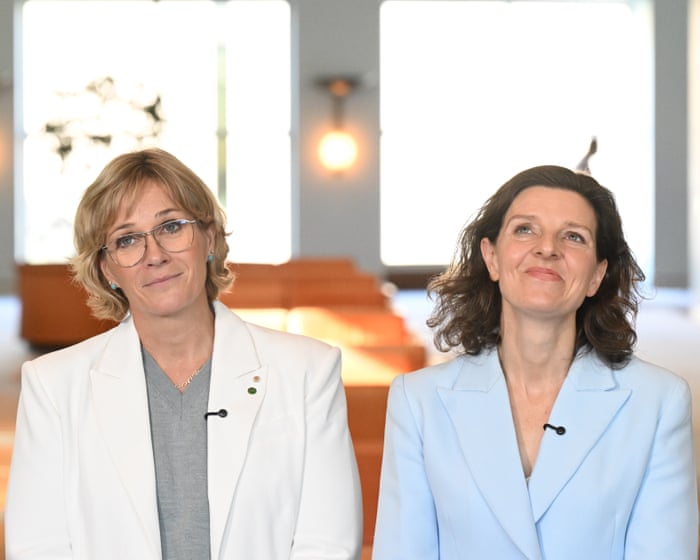
Two “teal” independent MPs have launched their own political party, with plans to organise themselves and run new candidates under the banner of “Community Strong”. Australia’s newest political party will be focused around a centrist agenda on housing, climate and cost of living, but allow its members a free vote in parliament – to reflect the wishes of their community.
This is what you need to know.
No other current member of the crossbench, nor any other notable names outside parliament, have so far indicated they will join.
The party does not anticipate having “members” in the same way as the Labor or Liberal parties do. Instead, community members will be able to get involved through volunteering and public events.
3. Why did they create a new political party?
Both Spender and Steggall said they believe many Australians are feeling despondent about politics, between the extremism and conservatism of the Coalition and One Nation, and the rising unpopularity of the Labor party. They painted Community Strong as an alternative to exist near the middle of the political spectrum.
“People have been approaching me since the election … saying ‘we need something different here, we are concerned about the extremists in our country, and we want to make a difference in this country, but we need you guys to come together’,” Spender said.
“I was overwhelmed by people from around the country saying ‘please do this because we need an alternate political force. I don’t feel represented. I don’t know where to go’.”
Another factor is new political electoral laws – including spending and donation caps – which disadvantage smaller players. Those changes, passed by Labor and the Coalition, place limits on the style of campaigning which has helped elect “teal” independents around the nation, but provide more benefits to politicians who exist inside more traditional party structures.
Spender earlier said the move wasn’t all about the donations changes, but in an email to supporters on Thursday afternoon, she said: “the reality is that new donation laws and structural advantages enjoyed by the major parties have made it harder for grassroots campaigns to compete.
“A party structure helps put us on a more level playing field, while preserving everything that makes the community independent model valuable.”
Steggall and Spender said they weren’t working with Climate 200, or its major donors like Scott Farquhar or Mike Cannon-Brookes, on the new party.
4. What about the other teals?
Most of the rest of the crossbench has ruled out joining the party, at least immediately.
Monique Ryan and Kate Chaney quickly ruled themselves out of joining the party several weeks ago. Other independent MPs like Helen Haines, Andrew Wilkie and Rebekha Sharkie also won’t be part of the new political alliance.
One exception is the member for Bradfield, Nicolette Boele. She congratulated Steggall and Spender, saying she would remain independent but was “still working through what this party would allow me to do for the people I represent that I cannot already do as a community independent”.
Boele did not rule out closer ties and said she expected to work with the party “often” on policy issues. Spender and Steggall said they also expected to keep working closely with other crossbenchers on policy issues.
5. What are the party’s policies?
The policies are still to be decided, and the party will develop some, but representatives will also retain a free vote in parliament – meaning they won’t be bound by a party room decision.
Steggall said members would have to “pledge to the core values” and “policy pillars” of the organisation.
On its website, Community Strong lists a number of “commitments” including:
AI and tech opportunity with guardrails to protect data.
A respectful multicultural society.
A productive economy.
Intergenerational fairness.
Energy security.
Spender said there would be a 100-day period of consultation with supporters about other parts of the party, saying “there is more listening to come”.
6. Where will the party’s candidates run?
The party will run candidates in the House of Representatives and Senate. Steggall and Spender wouldn’t say how many candidates they expected could run under the Community Strong banner, but “community engagement” would be a barometer for which campaigns they could seek to support.
The party’s website speaks of “local communities playing a central role in candidate selection, policy development and accountability”.
7. What is that logo?
The logo is in three parts, with a red orb at the top, a white stripe in the middle and a teal swirl below. We’re told that is meant to represent the sunrise, a speech bubble, and an outstretched hand, respectively; while the logo as a whole is also in the shape of a heart.
Those shapes weren’t immediately clear to some political observers on Thursday, however, with some remarks the logo reminded people of other things. Some claimed it looked like a Santa hat or Papa Smurf from cartoon The Smurfs, while others suggested a few more inappropriate things we won’t name here.
View original source — The Guardian ↗
Related stories

The Punch
PoliticsJun 25, 2026 · 1 min
Nigerians at the core of foreign policy, minister explains
The Punch
The Punch
PoliticsJun 25, 2026 · 1 min
PRP opposes state police, questions Tinubu’s motive
The Punch

The New York Times
PoliticsJun 25, 2026 · 1 min
More Temperature Records Fall as Deadly Heat Stifles Europe
The New York Times

The Hill
PoliticsJun 25, 2026 · 1 min
How Washington can easily help millions of people around the world
The Hill