Times of Israel
Vance: US-Iran deconfliction cell has IRGC, CENTCOM reps ‘hanging out’ in Doha
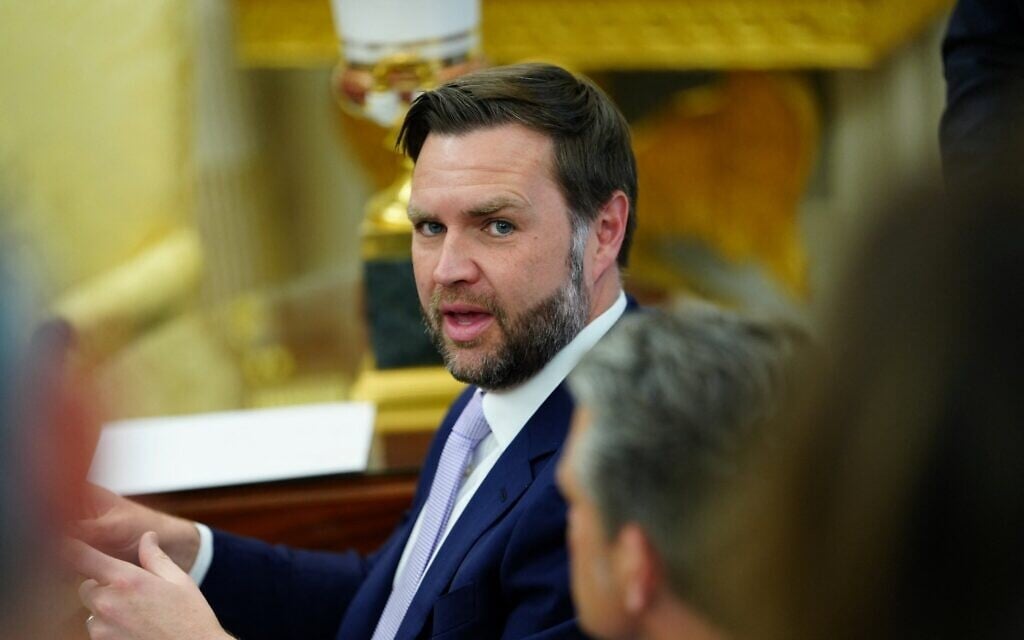
US Vice President JD Vance has revealed that the deconfliction channel Washington and Tehran agreed to set up during talks in Switzerland this past weekend includes representatives from the Islamic Revolutionary Guard Corps and the US Army’s Central Command, who will sit together in Qatar.
“One of the things we wanted to come out with [was a] channel on the Iranian side [for reducing conflict], which we did,” Vance said in an interview with the UnHerd British news site, which took place while the vice president flew back from those talks in Switzerland on Monday, but wasn’t published until Thursday.
“They were like, ‘OK, fine, we’ll send somebody from the IRGC to go hang out in Doha with somebody from CENTCOM,’ and that’s how we’re going to settle a lot of these disputes,” Vance said.
While US officials have recently revealed contact that has been established with the IRGC during negotiations with Iran since the outbreak of the war, the fact that Vance is now saying that the engagement is taking place at the military level was particularly noteworthy, given that the US has designated the IRGC as a Foreign Terrorist Organization.
Before departing Switzerland on Monday, Vance gave a press conference during which he touted what he said were two new mechanisms that the US and Iran agreed to establish during their weekend negotiations — one to ensure that the Strait of Hormuz remains open and another to maintain a regional ceasefire, particularly in Lebanon.
Get The Times of Israel's Daily Edition
by email and never miss our top stories
By signing up, you agree to the terms
It was unclear which of those two mechanisms Vance was describing in the UnHerd interview, or whether the IRGC-CENTCOM coordination hub that has purportedly been set up in Doha will deal with both of those issues.
It was specifically the deconfliction mechanism that Vance announced regarding Lebanon that infuriated Israel, which has argued that Iran should have no say on what happens in the country.
But either because of Iran’s significant leverage in the Strait of Hormuz or because Washington believes that Iran is needed to rein in Hezbollah, the US first agreed to Tehran’s demands that the memorandum of understanding inked last week include a ceasefire in Lebanon and then agreed to allow Iran to be part of the deconfliction mechanism that was established to ensure that ceasefire.
The US has sought to blunt criticism by announcing the reestablishment of a separate Lebanon deconfliction mechanism, in which Israeli and Lebanese military officials sit together with CENTCOM to respond in real time to potential threats to the ceasefire.
It’s unclear, though, whether this mechanism — outlined by Marco Rubio’s State Department — or the one laid out by Vance in Switzerland is actually active, as US President Donald Trump has oscillated between the two top aides to create a policy that sometimes appears contradictory.
The US established a direct channel between Israel and Lebanon in April, specifically to detach Iran from developments in Lebanon, only to reconnect Tehran to developments in Beirut by signing onto an MOU that included a ceasefire in Lebanon.
Harvesting decades of mistrust
Another aspect of the MOU that exposed the US to blowback is its inclusion of significant sanctions relief for Iran. The US has claimed that the funds released to Iran will have to be spent in the US for the betterment of the American economy.
But Iran’s parliament speaker and top negotiator, Mohammad Bagher Ghalibaf, denied that it was the case on Thursday.
“America falsely claims our unfrozen assets will buy their agriculture. Interesting. The only crop we’re harvesting is what you planted: decades of mistrust,” Ghalibaf said in a post on X, in the most recent assertion by Tehran that it will manage its own assets. “It’s organic, abundant, and homegrown. But apparently the US only exports GMO soybeans, broken promises and trash talks.”
Vance in the UnHerd interview insisted that the final deal the US seeks with Iran through the MOU will be “radically different” than the 2015 nuclear agreement signed by former US president Barack Obama because the inspection regime will be more intense and Iran’s stockpile of enriched uranium will be “eliminated” — something Iran has said it will not accept.
The vice president also argued that his deal will transform the Middle East by leading to more cooperation between Iran and the rest of the region.
Arab states are more appreciative of the MOU “because of the conversations they’re having with the Iranians,” Vance claims.
“The Emiratis — by far the most hawkish, by far the most pro-Israel country in the GCC — they’re having conversations with the Iranians that have never happened before, including with the IRGC, about various types of economic incentives — ‘Here’s what we’d need to see to make your country investable’ — and the Iranians come back and say, ‘Okay, yeah, we’re willing to do all those things,'” Vance says.
However, analysts overwhelmingly argue that those new conversations between Iran and its Gulf neighbors are due to the latter’s conclusion, following the recent war, that the US has become an unreliable security partner and feel that improving ties with their adversary is the only way to better ensure their security.
Gulf FMs say Iran proxies, missiles must be addressed for ‘lasting’ peace
Rubio jetted off to the Gulf this week, making stops in the UAE, Kuwait and Bahrain in a bid to reassure allies of Washington’s commitment to their security after it was significantly jeopardized by the war the US and Israel launched against Iran.
Rubio capped off his trip by participating in a Gulf Cooperation Council summit in Bahrain, which resulted in a lengthy joint statement by participating countries regarding their policies in the region.
Most notably, the statement included an assertion by the Gulf’s top diplomats that dealing with Iran’s proxies and missiles is key to lasting peace, and that any trade and investment with Tehran will be reversible and contingent on it respecting its deal with the US.
“The ministers further emphasized that lasting regional peace and security requires addressing the full spectrum of Iran’s threats, including its ballistic missiles, drones, and support of proxies in the region,” they said in the joint statement.
“Any trade and investment with Iran is conditional and reversible, contingent on Iran’s compliance with the MOU and the final agreement, cessation of its destabilizing behavior, and creation of the conditions necessary for economic engagement,” the statement added.
The Gulf ministers expressed their support for the memorandum of understanding inked between the US and Iran last week, while stressing the need for the parties to reach a final agreement that stabilizes the region.
The Gulf ministers also emphasized “the importance of reopening the Strait of Hormuz, noting that free, unconditional and unrestricted navigation, including the right of transit passage as guaranteed under international law, remains essential to regional and global security,” the statement says, rejecting any tolls or attempts to assert control over the strait, while welcoming Oman’s opening of an additional corridor in the channel to secure the safe passage of stuck vessels.
Shortly before the joint statement was issued, Oman’s Foreign Minister Badr Albusaidi issued one of his own, asserting that there will be no transit fees will be imposed in the Strait of Hormuz. Muscat previously offered mixed signals on the issue.
The GCC statement went on to stress Gulf support for the territorial integrity and sovereignty of both Syria and Lebanon, an apparent reference to the buffer zones that the IDF has established in both of those countries, claiming they are needed to ensure the security of Israel’s northern residents.
The ministers welcomed the ongoing talks between Israel and Lebanon and agreed on the importance of disarming non-state actors such as Hezbollah.
The statement also expressed support for the US 20-point plan for stabilizing Gaza, which is being overseen by the Board of Peace — a new Trump-chaired international body that Gulf countries have pledged billions to support.
The ministers reiterated their support for disarming Hamas and handing over control of Gaza to the Board of Peace-overseen committee of Palestinian technocrats.
The ministers also touted Trump’s statement last year rejecting Israeli annexation of the West Bank, while “underscoring that progress on Gaza redevelopment and Palestinian Authority reforms will create the conditions for a credible pathway to Palestinian self-determination and statehood.”
“The ministers further reaffirmed that no one will be forced to leave Gaza, and those who wish to leave will be free to return,” the statement said, rejecting ongoing Israeli efforts encouraging Palestinians to leave the Strip.
The statement concludes with a GCC condemnation of attacks against their countries by Iranian proxies in Iraq, while stressing the importance of Baghdad taking measures to rid itself of Iranian influence.
View original source — Times of Israel ↗
Related stories
TechRadar
TechnologyJun 25, 2026 · 1 min
Forget the Apple Watch Ultra 3, you probably don't need it
TechRadar

Engadget
TechnologyJun 25, 2026 · 1 min
Commodore has dropped the price of its retro phone by $100 ahead of preorders
Engadget
South China Morning Post
TechnologyJun 25, 2026 · 1 min
Why Hong Kong’s bilingualism is uniquely indispensable in the AI era
South China Morning Post

The Verge
TechnologyJun 25, 2026 · 1 min
Framework has good news and bad news
The Verge