Times of Israel
Times of Israel··11 min read
‘Zero hour is coming’: How Israel went from negotiating over hostages to the daring raid at Entebbe
On Thursday, July 1, 1976, as Prime Minister Yitzhak Rabin sat in Tel Aviv with a close circle of advisers, the IDF chief of staff approached him with some bad news.
“There’s no denying it,” Motta Gur said. “The IDF isn’t really built for operations in Entebbe.”
It was the middle of the afternoon, four days after the government had received word that an Air France plane, en route from Tel Aviv to Paris via Athens, had been hijacked and eventually taken to Entebbe Airport in Uganda. More than 240 passengers were on the flight, 83 of them Israeli. The crisis had consumed the government in the time since; this was the sixth meeting of that day alone, and there would be two more after it.
Rabin snapped at Gur — but not to contradict him.
“Is someone complaining?” said the prime minister, himself a former IDF chief of staff. Earlier, he had compared the idea of a rescue mission to the Bay of Pigs, the failed US-backed attempt 15 years earlier to overthrow the Cuban government.
He added, “I’m not complaining, and think we have no operational ability there, operational ability to free the hostages.”
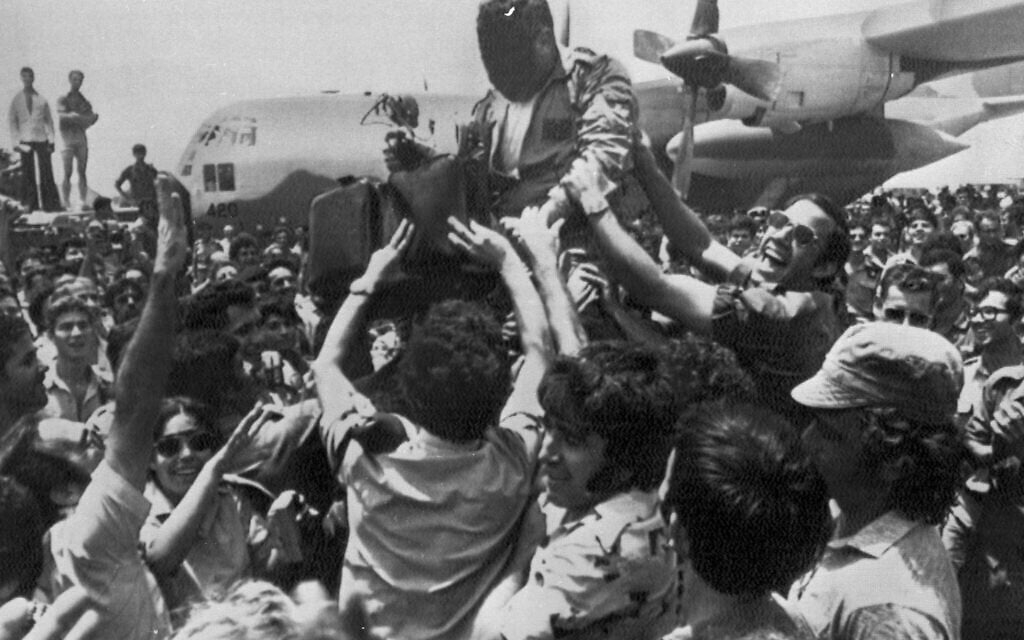
Some 48 hours later, four Israeli Hercules jets would take off from Sharm al-Sheikh, launching the rescue mission that would free the hostages and quickly become the stuff of Israeli legend.
What changed? Fifty years after the July 4, 1976, surprise operation at Entebbe, a new trove of documents from the State Archive in the Prime Minister’s Office has revealed the minutes of the many government meetings held during the fateful weeklong crisis.
Also included are diplomatic cables, photos and handwritten notes covering everything from Israel’s attempts to sway Ugandan dictator Idi Amin to a subject that may feel more familiar to the Israel of today: Attempts by the families of hostages to convince the government to cut a deal that would save their loved ones’ lives.
Rabin and his close circle of advisers changed tacks in real time, with the lives of dozens of their citizens in the balance
The documents tell a story not of an Israeli government that secretly planned, all along, to stage a dramatic rescue under the ruse of negotiating. Rather, Rabin and his close circle of advisers — a group that would later become known as the security cabinet — changed tacks in real time, with the lives of dozens of their citizens in the balance.
They first hoped for international assistance. When that wasn’t forthcoming, they ambivalently, reluctantly, opted for negotiations with the terrorist hijackers, all the while trying to flatter Amin and prevent leaks to the press.
Only days later did a risky, secret military operation become possible.
“I do not propose this lightly,” Defense Minister Shimon Peres said at a cabinet meeting on July 3, as the government was deciding to send commandos to Uganda. “This is an operation that the IDF has not experienced. This is the first operation in Israel’s history outside the borders of the Middle East.”
Then, he added, “When comparing both risks and results, we have reached a conclusion.”
‘I intend to hold the French government responsible’
Rabin got the news of the plane’s hijacking, after a stopover in Athens, in the middle of his weekly Sunday cabinet meeting on June 27, and immediately informed those in the room.
“It’s apparently hijacked, apparently flying toward Benghazi,” Rabin said of the jet. “Everything is still a matter of speculation. I want to stress that [security] checking of passengers in Israel is serious, but in Athens it’s less serious.”
Shortly afterward, while still in the meeting, Rabin passed a handwritten note to his chief of staff, Eli Mizrahi, making clear that as this was an Air France plane, it was a matter for the French government to address.
“I intend to hold the French government as the responsible party for the fate of the Israelis flying on an Air France airplane, and not to relieve the French government of this responsibility,” he wrote.
Later in the day, Rabin for the first time assembled what he would call the “special ministerial staff” — a group that included himself, Peres, Foreign Minister Yigal Allon and three other cabinet members. The group would meet a total of 18 times during the crisis, and would evolve into what became the security cabinet.
The French president communicated to Israeli officials that France was responsible for the safety of the passengers aboard its flagship airline. By the next day, the plane was in Entebbe and France was waiting for the hijackers — including members of the Popular Front for the Liberation of Palestine and two Germans from the group Revolutionary Cells — to send their demands so that negotiations could begin.
The terrorists demanded the release of “freedom fighters” held by Israel and a number of other countries, and set a deadline of July 1. But by June 30, there had been no meaningful progress. Speaking in a Foreign Affairs and Defense Committee meeting, opposition MK Shlomo Tamir pinpointed the issue: No country cared about the fate of the Israeli and Jewish passengers more than Israel.
“We have the duty to protect the lives of our citizens, and also those of Jews,” he said. “I fear that France is likely to remain the one responsible, and won’t care about this past a certain point… The issue is an Israeli-Jewish one.”
‘They’re going to blow up the plane’
Israeli officials brainstormed other leaders who might be able to mediate the crisis: Pope Paul VI? Henry Kissinger? And they initiated contact with the one man who, they felt, could intervene directly with the terrorists: Idi Amin.
Amin was no friend of Israel: In 1972, the capricious dictator had cut off relations with Jerusalem, and he trumpeted the Palestinian cause. Soon, the Israelis would learn that he was working with the hijackers.
Israel’s former military attaché in Kampala, Baruch Bar-Lev, remained on good terms with Amin, and the government tasked him with reaching out — but only as a private citizen, so that it wouldn’t seem like Israel was negotiating directly.
“How are you, my friend?” Amin said, according to a Hebrew transcript of the June 30 call, the first of five calls between the two men during the crisis. Bar-Lev soon began appealing to the dictator’s ego:
“You have a great opportunity to go down in history as a great peacemaker,” he said. “If you free the people, you’ll go down in history as a very great man.”
Amin was receptive, but responded with a warning: The deadline was approaching, and the hostages were in danger.
“They say that if the Israeli government doesn’t respond to their demands, they’re going to blow up the French plane and all of the hostages at 12:00 noon GMT tomorrow,” Amin said. “Your government must do everything possible to free these hostages.”
He said he spoke directly with the Israeli hostages. They were “very happy,” he claimed.
The hostage families
As the days wore on, government officials reiterated that negotiating with terrorists contravened Israeli policy. A Foreign Ministry cable from the evening of June 29 said that Israel’s position hadn’t changed: It “does not capitulate to extortion.”
Around the same time as that cable went out, however, a telegram arrived for Rabin.
“In exchange for corpses we freed terrorists,” it read, a reference to a 1975 exchange with Egypt for fallen IDF soldiers. “Better to do so in exchange for the living. Human life outweighs principles, and there are other ways to fight or prevent terror.”
It was signed, “The hostage families.”
The next day, Transit Minister Gad Yaakobi met with the families of the hostages, where they repeated the same demand. That evening, Rabin had his own meeting with editors of Israel’s newspapers.
Among his requests: Don’t publish articles about the hostage families’ outreach to the French government. Publicity, he said, could weaken Israel’s position. But he told his ministers he was sympathetic to the loved ones’ pressure campaign.
“These are family members,” he said. “You can’t expect them to act differently.”
In any case, officials realized that with the July 1 deadline approaching, they would need to do something. “Even no decision is a decision,” Rabin said at a June 30 meeting. And a military rescue operation still felt unrealistic.
“The IDF has the duty to protect every Israeli, wherever they are,” Gur wrote in a note to Rabin on the night of the 30th. “If the IDF is unable to do that, we must save the Israelis. So if all of the efforts and approaches don’t succeed, the chief of staff recommends giving in to the terrorists’ demands.”
Zero hour
By the morning of July 1, the terrorists’ 2 p.m. deadline was approaching, with their threat to blow up a plane full of hostages hanging over the ministers’ heads. Before they voted on whether to enter negotiations, Peres sounded a word of caution, predicting that giving in to the hijackers’ demands would have dangerous ripple effects for Israel.
“We need to be worried about the fate of people in the future, about what will happen to the State of Israel and its position on the subjects of hijacking, terror, etc.,” he said.
But Rabin backed entering into talks, using language strikingly similar to the telegram from the hostage families.
I’m not ready to explain to the Israeli public, or anyone else, why we can conduct an exchange for corpses, but not for live people
“I’m not ready, in light of this, to explain to the Israeli public, or anyone else, why we can conduct an exchange for corpses, but not for live people,” he said.
At a 10:00 a.m. meeting, with just four hours to go, Peres said, “The zero hour is coming, and we don’t know exactly what will happen. We feel that a great effort must be made to break the ultimatum.”
Amin was to be notified that Israel was ready to negotiate via the French. Shortly afterward, the terrorists announced that they would free the non-Israeli hostages.
‘The PFLP sees no logic’
By July 2, two things had happened that turned a military operation from fanciful to credible: The first was that Israel quickly hit a roadblock in the talks. The PFLP, communicating via the Somali ambassador, rejected Israel’s overture to discuss the list of terrorists to be released.
“The PFLP. sees no logic in the requests of the Israeli government to release all detainees in exchange for a certain number of freedom fighters,” the message read.
Also, by July 2, it became clear that the hijackers’ decision to release the non-Israeli passengers meant that Israel had a new source of information regarding where the remaining hostages were held and how to get there.
In a meeting on July 2, Gur discussed the possibility of a surprise military operation to rescue the Israelis held at Entebbe.
But it wasn’t a sure thing: One problem was that such an operation necessitated a government decision, and the next day was Shabbat. Any logistical complication because ministers wouldn’t be able to attend the meeting could compromise the operation, Peres argued, warning, “If we lose the advantage of surprise, we’re sending the boys on a suicide mission.”
Shortly afterward, Rabin issued a directive: Prepare a military operation — but only as a secondary option to the main track of negotiations.
“Just like I’m in favor of all the [military] preparations that can be done, I suggest to ourselves that we view this as secondary to the main effort of negotiations over some exchange process,” he said.
‘The entire operation was built on surprise’
By the following day, circumstances had changed. Ministers were instructed to stay in Tel Aviv for Shabbat, to discuss what Rabin called a “weighty decision.” In the morning, Gur presented a plan for an operation with much improved chances. Peres encouraged the ministers to approve it, despite the risks.
Hopefully, no one will be killed, and I’ll see the finger of God in that
“I certainly and clearly assume that we’ll be risking the lives of civilians,” he said. “I have no doubt in my heart regarding that. Hopefully, no one will be killed, and I’ll see the finger of God in that.”
Then he added, in reference to the two German terrorists, “This image, of a miserable German man and woman standing with weapons pointed at Jews — I can’t shake it off. There are also emotional matters, and I know we’re taking on a very heavy responsibility.”
Shortly after 3 p.m., the ministers approved the operation. Minutes later, the planes carrying the commandos took off for Entebbe, some 4,000 kilometers (2,500 miles) away.
They landed shortly after midnight on July 4, and within hours, the operation was complete and the hostages were headed back to Israel. In the end, four hostages were killed, along with the commander of the elite Sayeret Matkal, Yonatan Netanyahu, the brother of current Prime Minister Benjamin Netanyahu.
At a government meeting later that day, Peres eulogized Netanyahu as “one of the Jewish people’s most wonderful fighters.” The operation would later be renamed in his memory.
The next day, July 5, Rabin met with journalists again. He had spent the past week negotiating between countries and trying to enlist the world’s help. But ultimately, it was a secret Israeli operation, executed alone, that rescued the hostages.
“No country was involved in planning the operation in advance, certainly not Europeans or Americans. And all those who claim to say they knew are telling old wives’ tales,” Rabin told the journalists. “And that is for one simple reason: the entire operation was built on surprise.”
He added, “And I don’t know who you trust, but I don’t trust any Frenchman, German or Englishman — and not always the Americans, when it comes to keeping a secret.”
View original source — Times of Israel ↗
Related stories

South China Morning Post
NewsJun 26, 2026 · 1 min
Japan’s women-only carriages turn 25
South China Morning Post

The Punch
NewsJun 26, 2026 · 1 min
Davido drops first single of 2026, I Know Who I Be
The Punch

ESPN
SportsJun 26, 2026 · 1 min
Poch puzzled by 'weird' questions: We 'won group'
ESPN
The Punch
SportsJun 26, 2026 · 1 min
World Cup: US lose 3-2 to Turkey after last-gasp strike
The Punch