The Guardian
Fifa unites the world – in anger at hydration breaks (AKA ad breaks) | Barney Ronay
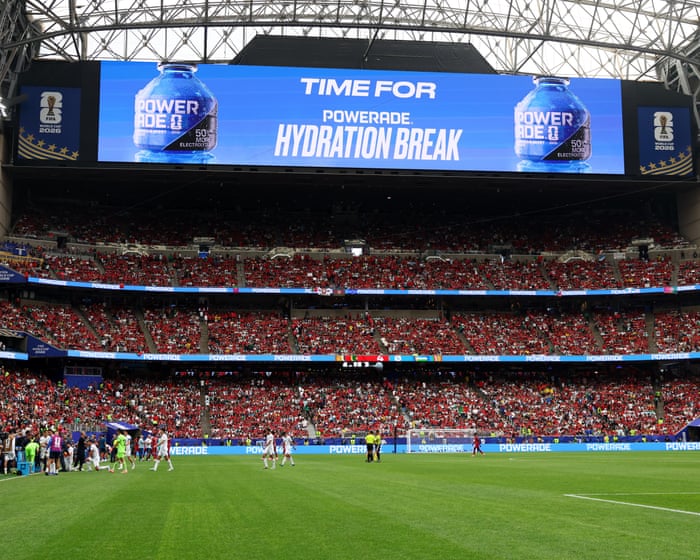
With 22 minutes gone on Tuesday night at Boston Stadium, and an injury delay in train, a clutch of England and Ghana players wandered to the side of the pitch and began taking drinks. This was the signal for a sudden spurt of refereeing indignation, the officials sprinting across in a state of apparently genuine outrage, appalled by the spectacle of unofficial hydration.
The first drinks break, Hydro-Quart-One, was only a minute away. Here we had players basically stealing hydration. Not to mention messing with the most vital part of the show – the advert timings. Guys, the director has not cued the break. David Beckham has the ice-cold faux beer halfway to his lips. Will Ferrell is making hyena-like vocal warm-up noises at the wheel of his crisp delivery lorry. We’re professionals. Hit your marks people.
When it finally came, the approved hydration break was massively, righteously booed by the fans in the stadium, despite the fact it did at least offer some respite from the stroke-inducing tedium of the actual game. And this has been the trend, begun with some mild booing by the Dutch in Dallas, and taken on by Spanish, Czechs, Mexicans, Japanese, Colombians, Saudis. There have been exceptions, namely the Brazilians and Haitians in Philadelphia, who seemed too busy dancing to Don’t Stop Believing, or enjoying the spectate of their nation on the world stage to really notice. USA fans have also seemed fine with it, but then US sport has interludes.
Norway against Senegal in New Jersey was the first attempt I have seen to actively curate the vibe of the hydration break, a trumpet-parping band popping up to reel off a medley of jaunty tunes, which just seemed utterly wrong and transgressive, the game suddenly falling apart, like someone walking their dog across the pitch. Frankly it was enough to make you long for the old-school hydration break, to become in that moment a Proper Hydration Man. Hang on. Maybe the hydration break has … gone.
Hopefully it will carry some impact, even within the closed world of Fifa governance, that the reaction to the enforced break has been almost entirely negative. Thomas Tuchel hates it. Marcelo Bielsa has spoken darkly about fissures in the deep soul of the sport. Kai Havertz says it’s annoying. Only two people seem to like it. First, Ralf Rangnick, who declared himself “excited” by the hydration break and called for European football to adopt it, something Uefa has so far ruled out, and long may its sibling hostility to Fifa continue.
The second person is Gianni Infantino, who imposed the drinks break in his capacity as executive law-maker, and is far too steeped in those sweet, sweet advertising revenues to consider anything as alien as a change of heart. Or indeed to admit the truth. Which is that the hydration break is an abomination, a desecration of the basic fabric of the sport, enacted by sleight of hand, and completely unnecessary in this form. Football has many problems. Insufficient broadcast revenue is very obviously not one of them.
This is more than a temporary borrowed Americanism, a take on the host nation-style, where the on-field space is constantly flooded with light, noise and cuts to celebrity observers in the crowd, as though the entire spectacle is a private four-way watchalong with Spike Lee, Taylor Swift and Matt LeBlanc. It is a fundamental change.
With breathtaking chutzpah, Fifa has made football into a game of four quarters, has crossed a line nobody thought possible, and done it right under our noses. Zoom out a little, and this is the biggest change to the basic structure of the game since 1897, when it was first codified that teams would play two halves of 45 minutes. Substitutions and red cards have all followed. But nothing so fundamental to the two basic axes of the game: time and space. It is an act of casual violence, one that changes not just the staging, but its most basic rhythms.
What to do about this? For a start we really should stop calling it “a hydration break”, giving room to the kind of phoney science-style language you might hear in an advert for a shampoo that leaves your hair four times as avocadoliciously multivitaminated. It’s an advert break. We know this. They know it. And language matters. This is the space where the truth is lost. But then Fifa also knows had it not styled this as a drinks break, which sounds swift and manageable, had it just said we are going to make football a four-quarter game so we can have adverts, there would have been outrage, protests even from people in the industry.
Even the pretence that this is driven by player welfare is classic Fifa, the perfect way of Trojan-horsing this into existence. Air conditioning and late kick-offs have mitigated temperatures. It could have been agreed on spec where necessary. It could have been a quick swig, not three full minutes.
But then the real motivation here is obvious enough. America is the target market, and America likes adverts. With the break Fifa not only makes more money from this tournament, it gets to sell the next round of TV rights at a higher price because revenues have gone up. Infantino has more power and an unanswerable war chest in next year’s third-full-term presidential acclamation campaign.
Power play and personal ambition: this is why that thing you love has been fundamentally altered, why Beckham, a retired celebrity mega-brand, has been more visible than most of the actual players, each break the signal to roll out his weirdly mute advert showreel, the Beckham features so immovable now it’s like he’s offering a masterclass in some revered Norwegian ultra-minimalist style of acting. Be empty, David. Anti-emote. Give less.
The disturbing part is just how easily this has been eased through. In the US, Fox just calls it “the break” as it cuts away happily to the The-Hydration-Break-Sponsored-by-Powerade, which is turn filled with break-themed adverts, Christian Pulisic swigging on a cold one, like this is all just another really cool part of football culture. And this does matter. Bielsa is right. Tactically, structurally and texturally the game is massively altered by the four-quarter structure. The insoluble difficulty of controlling football’s rhythms across an entire half is the essence of the game. The fact players get tired, physically, mentally and emotionally, is essential to its beauty.
Football is supposed to be hard, a sport of endless variables, democratised by its own difficulty. With breaks and rolling substitutions it becomes more easily manipulated. Carlo Ancelotti saved Brazil against Morocco in the hydration break in New Jersey, reshuffling his pack, stealing back a hard-won momentum that might otherwise have run on for half the game. A more micro-example of the power of time: one of the great modern football meme-moments, Jerome Boateng falling over backwards as Lionel Messi dribbled around him at the Camp Nou 11 years ago, came entirely from context, from the brutally unforgiving nature of spending 80 minutes pressed right up against this relentlessly ferreting genius.
The changes to this dynamic in the US are inherently reckless. There has been a wider discussion over whether football actually has the capacity to ruin itself. It has so far been oddly indestructible. Chuck what you like at it, exhaust the players, chip away at its competitive robustness, make it a constant rolling product. The game is so good it just keeps coming back, rewarding every commercial gamble with more, better, louder.
But this resilience comes from that basic structure. Football is long, hard and boring at times. This is its power. It also presents a modern paradox. For all the marketing doublespeak that young people only want short things, that it is our duty to continue driving slop into their brains for profit, football remains the world’s most popular shared entertainment. It also remains one of the last long, uninterrupted things in that space, still running to its amusingly uncooperative Victorian timelines.
This is heartening in itself, an act of resistance on the part of the human brain. It is also something that needs to be protected. We don’t know if this product is un-ruinable, if it can be depleted, flattened out and exhausted as a spectacle. But this kind of unilateral act of vandalism is definitely one step towards finding out.
But then, it is also another symptom of Fifa’s power-lust, the fact it sees itself as the main character here, the owner of this property as opposed to the latest set of transient administrators. The advert break reflects the urge of Fifa to place itself at the centre of the spectacle, there in the ludicrous broadcast cuts to Infantino himself during every game, frowning gravely, the king of football; in the rebranding of football itself as “Fifa” in the US, which really does seem to be working, to the extent casual fans here will refer to following Fifa, enjoying Fifa; and in the preceding years of unchecked executive power, the autocratic doling out of favour and ownership.
There was something jarringly real and heartfelt in the words of Paraguay head coach, Gustavo Alfaro, a 63-year-old Argentinian in his 19th job, speaking informally to reporters this week about the advert break, but also about commodification, loss of connection, the power of the sport to belong to the poor outside its commercial nexus, and concluding “that is what we must defend.”
So carry on booing. Show dissent. Reject Beckham-ism. Do not take this in silence. Those three minutes of selling are a huge step into that other place.
View original source — The Guardian ↗
Related stories

ESPN
SportsJun 26, 2026 · 1 min
Poch puzzled by 'weird' questions: We 'won group'
ESPN

The Punch
SportsJun 26, 2026 · 1 min
World Cup: US lose 3-2 to Turkey after last-gasp strike
The Punch
Sky Sports
SportsJun 26, 2026 · 1 min
Better than Rice and Rodri? Why Anderson is worth over £100m
Sky Sports

Philippine Daily Inquirer
SportsJun 26, 2026 · 1 min
World Cup: Japan, Sweden draw and both advance to knockouts
Philippine Daily Inquirer