CNA
Malaysia says new diesel subsidies can save millions to benefit citizens, but experts flag fiscal risks
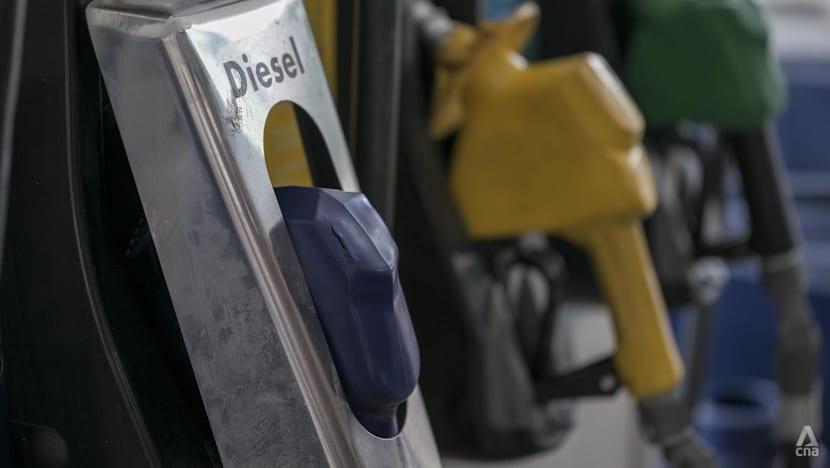
KUALA LUMPUR: Malaysia’s decision to revive blanket diesel subsidies under a more controlled scheme shows the “urgent need” to plug massive leakages and abuse through smuggling and consumption by foreigners in a way that is politically palatable, say analysts.
However, they caution that by more than halving the price of diesel in peninsular Malaysia, the government’s finances could come under strain if oil prices rise again.
From Jul 1, the price of diesel will drop to RM2.10 per litre (US$0.50), down from its current subsidised price of RM2.15 per litre in the East Malaysian states of Sabah and Sarawak, and RM4.07 in the Malaysian peninsular where it has been unsubsidised.
But this time there is a catch: Only Malaysian citizens qualify for the subsidised rate, subject to national identity card verification and a 200-L monthly cap, the same control mechanisms found in the RON95 petrol subsidy policy for citizens.
The introduction of the RON95 fuel subsidy controls has given the government more information on subsidised fuel misuse and smuggling patterns, said political analyst Adib Zalkapli of consulting firm Viewfinder Global Affairs.
“So, potentially, the government or enforcement agencies could use the information to curb leakages and smuggling of subsidised diesel,” he told CNA.
Finance Minister II Amir Hamzah Azizan said in a statement on Monday (Jun 22) that non-citizens “should not be able to enjoy” subsidies, in line with the government’s principles of subsidy rationalisation.
This latest move, he said, is expected to save up to RM2 billion a year, which will be returned to citizens in the form of lower diesel prices.
The move is the latest in a series of tweaks to the country’s diesel subsidy policies.
In 2023, Malaysia's coffers were under pressure, after the country had spent a huge RM14.3 billion on blanket diesel subsidies that year, surging from RM1.4 billion in 2019.
Anyone in the country could buy diesel for RM2.15 a litre, the second cheapest in Southeast Asia after Brunei.
In June 2024, the federal government had enough. It removed blanket subsidies for diesel on the peninsula, floating its price and increasing it to RM3.35 per litre.
This reached a peak of RM6.72 in April this year as global oil prices spiked amid the Middle East war, before falling to the current price of RM4.07 per litre.
The authorities, however, decided in June 2024 to retain diesel subsidies for everyone in East Malaysia, maintaining its price at RM2.15 per litre. The poor roads and vast distances in Sabah and Sarawak meant diesel vehicles were more commonly used.
Still, the federal government said then that the move was expected to save around RM4 billion a year.
Mohd Afzanizam Abdul Rashid, chief economist at Bank Muamalat Malaysia, said the “significant difference” in diesel prices in neighbouring countries had led to smuggling activities.
“Therefore, there is an urgent need to plug those leakages in order to safeguard the spending on fuel subsidies,” he told CNA.
CURBING LEAKAGES AND SMUGGLING
The predicted RM2 billion annual savings from July’s new diesel subsidy policy will come from curbing leakages that grew more rampant after the Middle East war started in February, Amir said at a briefing explaining the move on Monday.
As the war progressed, he said diesel consumption patterns in Sabah and Sarawak showed unusual trends: Current diesel consumption in the East Malaysian states rose to 2 billion litres annually, compared with an estimated actual requirement of about 1 billion litres per year.
Amir also highlighted that before global oil prices rose, the government’s monthly subsidy bill for petrol and diesel in January and February was approximately RM800 million. This jumped to nearly RM5 billion in March and April.
The minister did not give the latest figures for Malaysia’s fuel subsidy bill, including how it is expected to change after the new diesel scheme kicks in in July.
The high subsidy bill in recent months indicated the existence of substantial subsidy leakages, where non-citizens were buying subsidised diesel, or this cheaper diesel was being smuggled to neighbouring countries and sold for a profit, he said.
Seeing how diesel consumption in East Malaysia had almost doubled, Malaysia-based economist Shankaran Nambiar told CNA there was “clearly” an “abuse of the system”.
"This is a textbook case of how economic agents try to bypass the system when there are subsidies, leading to a surfeit of smuggling and arbitrage - buying low and selling it to other segments of the market where a higher price can be charged," he said.
Firdausi Suffian from Universiti Teknologi Mara’s (UiTM) Sabah campus pointed to reports of alleged diesel smugglers being caught in places such as Sandakan and Kudat, cities on the Borneo coast where diesel could be smuggled out by sea.
"So I think by default the moment you have a blanket subsidy, it is always susceptible to leakages," the economist told CNA.
Afzanizam said the federal government’s mechanism for subsidised RON95 petrol, rolled out in September 2025 where the price of RM1.99 per litre is restricted to Malaysians with a valid MyKad and capped at 200L a month, has been a "successful use case".
“Hence, it is only right that the government should replicate a similar approach for diesel,” he said, adding that these “efficiencies” will apply to the new diesel subsidy system and could save the government around RM2 billion a year.
Another factor in the savings is that the subsidies would now be restricted to citizens, as opposed to the unfettered access seen in 2024.
For instance, Firdausi noted that Sabah's 3.8 million population includes about 1 million foreigners. If just 10 per cent of these foreigners consumed 100L of subsidised diesel, 10 million litres of subsidised diesel would be leaked, he said.
"It's not supposed to go to them,” he added.
Nambiar said the government could have tried reducing leakages in the current diesel subsidy system, but this did not seem to have worked.
“As far as smuggling is concerned, either the implementation of measures was inadequate, enforcement poor or the borders too porous to meaningfully curb smuggling,” he said.
Instead, the government chose to tighten the mechanism “whereby the subsidy is extended, but with more controls”.
"This is also a politically more satisfactory approach than to have prices at the market level. With the cost of living already high, to remove the subsidy for individuals would be quite unpalatable."
SHRINKING FISCAL SPACE?
With that said, Nambiar acknowledged “there would be an impact” on the federal government’s fiscal standing if oil prices rise.
“But the impact would be limited in so far as the pool (of subsidised recipients) is limited in number and in quantity,” he said.
UiTM’s Firdausi believes the federal government will "walk a very tight rope" if its diesel subsidy bill ballooned again.
“On one hand, it wants to protect citizens (from higher prices). On the other hand it has to finance the subsidies. Of course, it will shrink the fiscal space for the government,” he said.
Afzanizam from Bank Muamalat agreed, saying the new diesel policy is still effectively a “blanket subsidy” that benefits all Malaysians regardless of income level.
“Perhaps, the next stage is to target based on income level. This could yield massive savings,” he said.
Firdausi admitted this will be "tough", seeing how the federal government has been unable to achieve this for RON95 subsidies amid varying income metrics in different states.
“It is doable as long as they have sufficient data. Because at the end of the day, subsidies are not really productive - it's good politics but bad economics,” he said.
For instance in Sabah, subsidy spending could instead go towards infrastructure development needs like improving highways, schools and hospitals, he added.
Serina Abdul Rahman, an associate fellow at the ISEAS-Yusof Ishak Institute’s Malaysia Studies Programme, said it is “somewhat confusing” as to how diesel subsidies could be expanded when fuel subsidies were “clearly costing the country billions”.
“The war in Iran is not yet over given the instability in the negotiations so we can't say that import supply has stabilised,” she told CNA.
Reuters reported on Thursday that oil prices fell to pre-war levels as the United States said flows through the Strait of Hormuz were nearing normal.
“More transparency and explanation on how the money flows are - given the global situation and earlier comments on necessary financial controls - remain factors to consider,” Serina said.
“If not, then there should be an effect on the fiscal position, but a lack of clarity makes it hard to properly understand it all.”
Serena noted that cost of living, unemployment and low wages continue to be a problem for Malaysians in general, with fuel price increases “painful” for the average consumer and small businesses.
“So, any reduction in prices is welcome,” she added.
“ELECTION CANDY”
The diesel price reduction for Malaysians also comes at a time when the country is in “election season”, said Adib from Viewfinder Global Affairs.
The states of Johor and Negeri Sembilan will hold elections on Jul 11 and Aug 1 respectively. And while Malaysia’s general election is not due until February 2028, Prime Minister Anwar Ibrahim has not ruled out snap polls.
“The political reality in Malaysia is that this is not the time for the government to be fiscally responsible,” Adib said.
“Any rational conversation or discussion on subsidies will have to wait until after the general election.”
On Tuesday, Malaysian Chinese Association (MCA) president Wee Ka Siong said the diesel price cut was an attempt by Anwar’s Pakatan Harapan (PH) coalition to give out “election candy” ahead of the state polls.
“Johor locals are not for sale. Their votes that will last for the next five years will not be bought by 200 litres of diesel,” said Wee - who is also a Johor federal lawmaker - in a video posted on social media.
MCA is a component party of the United Malays National Organisation-led Barisan Nasional coalition, which will go head to head with PH in the upcoming state polls despite being partners in the federal government.
“Of course PH will try to capitalise on the decision and position Anwar Ibrahim as the leader voters need in times of crisis,” Adib said.
"It will help with the campaign in the two states. Generally, a campaign gains momentum when policy decisions translate into visible financial benefits for voters."
Firdausi from UiTM highlighted that some on the peninsula had grumbled when diesel prices were floated in West but not East Malaysia in 2024, questioning why "equal privilege" was not granted.
“If it's close to any state election, of course the federal government has to come up with more reasonable goodies for the people,” he said.
Source: CNA/hz(ao)
Related stories

Rio Times
BusinessJun 26, 2026 · 1 min
Bitcoin Breaks Its Floor as Crypto Splits From Stocks
Rio Times

Rio Times
BusinessJun 26, 2026 · 1 min
Argentina’s Stock Market Steadies After the Index Crash
Rio Times

Rio Times
BusinessJun 26, 2026 · 1 min
Mexico’s Stock Market Surges, Snapping a Six-Day Slide
Rio Times
Bloomberg
BusinessJun 26, 2026 · 1 min
Palm Oil Climbs on Higher Exports and Indian Demand Expectations
Bloomberg