The Guardian
Vital Blue Mountains highway to be closed for another year as NSW reveals bridge plans
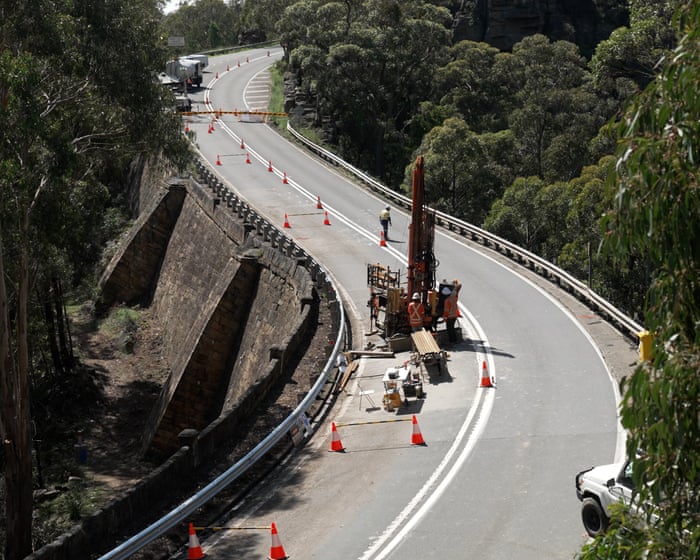
A vital road connecting Sydney with New South Wales’ central west will remain shut for at least another year, leaving Blue Mountains and Central Tablelands residents facing extended travel times and detours for longer than expected.
Transport for NSW closed the Victoria Pass section of the Great Western Highway in March after critical structural cracks were detected at Mitchells Causeway, or “Convict Bridge”, a 194-year-old, convict-built infrastructure.
The NSW government announced on Friday that a new structure would be built above the bridge, with construction due to start within weeks.
The road is now expected to reopen between April and June next year. In March, the NSW roads minister, Jenny Aitchison, said the road would remain closed for at least three months.
The bridge was used by about 12,000 vehicles, and its closure has forced many commuters and motorists to make major detours to get to Sydney or to other parts of the area.
In a statement, the NSW government said the convict-built causeway would be stabilised as part of the work. The new structure could allow for an additional lane in the future – something that was not possible with the current bridge.
Civil engineering contractor Seymour Whyte was selected to construct the new crossing following an accelerated procurement process that drew 10 submissions.
The state government announced an additional $20m in financial support on Friday. The package increases the grant amount that small businesses experiencing financial hardship in some areas can receive, from $10,000 to $25,000.
The package also extends the areas eligible to receive support.
The minister for regional NSW, Tara Moriarty, said the financial relief would be paired with ongoing logistical support to keep communities connected. The government will put on free coaches and spend $50m on ongoing upgrades to detour routes.
The Nepean Blue Mountains Local Health District said the updated timeline would not compromise local healthcare.
Despite the certainty of a timeline, the announcement has been met with scepticism.
“There is white-hot anger in communities that have been cut off, and who will say this compensation package barely touches the sides,” NSW Liberals leader, Kellie Sloane, said.
“After months of delays and broken promises, Labor has finally admitted this closure will continue well into next year. Businesses simply cannot survive another 10 plus months without meaningful support.”
The Nationals state MP for Bathurst, Paul Toole, shared the transport department’s media release on social media, quickly amassing more than 100 comments, with many doubting the completion date.
Other residents commented that the planned upgrade, which will eventually allow for an extra traffic lane, does not go far enough to service the growing demands of the central west.
Toole said he wanted to see work 24 hours a day, seven days a week to get the job done as fast as possible.
“This isn’t just a local road closure, this is a state significant highway and a major economic issue … This announcement offers a timeline, but no confidence.”
Blue Mountains MP, Trish Doyle, defended the project, saying: “We’re not just fixing what was there for the short term, we’re building something better.
“A new structure, properly engineered and anchored into solid bedrock, built to last,” she said.
Engineering challenge
Behzad Fatahi, professor of civil and geotechnical engineering at University of Technology Sydney said the steep, narrow, and “geotechnically challenging” terrain limited immediate expansion options. He called the plan to build an independent bridge deck a “practical way forward”.
“Some people may wonder why an additional lane is not being built now, especially if the new bridge is being designed to allow for future widening,” he said. “But this is not as simple as just adding more road surface.”
“An extra lane would likely mean a wider bridge deck, more or larger piles … and could add significant cost, risk and uncertainty to the project timeline.”
Fatahi said widening a short section may create a traffic bottleneck further along where the highway narrows again.
Maria Rashidi, an associate professor and the director of research at Western Sydney University’s school of engineering, called the strategy a “technically sound and practical solution” that addresses underlying geotechnical issues while preserving the historic causeway.
“The proposed reopening between April and June next year is an achievable target, provided there are no unforeseen ground conditions or prolonged weather delays,” Rashidi said. “As with any major infrastructure project in a geologically challenging environment, some uncertainty remains, but this approach offers the best long-term outcome for safety, resilience, and reliability.”
View original source — The Guardian ↗
Related stories

ESPN
SportsJun 26, 2026 · 1 min
Poch puzzled by 'weird' questions: We 'won group'
ESPN

The Punch
SportsJun 26, 2026 · 1 min
World Cup: US lose 3-2 to Turkey after last-gasp strike
The Punch

France 24
SportsJun 26, 2026 · 1 min
World Cup 2026: Seattle set for Iran-Egypt match amid ‘Pride Match’ controversy
France 24

BBC Sport
SportsJun 26, 2026 · 1 min
How not to be a tennis parent
BBC Sport