Indian Express
Indian Express··6 min read
‘Axe has to fall, and it will’: Gujarat High Court on Surat shanties’ demolitions
5 min readVadodaraJun 26, 2026 01:52 PM IST
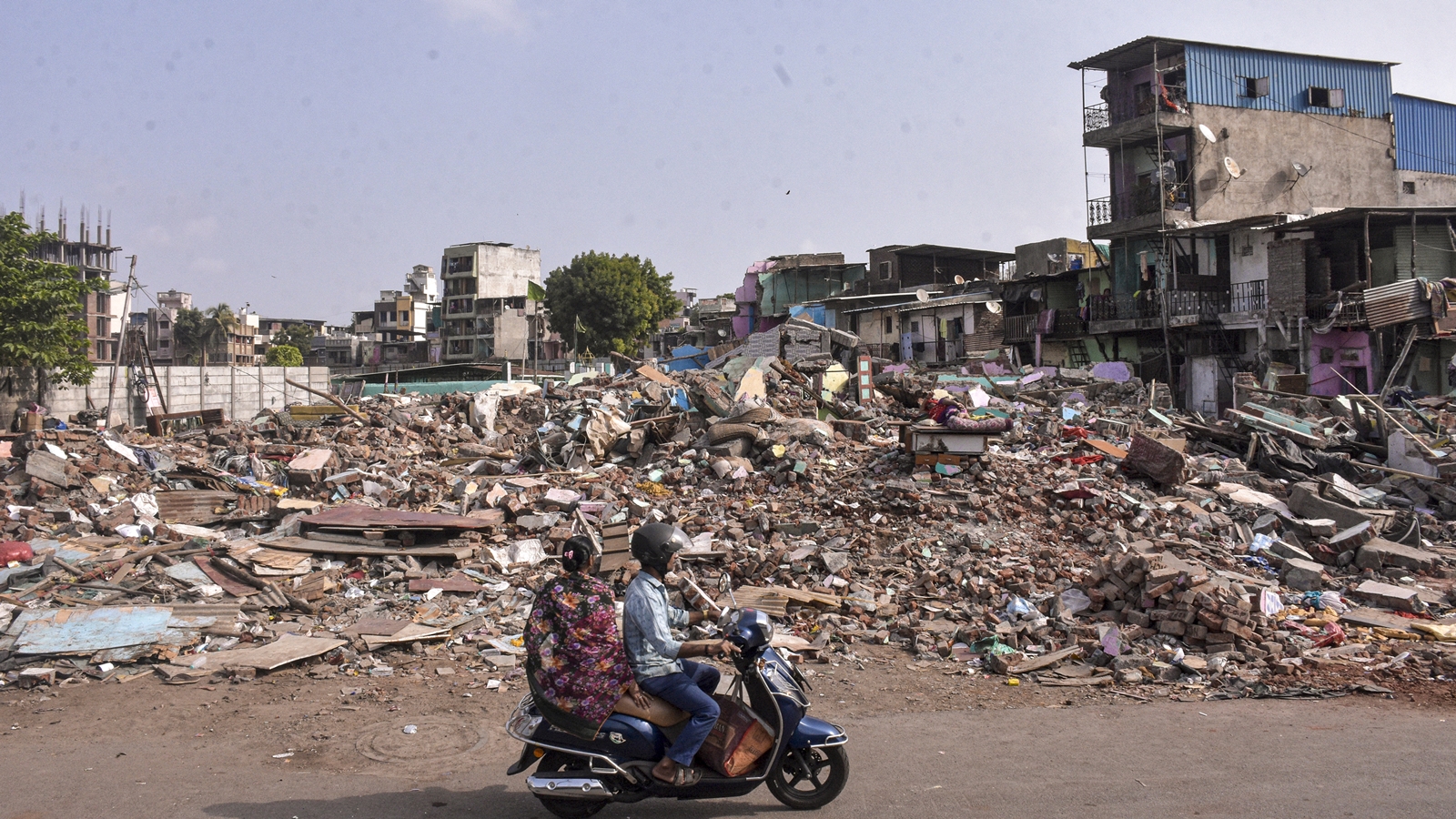
The Gujarat High Court orally directed the Surat civic body to prepare a “definite rehabilitation plan” for the displaced residents. (PTI File Photo)
After nearly 150 homes in Surat’s Nasirnagar were reduced to rubble in May, no authority has yet taken responsibility for the demolition — a gap that prompted the Gujarat High Court Thursday to question the state government, the municipal corporation, and even Torrent Power over who ordered the action and why due process was allegedly bypassed.
Residents of Nasirnagar slum in the city’s Ved Darwaja area moved the Gujarat High Court earlier this month, challenging the demolition of several shanties, alleging that bulldozers razed their homes without notice or any demolition order.
The demolition, allegedly carried out under police protection, has since been denied by the Surat Municipal Corporation, even as BJP MLA Vinu Moradiya called the episode “something fishy,” deepening questions over who authorised the operation.
Hearing the petition, Justice Nikhil Kariel in an oral observation questioned the Surat Municipal Corporation and remarked that even the “demolition of a single house” without due process could “not be countenanced”.
The court orally directed the Surat civic body to prepare a “definite rehabilitation plan” for the displaced residents by Monday, pending the decision on the petition. “I will not hear a submission that you do not have accommodation. Rent tents if you have to… The axe has to fall, and it will,” Justice Kariel said orally.
It also asked the government to explain why a deputy commissioner of police rank officer and municipal officials were allegedly present if the demolition was, as authorities claimed, not an official exercise.
‘Why no FIR?’
Through Government Pleader G H Virk, the court asked for a personal affidavit from the Surat police commissioner should be placed before the HC Monday, explaining the police response to the residents’ complaints.
Story continues below this ad
“If the commissioner is informed that 150 houses have been demolished, either he says it was an official demolition by the Corporation, or he explains why no FIR has been registered… The (Commissioner) cannot choose to ignore such allegations.”
The court also said that if the petitioners’ allegation that a deputy commissioner of police was present during the demolition was found to be correct, the officer would have to be personally appear before the court. However, if the demolition had been an officially sanctioned exercise, such an appearance would not be necessary.
The court orally said that Torrent Power should clarify who instructed it to disconnect electricity to the shanties.
“Learned Senior Advocate (for petitioners) shall ensure that a copy of this petition is served upon the learned Advocate normally appearing for the Torrent Power Ltd and whereas on the next date of hearing ie on 29.06.2026 (Torrent Power Ltd.) is expected to appear before this Court through the learned Advocate with appropriate instructions,” the court said in an oral order.
Story continues below this ad
The court orally said Torrent Power’s response could help determine whether the instructions originated from the Corporation or private individuals.
Following due process
The court also orally observed “conflicting positions” taken by the authorities and said they must not merely identify who demolished the houses, but ensure governmental accountability if a large-scale demolition occurred without due process.
During the proceedings Thursday, the court referred to the Supreme Court’s recent pronouncements mandating due process before demolitions and repeatedly pressed the authorities to explain who had authorised the exercise, why municipal and police personnel were allegedly present at the site, and why no criminal case had been registered despite complaints made to the police.
The court orally stated that two possibilities emerged from the material placed before it: either the demolition had been carried out by the Surat Municipal Corporation in violation of the mandatory legal process, or municipal officials had acted in their individual capacities while misusing their official positions.
Story continues below this ad
In either eventuality, the court orally said, the Surat civic body could not escape responsibility.
‘Annoyed with the pleadings’
The court in oral observations also criticised the petitioners’ pleadings, describing them as “inadequate” for a matter of such gravity, noting that while numerous officials and private individuals had been added as respondents, the petition lacked specific pleadings attributing responsibility to many of them.
“I am much more annoyed with the pleadings,” the court orally said, stating that allegations made in an affidavit are not a substitute for pleadings in the writ petition.
The court, however, clarified that the deficiencies in the petition would not prevent it from examining the larger constitutional issue.
Story continues below this ad
The matter has been listed for further hearing on June 29.
© The Indian Express Pvt Ltd
Aditi Raja is an Assistant Editor with The Indian Express, stationed in Vadodara, Gujarat, with over 20 years in the field. She has been reporting from the region of Central Gujarat and Narmada district for this newspaper since 2013, which establishes her as a highly Authoritative and Trustworthy source on regional politics, administration, and critical socio-economic and environmental issues.
Expertise:
Core Authority & Specialization: Her reporting is characterized by a comprehensive grasp of the complex factors shaping Central Gujarat, which comprises a vast tribal population, including:
Politics and Administration: In-depth analysis of dynamics within factions of political parties and how it affects the affairs in the region, visits of national leaders making prominent statements, and government policy decisions impacting the population on ground.
Crucial Regional Projects: She consistently reports on the socio-economic and political impact of infrastructure projects in the region, especially the Statue of Unity, the Sardar Sarovar Project on the Narmada River, the Mumbai-Ahmedabad High Speed Rail bullet train project as well as the National Highway infrastructure.
Social Justice and Human Rights: Her reporting offers deep coverage of sensitive human-interest topics, including gender, crime, and tribal issues. Her reports cover legal proceedings from various district courts as well as the Gujarat High Court (e.g., the Bilkis Bano case remission, POCSO court orders, Public Interest Litigations), the plight of tribal communities, and broader social conflicts (e.g., Kheda flogging case).
Local Impact & Disaster Reporting: Excels in documenting the immediate impact of events on communities, such as the political and civic fallout of the Vadodara floods, the subsequent public anger, and the long-delayed river redevelopment projects, Harni Boat Tragedy, Air India crash, bringing out a blend of stories from the investigations as well as human emotions.
Special Interest Beat: She tracks incidents concerning Non-Resident Gujaratis (NRIs) including crime and legal battles abroad, issues of illegal immigration and deportations, as well as social events connecting the local Gujarati experience to the global diaspora. ... Read More
Kamal Saiyed is a senior Correspondent for The Indian Express, providing extensive, on-the-ground coverage from Surat and the broader South Gujarat region and the Union territories of Daman, Diu & Dadra Nagar Haveli. With a reporting career at the publication spanning back to 2007, he has established himself as a high-authority voice on the industrial, social, and political pulse of one of India’s fastest-growing urban hubs.
Expertise
Industrial & Economic Beat: Based in the "Diamond City," Saiyed offers expert reporting on the diamond and textile industries. His work tracks global market shifts (such as De Beers production changes), local trade policies, and the socio-economic challenges facing the millions of workers in Surat’s manufacturing hubs.
Civic & Infrastructure Coverage: He consistently reports on urban development and public safety in Surat, including:
Traffic & Urban Planning: Monitoring the city's 13-fold increase in traffic violations and the implementation of new municipal drives.
Public Safety: Investigative reporting on infrastructure failures, fire safety NOC compliance in schools and commercial buildings, and Metro rail progress.
Political Reporting: Tracking the shifting dynamics between the BJP, Congress, and AAP in South Gujarat and the neighboring Union Territories (Daman, Diu, and Dadra & Nagar Haveli).
Crime beat: Armed with a good source network Saiyed has been able to bring out the human side of crime stories in his region ... Read More
Tags:
Gujarat High Court
Surat
Surat Municipal Corporation
View original source — Indian Express ↗
Related stories

The Punch
SportsJun 26, 2026 · 1 min
Super Falcons seek title defence as 16-team WAFCON begins July 26
The Punch
The Punch
NewsJun 26, 2026 · 1 min
Soldiers rescue eight kidnap victims in Plateau forest
The Punch
The Punch
NewsJun 26, 2026 · 1 min
Remi Tinubu faces backlash over akara, roasted corn remarks
The Punch
The Punch
NewsJun 26, 2026 · 1 min
World sends rescuers, aid as Venezuela reels from quakes
The Punch