Indian Express
Indian Express··4 min read
Bengaluru NGO denied FRCA renewal over COVID-19 fund use gets court relief
The Karnataka High Court has directed the Centre to reconsider a Bengaluru-based charitable trust’s application to renew its registration under the Foreign Contribution (Regulation) Act, 2010 (FCRA), saying that the initial rejection should not be treated as a “disqualification or adverse factor”.
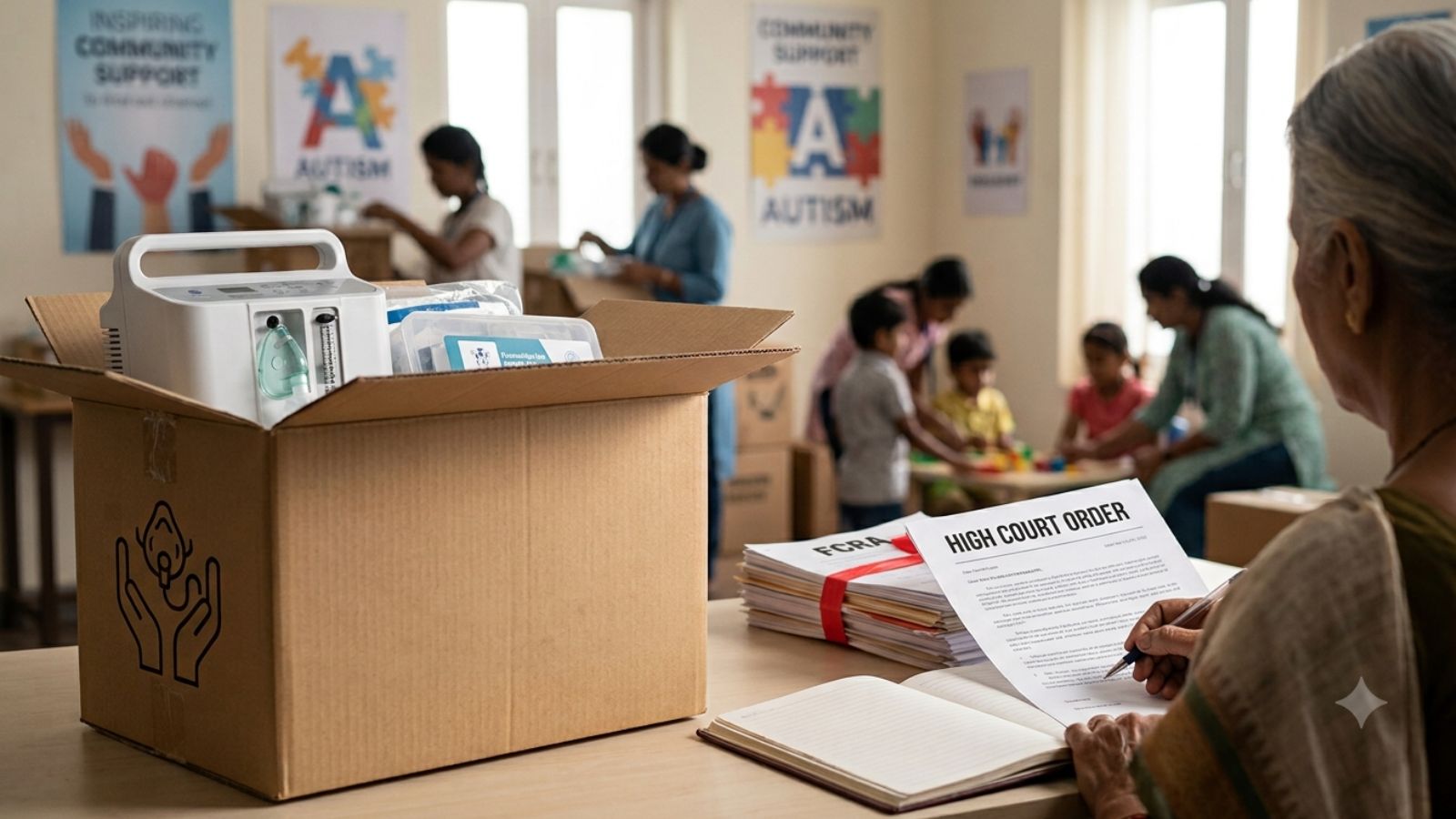
The government had refused to renew the registration granted to Academy for Severe Handicaps and Autism (ASHA) because it used a part of the foreign contributions it received to buy and distribute oxygen concentrators and provide help to hospitals and healthcare institutions in Karnataka during the COVID-19 pandemic.
“The rejection of the earlier renewal application shall not, by itself, be treated as a disqualification or adverse factor while considering the fresh application, particularly when the utilisation of the funds during the COVID-19 period was admittedly for public welfare and humanitarian purposes and there is no finding of misappropriation, diversion or personal enrichment,” Justice Suraj Govindaraj said in an order dated June 10.
The NGO ASHA was established in 1995 and is registered with the Ministry of Social Justice and Empowerment, the Karnataka Department of Empowerment of Differently Abled and Senior Citizens, and the NITI Aayog Darpan portal for receiving corporate social responsibility (CSR) contributions. It is engaged in the field of rehabilitation, education, and empowerment of children and individuals with physical challenges and autism.
The NGO had secured registration in 2001 under FCRA and was receiving foreign contributions. The last renewal application was submitted on April 29, 2021. The application was rejected on June 29, 2024. Following this, it filed an appeal, which was also rejected on November 7, 2025.
No funds misused or diverted: Advocate
Advocate Maya Holla, appearing for the NGO, argued that during the period when the NGO held a valid FCRA license there was no allegation of diversion, misappropriation, siphoning or personal misuse of foreign contributions. From the funds received, substantial amounts have been spent towards educational programmes, rehabilitation services and welfare initiatives directed at children and persons with disabilities, she added.
“During the COVID-19 pandemic, when the state and society were confronted with unprecedented challenges, the petitioner utilised a portion of the foreign contributions for emergency relief measures. The utilisation of funds was motivated solely by humanitarian considerations and undertaken for the benefit of society at large during a period of national crisis,” Holla submitted.
Story continues below this ad
It was also pointed out that the rejection orders did not mention any finding that the funds were misappropriated, diverted for personal gain, or utilised for any unlawful activity. “Thus when the expenditure itself has been incurred for public welfare and humanitarian purposes, such utilisation ought not to result in the drastic consequence of denial of renewal, particularly in the case of an institution which has been functioning under a valid FCRA registration for nearly 25 years,” she argued.
Submit a fresh application, says ASG
Additional Solicitor General Aravind Kamath informed the court that the authorities have merely declined renewal of the earlier registration having regard to the purposes for which that registration had originally been granted and the manner in which the funds were subsequently utilised. He suggested that it was always open to the petitioner to make a fresh application seeking registration under the appropriate category by clearly specifying the nature of activities proposed to be undertaken.
“If a fresh application is submitted indicating both educational and social welfare activities as its objects and purposes, the competent authority would consider the same in accordance with law and on its own merits,” he added.
‘Expenses for public welfare’
The bench noted that there is no allegation before the court that the foreign contributions received by the petitioner were diverted for personal gain, misappropriated or utilised for any unlawful purpose.
Story continues below this ad
“It cannot be lost sight of that the activities in question were admittedly undertaken during an extraordinary public health emergency and were directed towards providing assistance to hospitals and healthcare institutions. The expenditure incurred was thus for public welfare and not for any private or impermissible purpose,” the court said in its order.
“In these circumstances, this court is of the considered opinion that the rejection of the earlier renewal application ought not to operate as a stigma or as a disqualification against the petitioner while considering any fresh application that may hereafter be submitted,” it added.
The court further said that the competent authority should independently assess the NGO’s application on its own merits, “having regard to the objects of the institution, its past conduct, compliance with statutory requirements and such other relevant factors as may be applicable under law, without being unduly influenced by the rejection of the earlier renewal application”.
Partly allowing the petition, the court directed the NGO to submit a fresh application seeking registration.
View original source — Indian Express ↗
Related stories

The Punch
PoliticsJun 27, 2026 · 1 min
Welcome, but be good, Trump reveals new US passport design
The Punch
The Punch
NewsJun 27, 2026 · 1 min
Lagos, Ogun police commands rescue five, arrest 88 suspects in forests raid
The Punch

The New York Times
PoliticsJun 27, 2026 · 1 min
Deal With Israel Divides Lebanese, Fueling Protests in Beirut
The New York Times

CNBC
BusinessJun 27, 2026 · 1 min
Before there were Trump Accounts, SEED OK gave some newborns $1,000 — how researchers say the grants affected kids
CNBC