Indian Express
Knowledge Nugget: What is Pax Silica and why has India joined the US-led initiative?
Take a look at the essential concepts, terms, quotes, or phenomena every day and brush up your knowledge. Here’s your UPSC Current Affairs knowledge nugget on Pax Silica and its importance for India.
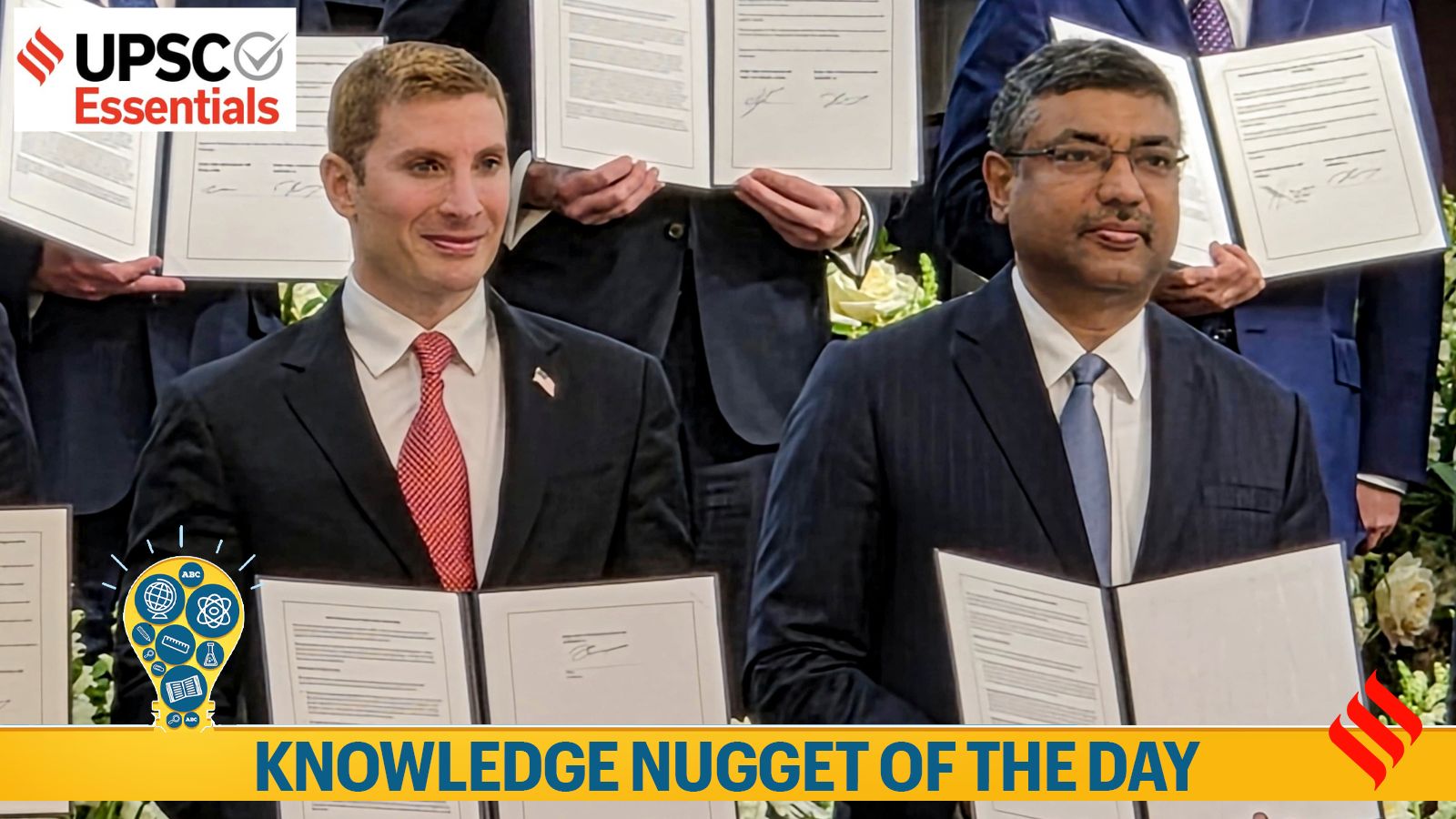
India, along with 35 other countries, signed a US-led initiative to build trusted and resilient supply chains to power artificial intelligence (AI) technologies at the second Pax Silica Summit in Washington on 25th June, 2026. India was represented at the summit by Secretary in the Ministry of Electronics and Information Technology S. Krishnan, along with representatives from Indian industry.
Let’s learn about the Pax Silica, its significance for India, and key terminology associated with critical minerals.
Key takeaways:
1. India had joined the initiative in February this year on the sidelines of the AI Impact Summit held in New Delhi. Argentina, Germany, the Netherlands, Chile, Costa Rica, Greece, Kazakhstan, Panama, and the European Union joined the Pax Silica initiative during the Second summit.
2. Pax Silica is a US-led strategic initiative to build a “secure, prosperous, and innovation-driven silicon supply chain” — from critical minerals and energy inputs to advanced manufacturing, semiconductors, AI infrastructure, and logistics. India was not part of the founding group when It was launched in December 2025.
3. According to the official statement, “Pax Silica” draws from the Latin pax—meaning peace, stability, and long-term prosperity, as seen in terms like Pax Americana and Pax Romana. Silica refers to the compound that is refined into silicon, one of the chemical elements foundational to the computer chips that enable artificial intelligence.
4. Measures under Pax Silica include pursuing new joint ventures and strategic co-investment opportunities, protecting sensitive technologies and critical infrastructure from undue access or control by countries of concern and building trusted technology ecosystems, including ICT systems, fibre-optic cables, data centres, foundational models and applications.
Story continues below this ad
Infographics by NotebookLM
5. It is aimed at building trusted, resilient, and innovation-driven supply chains for silicon and critical minerals that underpin semiconductors, artificial intelligence, digital infrastructure, and advanced manufacturing.
6. In a written reply to Lok Sabha unstarred question, Minister of External Affairs highlighted that joining the initiative is expected to facilitate investments in critical mineral processing, support domestic value addition, reduce import dependence in strategic sectors, and promote secure supply chains through collaboration with trusted partners.
What is the significance of Pax Silica for India?
• Pax Silica aims to build secure supply chains — ranging from critical minerals and energy inputs to advanced manufacturing and semiconductors. All of these are areas of concern for India.
• It is significant because it signals the manner in which the next global tech order could take shape as countries regroup in strategic sectors involving a Chinese presence. Groupings such as Pax Silica could cohesively work to address supply chain chokepoints next.
Story continues below this ad
• India, too has been trying to position itself as a spoke in the global supply chain realignment as American and European companies look to diversify away from China.
• India’s presence in Pax Silica could help New Delhi’s growth in technology-heavy sectors, which it currently lacks, deepening its import dependency. Experts said that the countries that are part of the US-led initiative are among the leaders in AI and the semiconductor supply chain.
• India currently lacks a global-scale AI infrastructure and stands to gain from the likely investments and partnerships under the initiative.
Related terms you should know for your UPSC preparation:
📌 Critical minerals: Critical minerals are a subset of minerals considered crucial for the manufacturing and technological needs of companies, industries, nations, or even the world. In 2023, the Centre identified 30 critical minerals, including lithium, cobalt, nickel, graphite, tin and copper, which are essential for the country’s economic development and national security.
Story continues below this ad
World reserves of rare earths.
📌 Rare Earth Elements (REEs): REEs or Rare Earth Metals are a set of 17 chemical elements in the periodic table — the 15 lanthanides, plus scandium and yttrium, which tend to occur in the same ore deposits as the lanthanides, and have similar chemical properties.
Despite the name – rare earth elements – these elements are not so rare. They are found in abundance in the Earth’s crust. However, they’re rarely found in concentrations that are economically viable for mining. Therefore, extracting and processing REEs is complex and expensive, requiring high-end techniques and specialised labour to isolate and purify them.
📌 Rare Earth Permanent Magnets: They are amongst the strongest types of permanent magnets and are used extensively in technologies requiring compact and high-performance magnetic components. Rare earth metals (REMs) are indispensable for producing these high-performance permanent magnets.
The government has announced the ‘Scheme to Promote Manufacturing of Sintered Rare Earth Permanent Magnets’, with the aim to support 6,000 metric tonnes per annum (MTPA) of integrated REPM manufacturing capacity. The scheme specifically focuses on “sintered rare-earth permanent magnets”, which are primarily neodymium, iron and boron (NdFeB) magnets, considered the strongest and most commercially demanded.
BEYOND THE NUGGET: Minerals Security Partnership (MSP)
1. In June 2023, India was inducted into the MSP, a US-led collaboration of 14 countries and the EU, aimed at catalysing public and private investment in critical mineral supply chains globally.
2. A joint India-US statement issued on June 23, 2023, had then reiterated the intention of the two governments “to work together to ensure that our respective markets are well-supplied with the essential critical minerals” and reaffirming a pledge by the two sides “to hasten bilateral collaboration to secure resilient critical minerals supply chains”, welcomed India into the grouping.
Story continues below this ad
3. MSP partners include Australia, Canada, Estonia, Finland, France, Germany, India, Italy, Japan, Norway, the Republic of Korea, Sweden, the United Kingdom, the United States, and the European Union (represented by the European Commission).
4. In January 2025, India launched a National Critical Mineral Mission to help achieve self-reliance in the critical mineral sector. In 2023, the Centre also identified 30 critical minerals, including lithium, cobalt, nickel, graphite, tin and copper, which are essential for the country’s economic development and national security.
5. India-US Critical Minerals Framework: In May, India and the US signed a bilateral India-US Critical Minerals Framework, focusing on securing the supply, mining, and processing of critical minerals and rare earth elements.
Post Read Question
Recently, there has been a concern over the short supply of a group of elements called ‘rare earth metals’. Why? (UPSC CSE 2012)
Story continues below this ad
1. China, which is the largest producer of these elements, has imposed some restrictions on their export.
2. Other than China, Australia, Canada, and Chile, these elements are not found in any country.
3. Rare earth metals are essential for the manufacture of various kinds of electronic items and there is a growing demand for these elements.
Which of the statements given above is/are correct?
(a) 1 only
(b) 2 and 3 only
(c) 1 and 3 only
(d) 1, 2 and 3
Answer Key
(c)
(Sources: Knowledge nugget of the day: Minerals Security Partnership (MSP), Why is Quad Critical Minerals Initiative important for your UPSC exam, What is India’s share in rare earth elements, the backbone of modern technologies?, )
Story continues below this ad
Subscribe to our UPSC newsletter. Stay updated with the latest UPSC articles by joining our Telegram channel – IndianExpress UPSC Hub, and follow us on Instagram and X.
🚨 Click Here to read the UPSC Essentials magazine for June 2026. Share your views and suggestions in the comment box or at [email protected]🚨
View original source — Indian Express ↗
Related stories

RFI
TechnologyJun 27, 2026 · 1 min
'An honour to be chosen': Italian astronaut on piloting Nasa lunar mission
RFI

The Verge
TechnologyJun 27, 2026 · 1 min
Why is Apple asking me to pay more for Big Tech’s AI obsession?
The Verge

Engadget
TechnologyJun 27, 2026 · 1 min
The differences between Dolby Digital, DTS and Atmos (and which is better)
Engadget

Lovin Malta
TechnologyJun 27, 2026 · 1 min
In Photos: Emergency Crews Tackle Industrial Fire In Żebbuġ | Lovin Malta
Lovin Malta