Indian Express
Behind Asian markets tanking: Apple’s price hike, AI-driven chip shortage, and more
5 min readMumbaiUpdated: Jun 26, 2026 04:27 PM IST
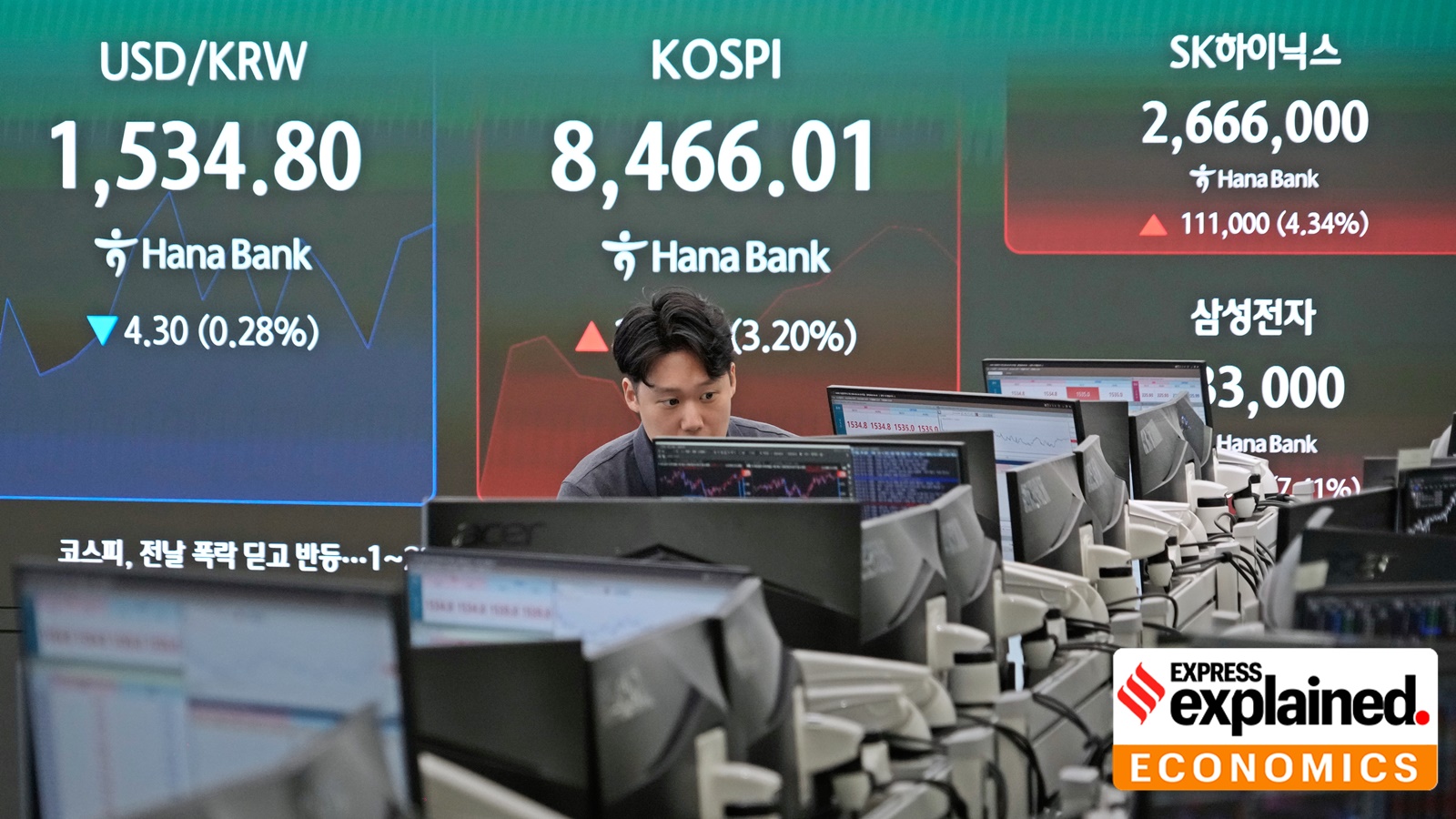
The Hana Bank headquarters in Seoul, South Korea, Wednesday, June 24, 2026. (AP Photo/Ahn Young-joon)
Asian Stock Market Crash Explained: Asian stock markets tanked as much as 6% on Friday (June 26) as Apple’s move to jack up prices of some of its product lines by as much as 20%, and the South Korean government’s proposal to tax unrealised gains on equities, weighed on sentiment for AI and chip-related stocks.
South Korea’s Kospi index ended 5.8% lower on Friday, briefly triggering the 8% lower circuit midway into the session, leading to a halt in trading for the second time this week after having lost 10% on Tuesday. For the week, the index ended around 7% lower.
Japan’s Nikkei 225 index lost 4.2%, with major constituent Softbank tanking 12.5%. Meanwhile, Taiwan’s Taiex index fell 3.6% on Friday. Both Japan’s and Taiwan’s stock markets are heavily dominated by chipmaking companies.
Samsung and SK Hynix, a semiconductor company, make up over 50% weight on the Kospi, while the chipmaking giant TSMC constitutes around 40% weight on the Taiex.
American technology giant Apple’s announcement on Thursday particularly triggered panic across markets, with investors preferring to cut their exposures in AI and tech stocks. The Nasdaq Composite index in the US lost 0.5% overnight after the announcement. Shares of Apple fell by over 6%. Competitor Dell fell 5.5%. All other big tech stocks in the US also ended lower.
In Asia, shares of SK Hynix plunged over 8% on Friday. TSMC and Samsung fell 2-5%.
“Apple’s price hikes likely confirmed that the chip shortage is not likely to go away anytime soon. If a company like Apple with big balance sheets cannot absorb the high costs, the entire industry will be forced to keep increasing prices. And that will eventually lead to lower margins and subdued volumes with some part of their customer bases being priced out of new products,” a head of research at a domestic research firm said.
Story continues below this ad
Indian markets were closed on Friday on the occasion of Muharram.
Apple’s price hike
Apple raised prices across its iPad and MacBook offerings by as much as 20% on Thursday, citing surging chip costs due to the recent global AI surge. It also hiked prices across TVs and HomePods.
“We have never seen a component price increase this much, this quickly. We have shielded our customers from these increases so far, but we have now reached a point where we need to begin raising prices on a number of products, including today’s increases for iPad and Mac,” the company said in a statement.
This comes at a time when a host of companies across the world have been forced to raise prices due to shortages and surging prices of graphics and memory chips. The global chip market is dominated by a handful of names such as SK Hynix, Samsung, and Micron.
Story continues below this ad
These players have focused on producing high-bandwidth memory (HBM) chips used for AI data centers due to higher margins, sharply cutting production capacities for other chips used in consumer devices such as phones, PCs, laptops, and other electronics.
This has led to a shortage in chips for consumer electronics, leading to exorbitant prices. Dubbed as the “RAMageddon” shortage, this has led to companies such as HP, Dell, and ASUS all announcing price hikes in recent times. Hours after Apple’s price hikes on Monday, gaming console maker Xbox also announced price hikes of up to 25% — their second such announcement within a year.
South Korea’s tax proposal
Many market participants believe that the South Korean market has also been weighed down by the government’s new proposal to tax unrealised gains. Introduced on Tuesday, the proposal seeks to treat unrealised gains from assets such as stocks and real estate as actual taxable income.
The South Korean market fell 10% on Tuesday in what was dubbed “Bloody Tuesday,” with the new proposal adding to concerns of the overstretched AI rally. The government’s proposals would lead to significantly higher costs for investors, especially for foreign institutional investors, who have been heavily investing in the South Korean market. The sharp sell-off on Tuesday had seen FIIs pulling out between $4 billion and $6 billion from South Korean equities.
Story continues below this ad
“People will start dumping (South Korean equities) the moment they realise they have to pay taxes on unrealised gains. It is not practically possible,” said Sumit Pokharna, a vice president covering the IT sector at Kotak Securities. Investors, who already have highly leveraged positions in order to maximize returns, would need to sell some holdings in order to pay these taxes, which would lead to a sell-off, Pokharna added.
© The Indian Express Pvt Ltd
View original source — Indian Express ↗
Related stories

TechRadar
TechnologyJun 26, 2026 · 1 min
I've been looking for a smart speaker for the kitchen and this is my last chance to pick up the Amazon Echo Spot for…
TechRadar

AllAfrica
TechnologyJun 26, 2026 · 1 min
Kenya: DPP Closes Case in Sh8.2bn Meth Bust As Six Iranians Await Fate in Landmark Drug Trafficking Trial
AllAfrica

ZDNet
TechnologyJun 26, 2026 · 1 min
7 WFH gadgets that seriously improved my workflow (and they're on sale)
ZDNet

TechRadar
TechnologyJun 26, 2026 · 1 min
New report reveals the Nintendo Switch 2 is the second fastest-selling video game hardware in US history, as Xbox and…
TechRadar